
Your needs, this model
Does it fit your priorities?
Can I connect the earlier Classic EVO Moonstone directly to a receiver PHONO input?
Yes, if that is a compatible MM PHONO input: Sumiko classifies Moonstone as moving magnet, and the Classic EVO manual describes phono-level RCA output plus a ground terminal. The turntable has no built-in stage; do not connect phono output to a line-only input without a separate stage.
Explore this need in the finder →Can this Classic EVO drive powered speakers with only LINE/AUX input?
Not by itself. Put a compatible external MM phono stage between the turntable's phono-level output and the powered speakers' line input; keep the ground lead connected as the manual directs if needed.
Explore this need in the finder →Will the Classic EVO lift the arm or stop when a record ends, and how much shelf body space is listed?
The reviewed manual does not confirm an automatic end stop or arm return, so do not count on one. It lists a 462 x 131 x 351 mm closed-cover body (about 18.19 x 5.16 x 13.82 inches); include earlier=yes to see this package, then leave extra room for the open cover, arm access and cables.
Explore this need in the finder →This assessment covers two U.S.-facing Pro-Ject The Classic EVO items named with a pre-mounted Sumiko Moonstone moving-magnet cartridge: Satin Walnut and Satin Eucalyptus. The model maker now lists The Classic Evo in its archive for products no longer in manufacture, so treat it as an earlier design rather than a verified current-production offer. This is document-based analysis, not a hands-on setup, listening test or measurement.
Two exact finish items, one reviewed operating package
Acoustic Sounds identifies the Walnut item as T PJCLSEVOW and the Eucalyptus item as T PJCLSEVOE; its Eucalyptus page also displays a UPC, which I retain only as a seller-page observation. Each exact page names the Sumiko Moonstone package, and Pro-Ject's 2023 guide separately says the U.S. version comes with a Sumiko cartridge. I found no source evidence that the two wood finishes change the drive, signal route or operation, so the functional assessment is shared. The item photographs are visual references for those exact finishes only; they do not establish cartridge identity, current availability or box contents.
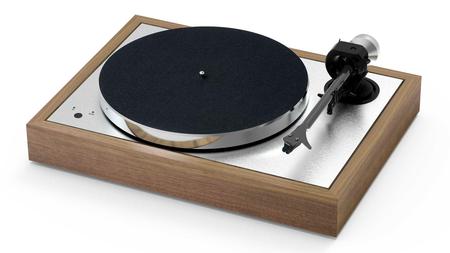
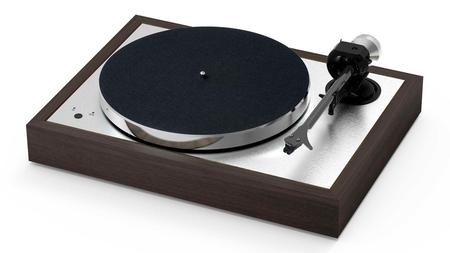
A substantial manual deck with a defined space cost
Pro-Ject specifies a metal/MDF sandwich chassis on TPE suspension, a damped subchassis, a 300 mm aluminium platter, precision aluminium sub-platter and a nine-inch carbon/aluminium tonearm. The source material describes adjustable azimuth and vertical tracking angle, plus height-adjustable feet. Those are construction and setup facts, not evidence of an audible outcome. The listed net mass is 10.5 kg, so moving and leveling it deserves more care than a light one-piece starter deck; choose a sound, level support and follow the transit and unpacking instructions.
The maker's closed-cover body figure is 462 × 131 × 351 mm, about 18.19 × 5.16 × 13.82 inches. With the cover open, Pro-Ject lists a much taller envelope of 462 × 423 × 390 mm. The closed dimensions help rule out an undersized shelf, but they are not working clearances: leave room for cover movement, the tonearm, cable bends and safe handling. The body-only finder first admits the listed width at an 18.5-inch maximum and depth at 14 inches; do not treat that result as proof the installed deck will operate in a tight cubby.
Electronic speed selection is not automatic arm handling
The standard belt-drive routine uses an electronic button for 33⅓ and 45 RPM. The manual also documents 78 RPM, but that speed is not a simple additional button choice: remove the platter, replace the flat belt with the supplied round belt, then select 78. That extra conversion makes it a poor fit for someone who wants effortless switching among records at all three speeds. Verify the correct stylus for the record as well; a speed setting alone does not make a cartridge suitable for every groove.
The same button starts the motor, and holding it for more than three seconds stops it. That does not establish automatic record-end stop. The instructions describe user-controlled tonearm handling rather than an automatic start/return cycle, so listeners who want the arm to lower and return by itself should not shortlist this as fully automatic. The examined material does not confirm an automatic platter stop at the end of a side either; keep that feature unknown, not promised or assumed absent. A manual stop command is different from end detection.
Choose the phono stage before connecting speakers
The supplied Moonstone is an MM cartridge. Sumiko specifies 3.0 mV output, a 47 kΩ load, 100–200 pF capacitance and 2.0 g recommended tracking force within a 1.8–2.2 g range. The turntable has phono-level RCA output and no built-in phono preamp. Use a compatible MM PHONO input on an amplifier or receiver, or add an MM phono stage before the LINE input of powered speakers or an amplifier. Line/AUX alone is not a substitute for the phono stage. The manual also identifies an earth terminal; connect and troubleshoot grounding according to the phono component instructions.
Pro-Ject's older global product sheet describes no-cartridge and Ortofon Quintet Red versions, while the two observed U.S. item pages name Moonstone. Do not carry the global MC cartridge's setup data over to this package. If the deck is used, open-box or sold with a changed pickup, verify the actual cartridge and use the instructions for that cartridge rather than relying on a familiar Classic EVO title.
Who should consider this earlier package
It suits a buyer who wants a wood-finish, manually cued belt-drive turntable with a named MM cartridge package, accepts a separate phono-stage decision and has enough room and support for a 10.5 kg deck. It is not a compact plug-in solution, an integrated preamp, a fully automatic turntable or a verified auto-stop choice. Nor is an old retailer page evidence of present stock: compare the exact item, seller, condition, included cartridge and stylus, dust cover, power supply and RCA lead before treating any offer as complete.
Documents and exact items checked
The specific Satin Walnut and Satin Eucalyptus U.S.-facing pages establish the observed Moonstone finish items. Pro-Ject's product archive, 2023 guide, product information and user manual support the model, operation and body details. Sumiko's Moonstone specifications supply the cartridge-specific setup values.
Key specifications
Key details at a glance
| Drive | Belt drive |
|---|---|
| Documented record speeds | 33⅓ RPM / 45 RPM / 78 RPM with supplied round belt installed |
| 78-RPM play option | Yes |
| Included cartridge | Pre-mounted sumiko moonstone moving-magnet cartridge, identified by both exact u.s.-facing acoustic sounds finish pages and consistent with pro-ject's 2023 statement that the u.s. version comes with a sumiko cartridge. |
| Built-in phono preamp | No |
| Manual tonearm cueing | Yes |
| Platter | Aluminium with tpe damping |
| Body width | 18.19 in |
| Body depth | 13.82 in |
| Body height | 5.16 in |
| Published phono output | 3 mV |
Use the exact model’s instructions for operating limits, supplied equipment and version differences.
Sources for this review
Sources for this assessment
- Pro-Ject product archive entry for The Classic Evo
- Pro-Ject Product Guide 2023, The Classic Evo entry
- Pro-Ject The Classic EVO product information sheet
- Pro-Ject The Classic Evo instructions for use, revision 2019-03-26
- Acoustic Sounds U.S.-facing Satin Walnut Classic EVO / Sumiko Moonstone item page
- Acoustic Sounds U.S.-facing Satin Eucalyptus Classic EVO / Sumiko Moonstone item page
- Sumiko official Moonstone moving-magnet cartridge specifications
Check your phono route before choosing
Check each model's documented input route, arm operation, and body limits. Use the finder to compare supported phono-system arrangements without assuming adjacent models share features.