
Your needs, this model
Does it fit your priorities?
Can the Walnut Debut Carbon EVO connect to a receiver PHONO input?
Yes, if the exact item still contains the Sumiko Rainier named on the seller page and the receiver PHONO input supports a compatible moving-magnet cartridge. The deck has phono-level RCA output and no documented internal stage; connect the earth lead as directed. A line-only input needs a separate MM phono stage.
Explore this need in the finder →Can I use this Debut Carbon EVO with powered speakers?
Only through a suitable external MM phono stage first: the turntable has no documented built-in stage and the powered speakers need a line-level input. Confirm the seller's exact Rainier package and match the external stage before connecting it.
Explore this need in the finder →Can the Debut Carbon EVO play 78 RPM shellac records?
The model documents 78 RPM using its round belt, but the standard Rainier stylus is not a 78-specific tip; Sumiko lists a separate RS 78 replacement stylus. Verify the round belt and correct stylus in the exact seller package and follow their installation instructions. The exact item page does not itemize its carton.
Explore this need in the finder →Can I use the Debut Carbon EVO / Rainier Walnut item with passive speakers?
Yes, but the turntable has no documented internal phono stage. Put a compatible external MM phono stage between the deck's phono-level output and the amplifier's LINE/AUX input; the amplifier must drive the passive speakers. Confirm the exact Rainier seller package and match the stage before connecting.
Explore this need in the finder →Does the earlier Rainier Walnut package fit a compact body limit if I accept manual cueing?
Its published 16.34-inch width and 12.60-inch depth pass the questionnaire's 16.5-by-13-inch body limits but miss 16-by-12.5 inches. These screens cover the body only; allow additional space for the open cover, arm movement, cables and record handling. The deck is manually cued.
Explore this need in the finder →This assessment concerns one exact U.S.-facing listing: Pro-Ject Debut Carbon EVO, Walnut finish, seller Product No. T DCEVOW, with a Sumiko Rainier moving-magnet cartridge named on that item page. T DCEVOW is the retailer's identifier, not a confirmed Pro-Ject model code. The manufacturer now places Debut Carbon EVO in its archive for products no longer in manufacture, so this is an earlier configuration rather than the current Debut EVO 2. No present price, stock, unit condition, listening test or hands-on result is claimed.
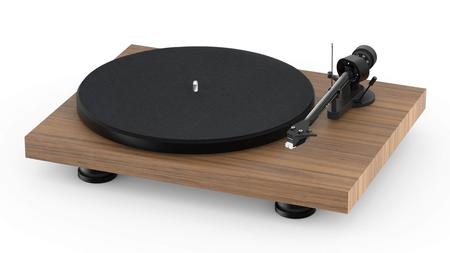
Read the package before comparing it with the newer EVO 2
The Debut Carbon EVO is a manually cued belt-drive deck with an 8.6-inch carbon tonearm, electronic 33/45 selection and a 1.7 kg steel platter with thermoplastic-elastomer damping. Pro-Ject also lists adjustable metal feet and a felt mat. The practical distinction is the exact cartridge package: the seller page for this Walnut item names Sumiko Rainier, while the older global product sheet calls Ortofon 2M Red the standard and describes multiple configurations. The official user guide lists both as possible fitted cartridges. Keep the seller-specific Rainier identity attached to this item; don't transfer 2M Red settings or assume all Debut Carbon EVO listings contain Rainier.
That distinction also separates it from the current U.S. Debut EVO 2 review. EVO 2 uses the Pick it MM EVO package in the researched U.S. listing, while this older item is the Rainier configuration; EVO 2 also replaces the steel/TPE platter with damped aluminum. Compare the exact included cartridge, production status, support documentation and offered package instead of treating the family name as a single interchangeable product.
Plan the phono connection around the Rainier
The Debut Carbon EVO has phono-level RCA output and an earth connection, not a documented built-in phono preamp. Pro-Ject's official manual directs the owner to an appropriate PHONO input or a separate phono stage ahead of an amplifier's line input. Sumiko's Rainier specification identifies it as moving magnet, with a 5.0 mV output and a 47 kΩ load specification. That makes a compatible MM receiver or integrated-amplifier PHONO input the straightforward route when the owner has one and uses the ground lead as instructed. Confirm the receiver's input loading and gain rather than relying on the word “PHONO” alone.
For powered speakers that accept only LINE input, insert a suitably matched external MM phono stage between turntable and speakers. With passive speakers, use that stage and then an amplifier's LINE/AUX input; the amplifier, not the turntable, drives the speakers. A connection straight to AUX or to powered-speaker LINE is not an equivalent shortcut because it omits the required phono equalization and amplification. If a seller substitutes a different cartridge, reassess the phono-stage match before using this Rainier-specific signal path.
Speed selection is electronic; arm work stays manual
The bottom-mounted rocker selects 33⅓ or 45 RPM and controls the motor. The maker's product information and manual describe 78 RPM operation with the round belt, but shellac playback also needs a suitable 78 stylus: the Rainier page lists a separate Sumiko RS 78 replacement stylus. The turntable item's page does not itemize the exact carton, so check for the belt and stylus rather than assuming both are present. Follow the cartridge and turntable instructions when changing parts.
The manual shows a lift lever and user balancing and tracking-force setup. Its recommended Rainier force is 20 mN (2.0 g), within Sumiko's stated 1.8–2.2 g range. This is an installation reference, not a measurement of any individual unit. Electronic speed switching does not make the tonearm automatic. The inspected model documents do not establish end-of-record platter stop or automatic arm return, so auto-stop remains unknown here and should not be treated as a verified feature.
Use dimensions as body screens, not shelf-clearance promises
The seller item and manufacturer references agree on about 16.34 inches wide and 12.60 inches deep with the cover closed. These are useful first-pass limits for a shelf, but they do not reserve the space to lift the cover, reach the cue lever, handle records or route the cable. The seller lists a much larger cover-open envelope of 415 × 365 × 405 mm. Check the actual shelf and operating space separately. The cited height differs—113 mm in the product information versus 118 mm in the manual and seller specification—and mass also differs between 6 kg and 5.6 kg. Neither disputed value is used as a settled spec here.
The model-level documents list an acrylic dust cover, RCA phono cable, power supply, single adapter and round 78 belt. The exact seller page identifies the Rainier and Walnut finish but does not enumerate its carton, so those general in-box statements are not a guarantee about a particular used, open-box or incomplete unit. The photographed assembly shows the Walnut-finish turntable only; it does not prove package condition or every included accessory.
Who should shortlist this earlier package?
It is worth comparing if the buyer wants the older Carbon EVO chassis, values the named Rainier MM package and already has a compatible PHONO input—or is prepared to add a phono stage and confirm the cartridge. It is a poor fit for anyone who requires a built-in preamp, fully automatic arm behavior, a verified record-end stop, or certainty that a particular accessory remains in a seller's box without written confirmation. A compact footprint on paper also does not resolve cover clearance.
Before committing, verify that the specific item is the Walnut T DCEVOW/Rainier configuration rather than another Carbon EVO bundle, confirm condition and carton contents, and ask the seller or manufacturer to resolve any disputed dimensions that affect your installation. For 78s, verify the correct round belt and 78 stylus separately. These checks matter more than borrowing capabilities from a newer EVO 2 or an unrelated listing. The manufacturer's archive establishes that this model is no longer in manufacture; it does not establish whether a particular seller has a complete or serviceable unit.
Key specifications
Key details at a glance
| Drive | Belt drive |
|---|---|
| Documented record speeds | 33 1/3 RPM / 45 RPM / 78 RPM with the model-compatible round belt and an appropriate 78 stylus; verify the exact item package |
| 78-RPM play option | Yes |
| Included cartridge | Sumiko rainier moving-magnet cartridge, as named on the exact u.s.-facing item page |
| Built-in phono preamp | No |
| Manual tonearm cueing | Yes |
| Platter | Steel with tpe damping and felt mat |
| Body width | 16.34 in |
| Body depth | 12.6 in |
| Published phono output | 5 mV |
Use the exact model’s instructions for operating limits, supplied equipment and version differences.
Sources for this review
Sources for this assessment
- Acoustic Sounds exact Debut Carbon EVO Walnut seller item
- Pro-Ject Debut Carbon EVO official product-information PDF
- Pro-Ject Debut Carbon EVO official instructions for use, revision 2020.08.05
- Acoustic Sounds exact-item image-browser page for item 163918
- Pro-Ject official product archive
- Sumiko official Rainier MM phono-cartridge specifications
Check your phono route before choosing
Check each model's documented input route, arm operation, and body limits. Use the finder to compare supported phono-system arrangements without assuming adjacent models share features.