
Your needs, this model
Does it fit your priorities?
What listening routes does the Debut E HP document?
The exact page and product sheet list a built-in phono preamp, separate RCA LINE and PHONO outputs, and a headphone amplifier. Confirm the headphone connector and compatibility for your own headphones; no passive-speaker amplifier is documented.
Does the “(78)” speed line establish a complete 78-rpm setup?
No. The manufacturer’s notation is “33, 45/(78)” but the cited page and sheet do not explain the parts or procedure for 78 rpm. Treat it as unconfirmed until a dealer identifies the required belt/stylus and verifies the exact package.
Does this model document USB recording or fully automatic operation?
The reviewed exact manufacturer page and sheet document RCA outputs and a headphone amplifier, but no USB recording path or automatic arm/end-stop behavior. Those functions are unverified for this exact model.
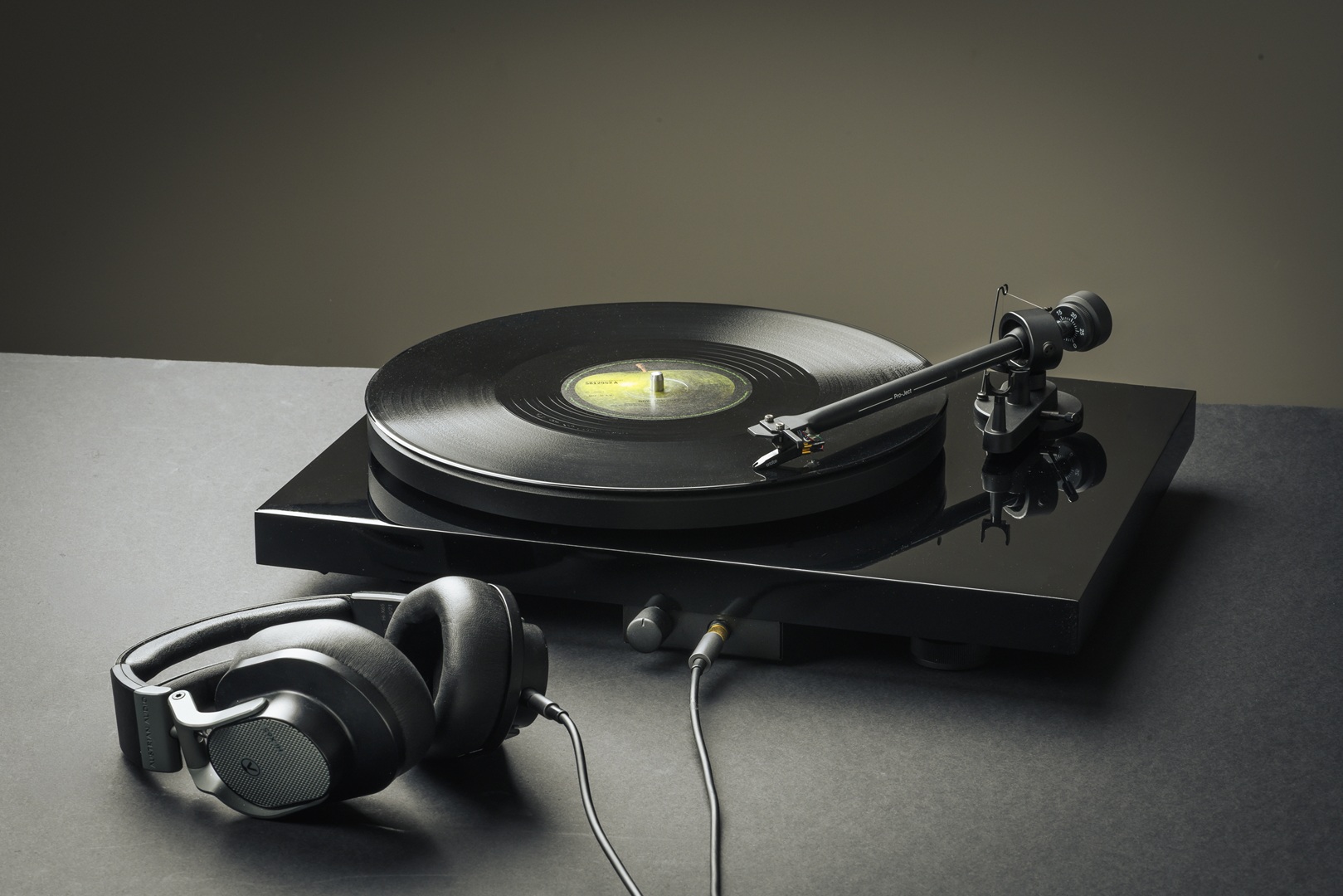
Pro-Ject’s global directory names the Debut E HP, and the matching manufacturer page and product-information sheet describe a standalone belt-drive turntable built around two distinct conveniences: an integrated phono preamp and a headphone amplifier. It also has separate RCA line and phono outputs. No exact U.S. seller package or local offer is established in the reviewed manufacturer material, so this page is an evidence-limited global reference, not a U.S. buying recommendation.
Headphones and speakers are separate listening routes
The built-in headphone amplifier is the model’s clearest point of difference from a basic turntable. Pro-Ject describes the E HP as suitable for listening through speakers or headphones, and the sheet lists the headphone amplifier as an included function. The same documents do not specify a headphone jack format, supported headphone impedance range or compatible headphone models. Check the physical connection and your headphones before assuming a particular set will work well. There is no claim here that the turntable drives passive speakers directly; the published feature list identifies headphone amplification, not speaker outputs.
For an external speaker system, the source material specifies separate line and phono RCA outputs alongside a built-in phono preamp. LINE is the appropriate level for a powered speaker’s line input or an amplifier’s AUX/LINE input. The separate PHONO output is for a compatible MM phono input or an external phono stage. Those are different signal levels, so choose the matching input rather than connecting by socket shape alone. The documents do not establish a USB output or a computer-recording function for this model; do not assume the RecordMaster II’s USB feature is shared by the E HP.
A conventional belt-drive deck with an unusual speed note
The sheet specifies a 300 mm steel platter weighing 1.7 kg, a one-piece 8.6-inch aluminium tonearm and a pre-adjusted Ortofon OM5e moving-magnet cartridge. It also lists a silicon-damped arm lift, dust cover, felt mat and 7-inch single adapter. These details give a buyer a practical starting point for setup and record handling, but they do not mean that every adjustment is eliminated or that an exact seller box contains every listed piece.
One specification deserves caution: the published speed line reads “33, 45/(78)” with electronic speed change. The available page and one-page sheet do not explain what the parentheses mean, whether a separate belt or stylus is required for 78 rpm, or which parts are included for that use. Treat 33 and 45 rpm as the clear documented speeds; ask the dealer to explain the exact 78-rpm procedure and package before relying on it for shellac records. The documents also do not specify automatic arm placement, return or end-of-record stop. Do not infer an automatic cycle from the product’s “simple to use” description.
Size and system checks before choosing a shelf
The manufacturer lists the body at 415 × 118 × 320 mm (width, height and depth) and 5.7 kg net. Those are published chassis dimensions, not a measurement of the space needed to open the cover, lift the arm or route cables. Leave operating room and check the depth of your actual shelf. The supplied power unit is specified as 15 V DC / 0.8 A, but the global page does not establish the plug, voltage label or carton for a particular U.S. seller item.
Compared with the similarly named Debut RecordMaster II, the E HP’s headline addition is a headphone amplifier; the RecordMaster documentation instead makes USB-B recording a central capability and explains a manual belt-and-stylus change for 78 rpm. The E HP source set does not establish that USB recording path, nor enough detail to transfer the RecordMaster’s 78 procedure. Compare the precise output and accessory lists, not just the shared Debut family name.
Keep the listing boundary visible
The dedicated product page and matching manufacturer sheet support the turntable’s core identity, phono stage, headphone amplifier, outputs, cartridge and listed dimensions. They do not establish an exact U.S. SKU, current stock, seller warranty, mains adapter or full 78-rpm arrangement. Before buying any specific offer, confirm the exact model name, color, power supply, output selector and accessory contents. If headphone compatibility or 78 playback is essential, get those details for the exact unit in writing. This assessment uses manufacturer documentation only; it does not claim ownership, listening tests or hands-on measurements.
Key specifications
Key details at a glance
| Drive | Belt drive |
|---|---|
| Included cartridge | Ortofon om5e, pre-adjusted |
| Built-in phono preamp | Yes |
| Platter | 300 mm steel platter, 1.7 kg, with felt mat. |
Use the exact model’s instructions for operating limits, supplied equipment and version differences.
Sources for this review
Sources for this assessment
Check your phono route before choosing
Check each model's documented input route, arm operation, and body limits. Use the finder to compare supported phono-system arrangements without assuming adjacent models share features.