
Your needs, this model
Does it fit your priorities?
Can the earlier E1 BT send a record to Bluetooth headphones or powered speakers?
Yes, the older U.S. edition has a Bluetooth 5.0 transmitter for a compatible receiving device. It does not receive Bluetooth audio from a phone, and it does not include speakers or amplify passive speakers.
Explore this need in the finder →Can the earlier E1 BT connect to a wired receiver PHONO input?
Yes, if the receiver input accepts MM cartridges and the E1 BT selector is set to PHONO, bypassing its built-in stage. For AUX/LINE, choose LINE instead.
Explore this need in the finder →Does the earlier E1 BT cue or stop records automatically?
No automatic arm start, lift or return is documented; the manual describes user-controlled cueing. End-of-record platter stop is not specified and remains unknown.
Explore this need in the finder →This identification review covers the earlier U.S. Pro-Ject E1 BT Gloss Black package with its factory-aligned Ortofon OM 5E moving-magnet cartridge. The U.S. E1 family sheet calls the BT model a transmitter version with an internal phono stage and lists Bluetooth 5.0 for that generation. Do not merge those details with the separate current-reference E1 BT package elsewhere in this library, which has an Audio-Technica AT3600L record and newer product-page claims. The exact Crutchfield U.S. item page now says it is no longer available there, so this page is a model reference, not a current buy recommendation.
Bluetooth sends record playback out
The “BT” here means the turntable can transmit its record signal to a compatible Bluetooth receiver, such as headphones, powered speakers or an amplifier with Bluetooth input. It is not a Bluetooth input for playing a phone through the turntable, and the deck does not contain speakers or a power amplifier. Before relying on wireless operation, confirm that the intended receiver can pair with the exact unit. The 2022 U.S. E1 sheet specifies BT 5.0 for this older OM 5E edition; that is a generation-specific fact, not a promise about another product page's later E1 package.
Wired use remains possible. The switchable internal MM stage provides a LINE output to a powered speaker or amplifier line input. Set the selector to PHONO when feeding a compatible MM receiver PHONO input or an external MM phono stage. If you connect to a receiver PHONO input, the internal stage must be bypassed; LINE into PHONO would put two phono stages in series. The external-stage route is useful when the final component has no suitable PHONO input, but passive speakers still need an amplifier. The manual treats Bluetooth as a separate transmit route, not as a replacement for a wired phono connection's correct input level.
Manual deck with two speeds
The E1 BT retains the E1 belt-driven platform: electronic 33/45 RPM selection, ABS-polymer platter, felt mat, 8.6-inch aluminum tonearm and factory-aligned OM 5E. The published U.S. sheet lists the platter's speed-drift, wow/flutter and signal-to-noise figures; those are manufacturer specifications rather than independent test results. The shared guide describes setup of the platter and belt and user-controlled cueing. Nothing in the speed button or wireless transmitter automates the arm.
Do not assume that Bluetooth also means automatic end-of-record handling. The checked official manual and the exact U.S. item page establish manual operation but do not specify an auto-stop or arm-return function. Stop behavior is unknown for this record, not a feature claim either way. If an automatic stop is essential, look for a separate model whose exact documentation says so instead of inferring it from the wireless feature.
Choose the output route that matches the system
The built-in MM stage makes the BT version more flexible than the older E1 Standard/OM 5E: set LINE for powered speakers or an amplifier's AUX/LINE input, or set PHONO to bypass the stage for an MM receiver input or separate phono stage. E1 Phono adds the stage but not Bluetooth transmission; BT combines the two. The BT transmitter does not by itself make an analog-only receiver Bluetooth-compatible, and no audio system is complete without the appropriate receiving device and, for passive speakers, amplification.
For a wired chain, one phono-equalization stage should appear between cartridge and line-level input. For a wireless chain, pair the transmitter with a Bluetooth receiving endpoint; check the supplied guide on the specific unit for pairing and switching behavior. Avoid assuming wired and wireless paths operate simultaneously unless the exact manual states it. The fit question is therefore not simply “does the turntable have Bluetooth?” but whether a compatible receiver is already part of the system and whether the wired selector will be set correctly when used.
Body size, identity and image limits
Pro-Ject's U.S. sheet lists 420 × 112 × 330 mm (W × H × D), approximately 16.54 × 4.41 × 12.99 inches, and 3.5 kg net. Treat that as the turntable body, not the shelf footprint in use: open the dust cover, leave room for the tonearm, route RCA or power cables, and allow record-handling space. The BT electronics do not reduce the clearance needed around the shared chassis.
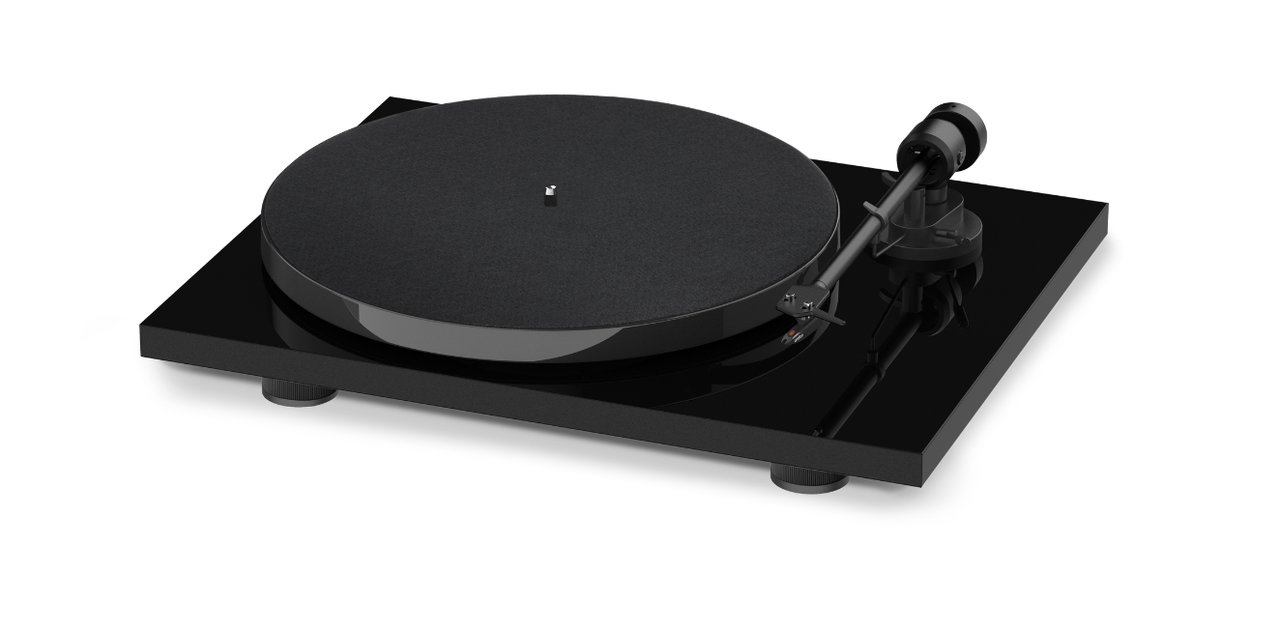
The associated black illustration is from an Australian retailer page for an E1 BT / OM5e. It shows the physical model family, but it does not prove a U.S. item number, cartridge in any particular box, Bluetooth version or operating condition. The U.S. package record is based on Pro-Ject's U.S. sheet and the exact Crutchfield item page. That page's no-longer-available notice is limited to Crutchfield; it does not establish market-wide discontinuation or stock elsewhere.
Checks for the older BT package
Read the complete model label, confirm the cartridge is Ortofon OM 5E, and verify the Bluetooth transmitter and stage controls on the exact deck. Check receiver compatibility before choosing wireless, and use the correct PHONO or LINE output for any wired connection. Inspect the belt, platter, felt mat, dust cover, 45 adapter, supply and RCA parts against the specific unit's manual and seller condition. An old family name or a similar black E1 photo is not enough to establish a box's cartridge or state.
Sources checked: Pro-Ject U.S. E1 product-information sheet; Pro-Ject shared E1 user guide; Pro-Ject E1 setup guide; Crutchfield U.S. E1 BT item record; Midland Records image page (Australia; image only). This review makes no claim of ownership, listening, hands-on testing or independent BT-range measurement.
Key specifications
Key details at a glance
| Drive | Belt drive |
|---|---|
| Documented record speeds | 33 1/3 RPM / 45 RPM |
| 78-RPM play option | No |
| Included cartridge | Ortofon om 5e moving-magnet cartridge |
| Built-in phono preamp | Yes |
| Manual tonearm cueing | Yes |
| Platter | Abs polymer |
| Platter mat | Felt |
| Body width | 16.54 in |
| Body depth | 12.99 in |
| Body height | 4.41 in |
Use the exact model’s instructions for operating limits, supplied equipment and version differences.
Sources for this review
Sources for this assessment
Check your phono route before choosing
Check each model's documented input route, arm operation, and body limits. Use the finder to compare supported phono-system arrangements without assuming adjacent models share features.