
Your needs, this model
Does it fit your priorities?
Can the older OM 5E E1 Phono connect to a receiver PHONO input?
Yes, if that receiver input is compatible with a moving-magnet cartridge and the E1 Phono selector is set to PHONO so its internal stage is bypassed. Confirm grounding and the exact receiver label.
Explore this need in the finder →Can the older OM 5E E1 Phono connect directly to powered-speaker line inputs?
Yes, with the selector at LINE and compatible speaker line inputs. The built-in MM stage provides line-level phono equalization, but does not power passive speakers.
Explore this need in the finder →Does the OM 5E E1 Phono stop at the end of a record or return the arm?
The checked sources document manual cueing and speed switching, but do not specify an end-of-record stop or arm return. Treat those functions as unverified rather than relying on them.
Explore this need in the finder →This review identifies a specific earlier Pro-Ject E1 Phono package: Gloss Black with the pre-mounted Ortofon OM 5E moving-magnet cartridge. It is not the current U.S. E1 Phono package reviewed elsewhere here, which is listed with an Audio-Technica AT3600L. The 2022 U.S. product sheet names the older Standard, Phono and BT versions and specifies the OM 5E family package. This is an evidence-based identification review, not a listening test or current-stock recommendation; the U.S. retailer records examined now label this exact edition unavailable at those sellers.
The Phono version adds a switch, not speakers
The key difference from the older E1 Standard is a switchable moving-magnet phono stage. In LINE mode, the turntable applies phono equalization and sends a line-level signal to powered speakers with a compatible line input or to an amplifier's AUX/LINE input. Passive speakers still need an amplifier: a phono stage only raises and equalizes the cartridge signal; it does not provide speaker power.
In PHONO mode, the built-in stage is bypassed. That is the appropriate output for a compatible MM PHONO input on a receiver or integrated amplifier, or for a separate MM phono stage placed before powered speakers or an amplifier's line input. Avoid sending LINE output into another PHONO stage, which applies phono equalization twice. Conversely, PHONO into AUX or a line-only powered speaker is not a usable substitute for a stage. The shared Pro-Ject guide depicts the separate PHONO and LINE routes; verify labels and grounding at the exact deck and destination before connecting.
Manual 33/45 playback
The U.S. E1 sheet specifies a belt drive, an ABS-polymer platter, 33 and 45 RPM electronic speed selection, an 8.6-inch aluminum tonearm and factory alignment of the OM 5E. The guide still requires the owner to install the platter and belt and to raise and place the arm by hand. A switch for speed does not automate record start, arm lift or return. No end-of-record platter stop is specified in the checked documents, so do not count on one; the stop behavior remains unknown rather than a documented feature or a verified absence.
The OM 5E is an MM cartridge, so compatible receiver and external stages should accept moving-magnet cartridges. Pro-Ject's shared manual lists the OM 5E replacement stylus, but that document covers more than one E1 package and is not proof of which cartridge is in a particular used or open-box unit. The U.S. product sheet and the exact Crutchfield and B&H item records identify the older black Phono/OM 5E package; their seller item or displayed MFR numbers should be treated as identifiers on those pages, not as a universal discriminator for every E1 carton.
Published footprint and setup space
The U.S. product sheet lists 420 × 112 × 330 mm (W × H × D), about 16.54 × 4.41 × 12.99 inches, and 3.5 kg net. The Crutchfield listing gives different body figures, including a wider/deeper listed envelope. Prefer neither figure as a precision clearance promise: the sources do not explain the discrepancy, and the measurements do not include rear cable bend, record handling or access to the cue control. The setup drawing also shows a larger dust-cover operating envelope than the turntable body. Measure your own surface and the room above and behind it before placing a deck.
Distinguish this historical package from today's namesakes
“E1 Phono” alone does not identify the supplied cartridge. The U.S. records establish a former black OM 5E configuration, while separate current-reference pages identify an AT3600L E1 Phono. Those are not interchangeable fact records: the turntable family and phono routing are closely related, but the package and stylus are different. The E1 BT adds a Bluetooth transmitter as well as the stage; the E1 Standard lacks the built-in stage. This article therefore stays a model-identification reference, outside the buying matcher, instead of treating a historical label or a seller's no-longer-available notice as evidence of a present offer.
Image and what it can establish
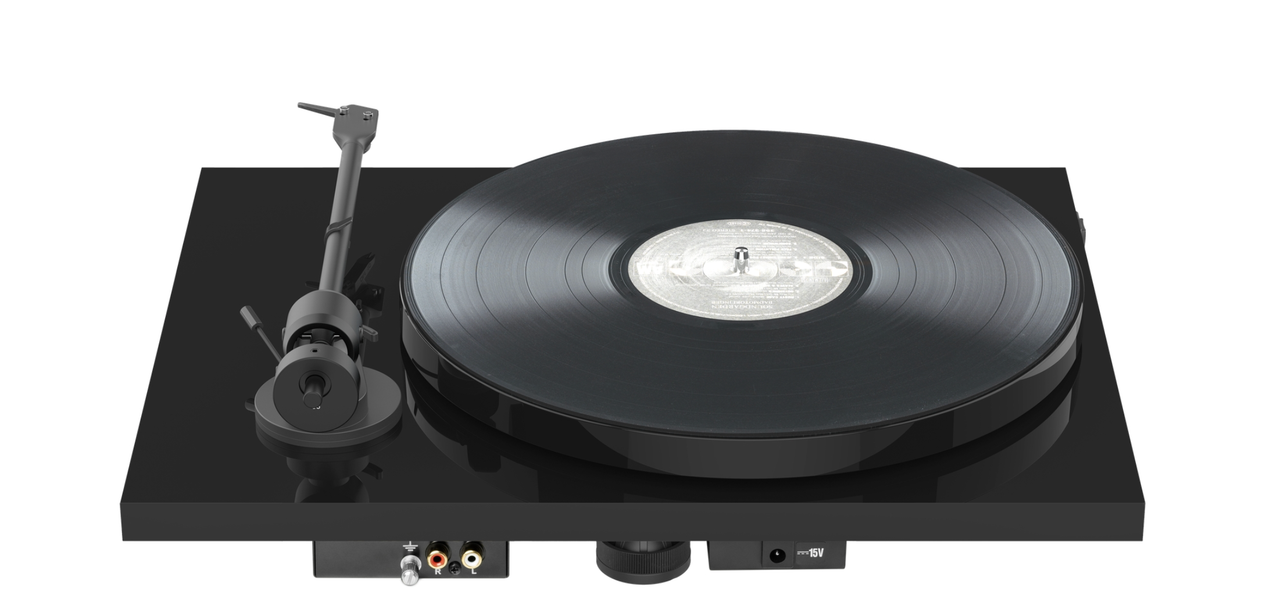
The associated main image is from an Australian retailer's exact black E1 Phono/OM 5E page. It is an exact-model illustration, not a U.S. carton photo. It shows the black plinth, platter and tonearm; it cannot show which cartridge is in a particular U.S. offer or whether the internal selector is set to PHONO or LINE. The U.S. package identity comes from the separate U.S. item records and Pro-Ject's U.S. product sheet.
Checks for an existing or old-stock unit
Read the model and cartridge names on the exact listing or unit rather than relying on a family photo. Confirm the cartridge says Ortofon OM 5E if that is the configuration sought, then check that the rear selector and downstream input form one valid route. Confirm the platter, belt, mat, dust cover, power supply, RCA leads and 45 adapter are actually present, especially for a used or open-box purchase. Inspect the seller's condition and return terms independently. The old U.S. pages examined here report their own unavailability; they do not establish what another seller has, or what is inside an unverified box.
Sources checked: Pro-Ject U.S. E1 product information; Pro-Ject shared E1 user guide; Pro-Ject E1 setup guide; Crutchfield E1 Phono item record; B&H E1 Phono item record; Stereophonic image page (Australia; illustration only). No source is represented as an independent listening test.
Key specifications
Key details at a glance
| Drive | Belt drive |
|---|---|
| Documented record speeds | 33 1/3 RPM / 45 RPM |
| 78-RPM play option | No |
| Included cartridge | Ortofon om 5e moving-magnet cartridge |
| Built-in phono preamp | Yes |
| Manual tonearm cueing | Yes |
| Platter | Abs polymer |
| Platter mat | Felt |
| Body width | 16.54 in |
| Body depth | 12.99 in |
| Body height | 4.41 in |
Use the exact model’s instructions for operating limits, supplied equipment and version differences.
Sources for this review
Sources for this assessment
- Pro-Ject U.S. E1 family product-information sheet (OM 5E generation)
- Pro-Ject E1 / Phono / BT shared user guide, revision 2022-06-29
- Pro-Ject E1 setup guide
- Crutchfield U.S. historical E1 Phono Black item observation
- B&H U.S. historical E1 Phono Piano Black item observation
- Stereophonic E1 Phono OM 5E black image page (Australia; image provenance only)
Check your phono route before choosing
Check each model's documented input route, arm operation, and body limits. Use the finder to compare supported phono-system arrangements without assuming adjacent models share features.