
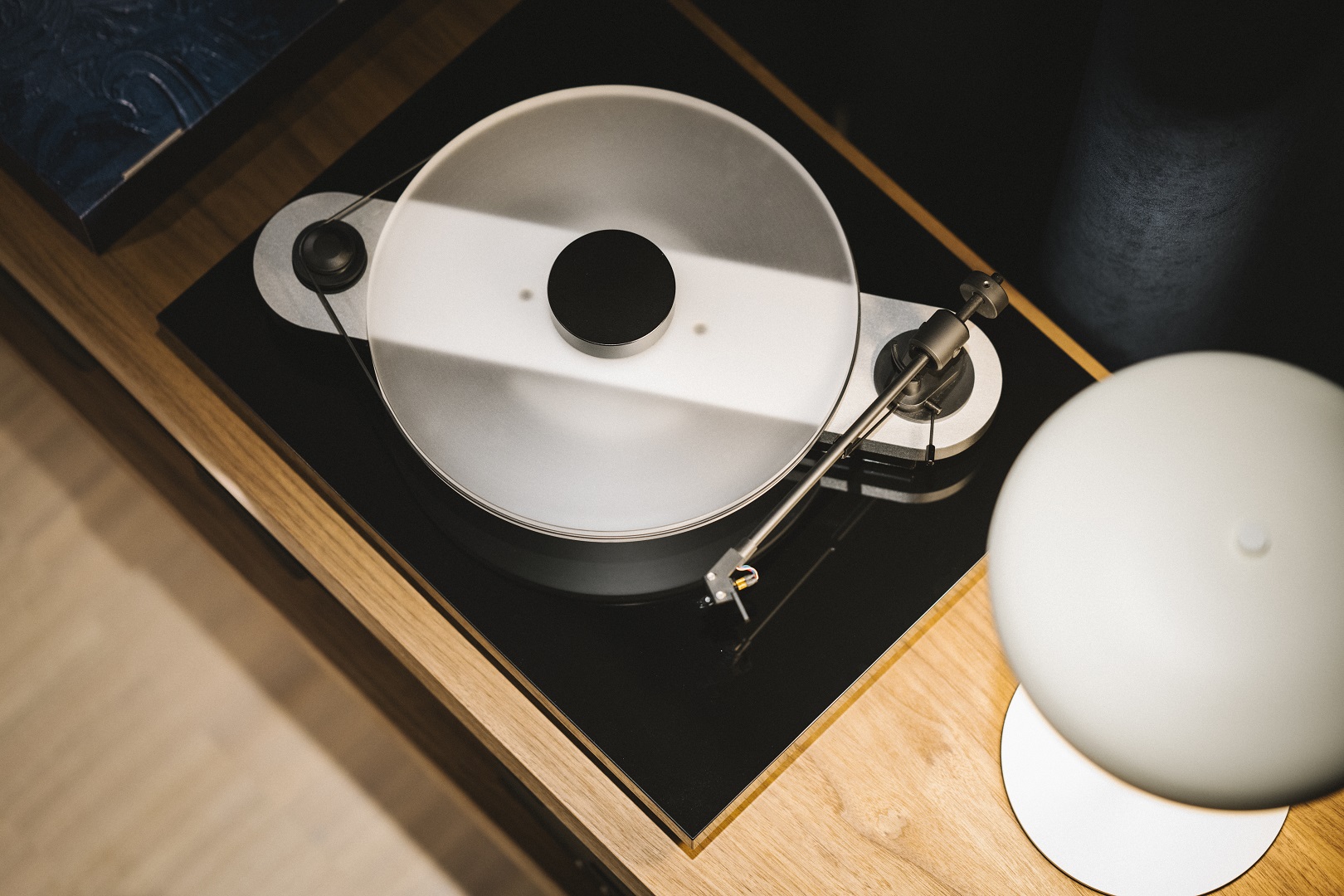
Your needs, this model
Does it fit your priorities?
Does the Elemental Phono USB Final Edition include a phono preamplifier?
Yes. Its exact product-information sheet explicitly lists an integrated phono preamplifier with RCA and USB-B outputs. The sheet does not identify a bypass mode, so verify the intended RCA path before adding another stage.
Explore this need in the finder →What USB recording quality does the manufacturer document?
The page states up to 16-bit / 48-kHz recording, and the product information specifies a 16-bit Delta-Sigma converter. The cited documents do not establish recording software, file format or computer compatibility.
Can this Final Edition play 78-RPM records?
No 78-RPM setup is documented. The exact product information lists manual 33 and 45 RPM speed change only.
Pro-Ject’s current global directory labels this entry “Elemental Final Edition”; its dedicated page identifies the product as the Elemental Phono USB Final Edition. The page and linked product information describe a complete turntable with a built-in phono stage and USB recording output. Pro-Ject’s page currently marks it sold out while noting that dealer stock may remain. That is not proof of a U.S. offer, exact power package or local stock, so this review is a global product reference, not a U.S. buying recommendation.
The useful distinction is the built-in phono stage and USB output
The product sheet explicitly lists an integrated phono preamplifier, RCA output and USB-B output. It also identifies a 16-bit Delta-Sigma A/D converter and the manufacturer page states recording up to 16 bit / 48 kHz. That combination is the model’s main system distinction: the phono stage is documented inside the turntable, and the USB connection is a separate route for digitizing records. The sources do not specify recording software, computer compatibility, file format or a particular recording workflow, so those should be checked before treating USB as a complete archiving setup.
The included Pick it 25A cartridge is described as pre-adjusted, and the product information says tracking force and anti-skating are pre-set. The fixed 33/45 speed change is manual. Pro-Ject does not list 78 RPM for this model, so a 78 collection is not supported by the published speed specification. The sources also do not establish automatic arm placement, return or an end-of-record stop; do not infer those behaviors from “plug & play” language about the preset cartridge.
Acrylic platter and the listed accessories
Pro-Ject specifies a 300 mm acrylic platter, an 8.6-inch low-mass tonearm and a central artificial-stone mass point beneath the platter bearing, which the manufacturer says is intended to absorb rumble and motor vibration. Those are design descriptions, not independent tests of sound. The sheet gives body dimensions of 415 × 90 × 300 mm and a net weight of 2.7 kg. Use the numbers as published body dimensions; they are not the height or footprint of the complete turntable with its listed platform and open dust cover.
The Final Edition product information lists Cover it E, Ground it E and a Record Puck as included; the current web page’s brief accessory list names the RCA cable, USB-B cable and 15 V DC supply. Those records are not necessarily contradictory, but the online list is shorter. Confirm the actual contents if the cover, isolation platform or puck is important to the purchase. The 15 V DC output specification also does not identify the exact U.S. mains adapter or plug in a seller’s box.
Fit the signal chain to the actual unit
Because the manufacturer documents an integrated phono preamplifier and RCA output, the model offers a path to an ordinary amplifier line input without relying solely on a separate PHONO input. The manufacturer does not document a bypass switch or describe the exact RCA output mode in the material cited here. Verify the unit’s connection instructions before adding another phono stage in series. The USB-B capture path and analog RCA playback path are distinct; decide which one matters, and confirm the computer and software requirements separately.
The page’s “sold out” notice and remaining-dealer-stock note are a dated global status statement, not a U.S. inventory listing. The official U.S. dealer locator names a distributor but does not list this exact product or a package. Confirm any seller’s model name, preamp/USB configuration, power adapter and contents rather than substituting information from an earlier Elemental variant.
Who should use this reference?
The documented appeal is specific: a built-in phono stage, USB-B digitizing at up to 16 bit / 48 kHz, a factory-adjusted Pick it 25A and an acrylic platter. Those features can simplify a two-route playback and archiving plan, but the manual 33/45 speed change, unsupported 78-RPM claim, unknown automatic behavior and unverified U.S. package remain important limits. Keep this Final Edition distinct from other Elemental models, and do not treat its global page as proof of a current local offer. This is a document-based assessment only; it does not claim a listening test, recording test or personal setup experience.
Primary sources: Pro-Ject Elemental Phono USB Final Edition page, its linked product information and the official dealer locator.
Key specifications
Key details at a glance
| Drive | Belt drive |
|---|---|
| Documented record speeds | 33 RPM / 45 RPM |
| 78-RPM play option | No |
| Included cartridge | Pro-ject pick it 25a, pre-adjusted |
| Built-in phono preamp | Yes |
| Platter | 300 mm acrylic |
Use the exact model’s instructions for operating limits, supplied equipment and version differences.
Sources for this review
Sources for this assessment

Check your phono route before choosing
Check each model's documented input route, arm operation, and body limits. Use the finder to compare supported phono-system arrangements without assuming adjacent models share features.