
Your needs, this model
Does it fit your priorities?
Can the Sgt. Pepper's Drum connect directly to a line-only amplifier or powered speakers?
The linked Essential III guide specifies PHONO-level output, so use a compatible MM PHONO input or add a phono stage before a line input. The included RCA lead is not a line-level converter.
Which OM10 force should be set?
The exact-edition page and sheet recommend 18 mN, while the linked general Essential III guide says 15 mN for its OM10. Check the instruction supplied with the exact edition or ask the seller before adjustment.
Will the advertised dimensions fit a shelf?
Do not rely on 488 x 235 x 393 mm as confirmed body clearance: the general guide labels those values as packaging dimensions. Confirm the exact deck's body dimensions with the seller.
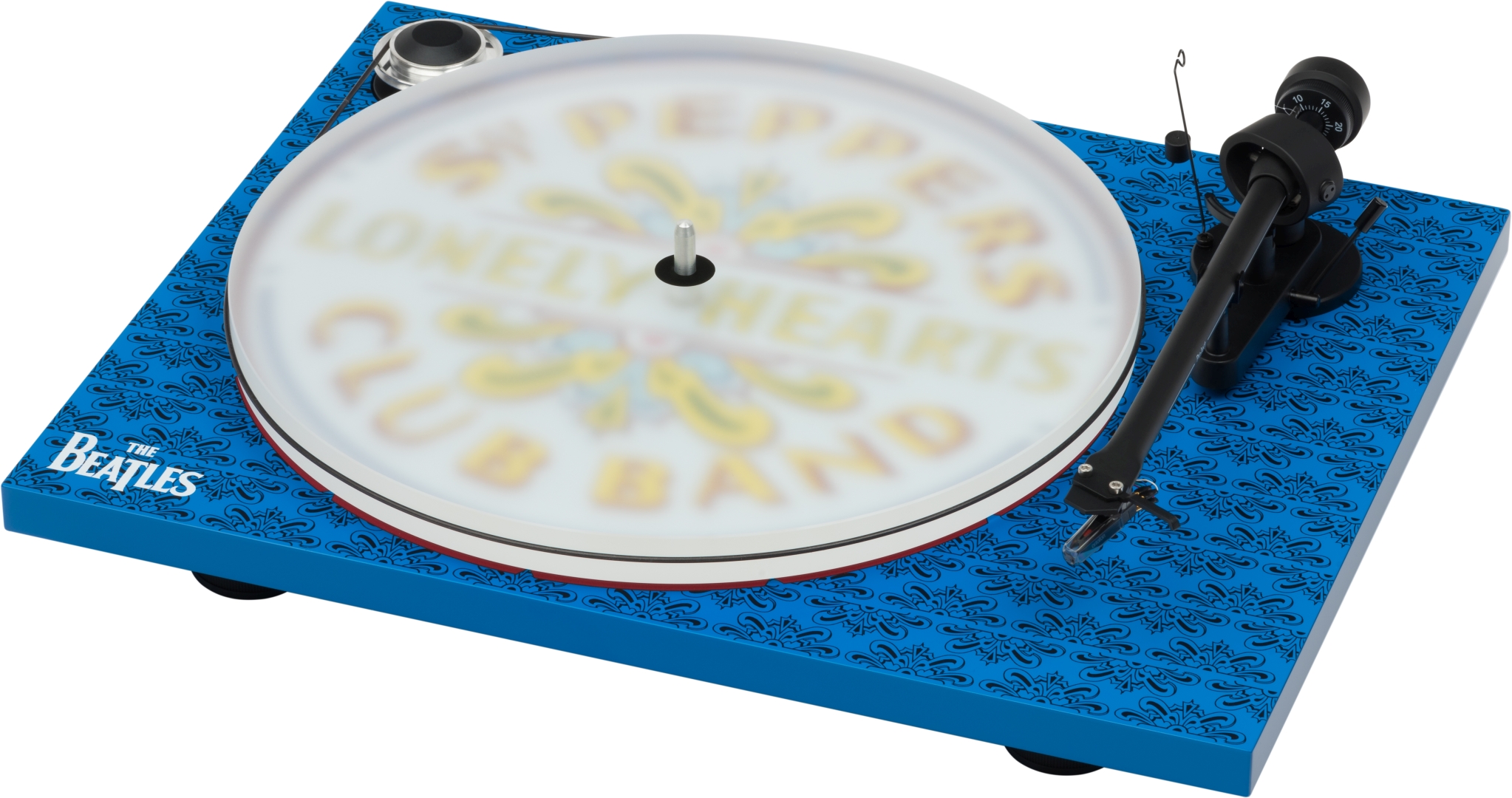
Pro-Ject’s global directory links the title “Sgt. Pepper’s Drum” to a dedicated page headed “Essential III Sgt. Pepper’s Drum.” That page identifies a complete special-edition turntable based on the Essential III, not a stand-alone accessory or an album bundle. It lists a pre-mounted Ortofon OM10, a clear acrylic platter over Beatles-inspired artwork, belt drive and manual 33/45 selection. This is an evidence-limited reference to the documented global edition: the directory is not a U.S. offer, and the exact local seller carton and power supply have not been established.
A recognizable plinth, familiar Essential III setup
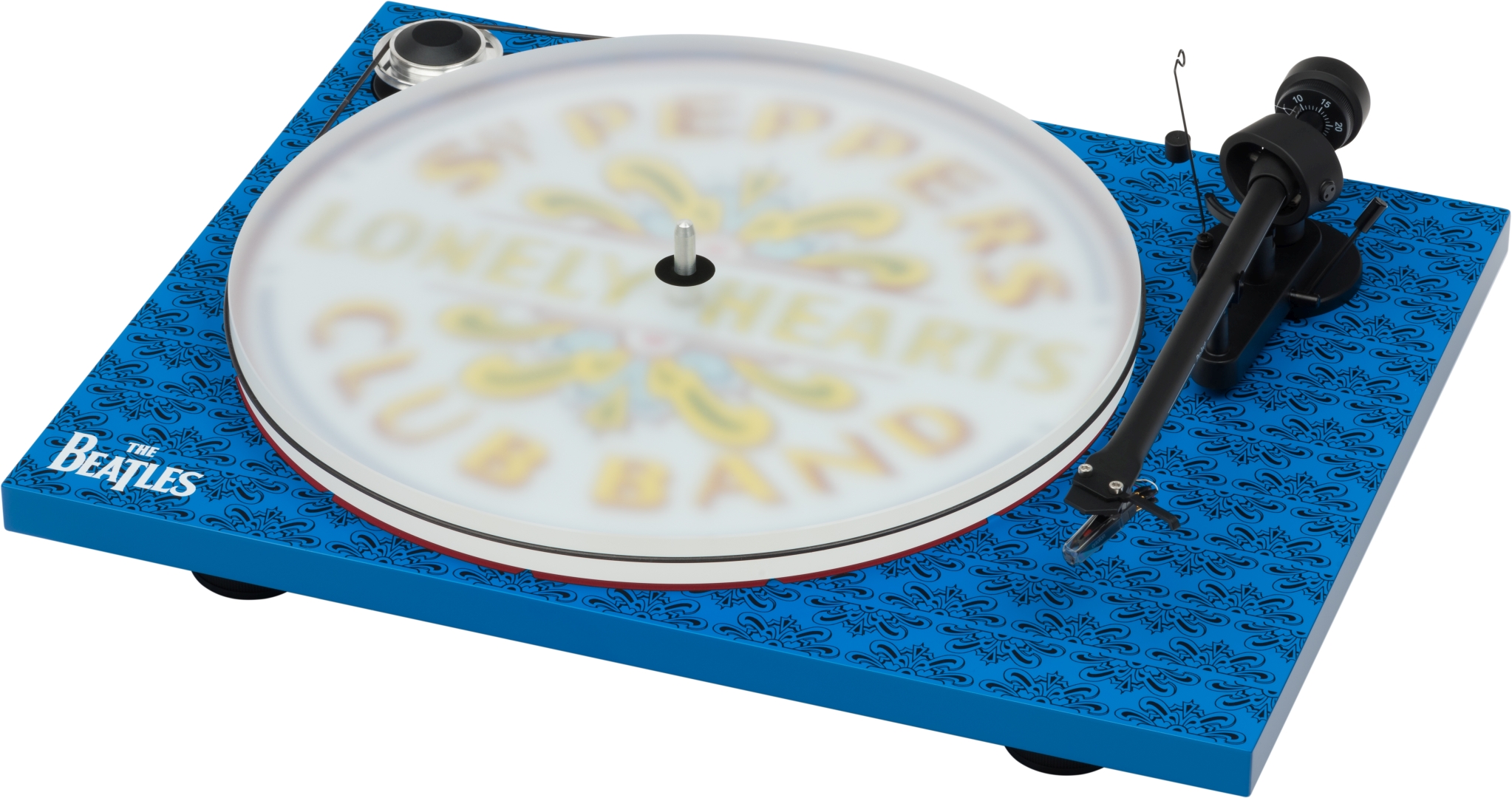
The dedicated page and product sheet describe a blue plinth decorated with the Sgt. Pepper’s Drum artwork and an acrylic platter. The specific sheet calls it a special edition of Essential III; it lists a synchronous belt-drive motor, a 300 mm acrylic platter and felt mat, an 8.6-inch aluminium tonearm with sapphire bearings, a pre-mounted Ortofon OM10 and a semi-balanced RCA phono interconnect. A dust cover and power supply are also listed. The official photo shown with this assessment depicts the decorated blue table and translucent platter artwork; it does not establish a seller’s current package or condition. The maker’s Essential III guide explains the basic setup and operation: fit the platter and belt, balance the arm, adjust anti-skating, use the lift, and move the belt between the 33 and 45 rpm pulley steps. It describes the signal lead as PHONO-level and calls for a compatible phono input or an external phono stage before a line-level amplifier or powered speakers. The special-edition page explicitly identifies the deck as Essential III, so the guide is useful for this platform-level operating path. It is not an edition-specific carton list or proof that an altered, used or regional package contains the same parts.Check the dimensions before reserving shelf space
There is a consequential labeling conflict in the published measurements. The special-edition product page and its sheet both print 488 × 235 × 393 mm and a 7 kg weight. The linked general Essential III manual lists those same dimensions as packaging dimensions and gives the bare deck as 420 × 112 × 330 mm and 5 kg, with 7 kg including packaging. That match makes the exact edition’s printed size unsuitable as a reliable clearance promise, but it does not authorize silently replacing the special-edition figures with generic platform figures. Treat the body clearance and net weight for the exact Sgt. Pepper’s Drum package as unresolved; obtain the exact seller’s dimensions before planning a tight shelf.Do not smooth over the cartridge-setting and speed-data conflicts
The special-edition page and product information recommend 18 mN tracking force for the fitted OM10. The linked Essential III guide gives 15 mN for its factory-fitted OM10. The model-specific documents are the stronger description of the named edition, but the discrepancy matters during setup. Check the instructions supplied with the exact turntable or ask the seller before adjusting the counterweight rather than treating the general platform manual and special-edition recommendation as interchangeable. There is also a labeling mismatch in the speed-performance figures: the page and product sheet assign the same pairs of values to speed variance and wow-and-flutter in opposite ways. Those figures are not used here to make a stability claim. The documented format choices are simpler: manual 33/45 playback is listed, while no 78 rpm arrangement is specified. The sources also do not establish automatic start, auto-return or end-of-record stopping, so manual arm handling is the safe expectation rather than a claim about every possible mechanism.What this reference can and cannot settle
For a compatible receiver with an MM PHONO input, the linked Essential III guide documents a suitable connection. Alternatively, it calls for a separate phono stage before a line-only amplifier or powered speakers. Do not connect its phono-level signal directly to a line input based only on the supplied RCA cable. The page and guide do not document Bluetooth transmission or USB recording for this edition. Pro-Ject’s current global listing and detailed page carry a sold-out label, while its U.S.-selected dealer locator is a distributor/dealer index rather than an inventory of this model. That evidence does not prove U.S. absence or identify a U.S. seller package. Anyone considering a second-hand or regional listing should verify the exact deck, cartridge, supply voltage and plug, parts, condition and return terms. This assessment is based on manufacturer documents; it does not claim ownership, listening tests or hands-on measurements. Primary sources: Pro-Ject Essential III Sgt. Pepper’s Drum page, the linked edition product information and Essential III user guide.Key specifications
Key details at a glance
| Drive | Belt drive |
|---|---|
| Documented record speeds | 33 / 45 |
| 78-RPM play option | No |
| Included cartridge | Ortofon om10, pre-mounted |
| Built-in phono preamp | No |
| Manual tonearm cueing | Yes |
| Platter | 300 mm acrylic platter with felt mat |
Use the exact model’s instructions for operating limits, supplied equipment and version differences.
Sources for this review
Sources for this assessment
Check your phono route before choosing
Check each model's documented input route, arm operation, and body limits. Use the finder to compare supported phono-system arrangements without assuming adjacent models share features.