
Your needs, this model
Does it fit your priorities?
Can one cartridge package be assumed for the Signature 12.2?
No. The product-information sheet describes the base version without a cartridge and shows the Pick it MC9 as separately available; the user guide also describes cartridge-equipped packages. Confirm the exact offer and cartridge before selecting a phono stage.
Can the Signature 12.2 feed powered speakers directly through LINE/AUX?
No. The user guide requires a compatible PHONO input or an external phono stage before a line-level input. No built-in stage is documented; the cartridge and phono stage must be matched.
Explore this need in the finder →What makes setup more involved than a ready-to-play deck?
The exact user guide includes transport-screw removal, platter and idler-pulley installation, belt assembly, detachable tonearm setup, cartridge alignment, tracking force, anti-skating, VTA, azimuth and leveling.
Explore this need in the finder →How much support space should be reserved?
Pro-Ject lists a 580 x 220 x 480 mm body and 37 kg net weight. Convert and check the exact furniture rating, then allow additional space for access and cables; these body figures are not an installation clearance measurement.
Explore this need in the finder →Pro-Ject’s current global directory and dedicated product page identify the Signature 12.2 as a whole turntable. This is the exact “12.2” model, not the Signature 10 or an unqualified Signature 12. Its manufacturer information is substantial, but the checked U.S. dealer page names a distributor rather than a model line or seller package. This is a global documentation reference; it does not establish a U.S. SKU, offer or exact retail carton.
A 12-inch arm and a very substantial chassis
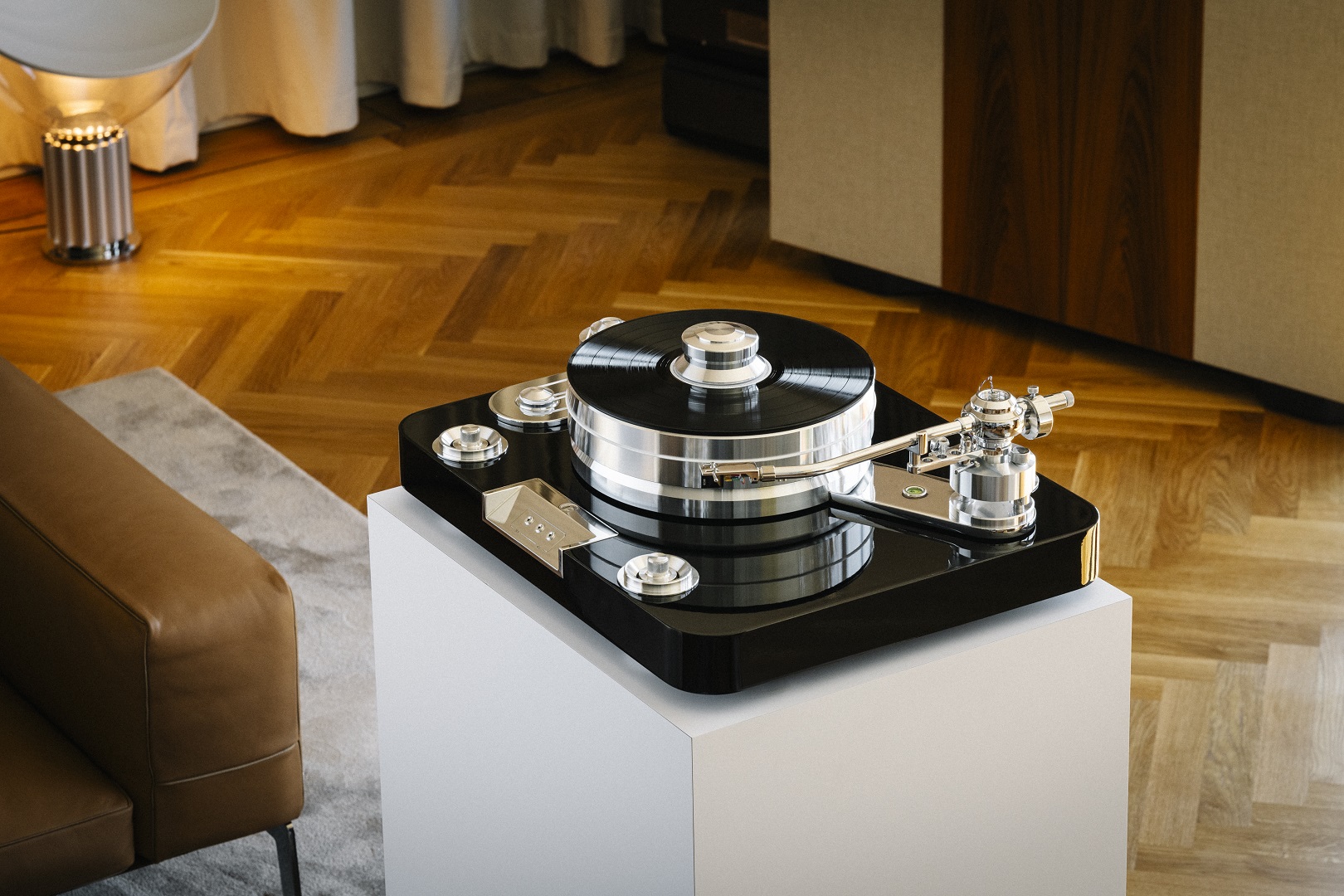
The Signature 12.2 uses a 12-inch S-shaped aluminium tonearm with a three-point pivot bearing, an SME-style detachable headshell and adjustable tracking, anti-skating and vertical tracking geometry. Pro-Ject’s 2024 product information describes the three-point bearing as a change from the previous uni-pivot approach. That distinction is useful when comparing it with earlier Signature material; it is not a claim that one design has been independently measured to sound better. The user guide also treats arm assembly, cartridge installation and alignment as real setup steps, not as a simple plug-in accessory.
The platter is listed at 10.55 kg, made from aluminium, TPE damped and magnetically decoupled over an inverted ceramic-ball bearing. Pro-Ject describes a flywheel belt drive and electronic 33/45 RPM selection. The exact user guide documents those two speeds; it does not list 78 RPM. This large, high-mass design is clearly different from a light, quick-start deck, but the product specifications cannot tell us how it will sound in an individual room or system.
Cartridge and phono-stage details need to be decided separately
The product-information sheet describes the listed base price without a cartridge and identifies the pictured Pick it MC9 as separately available. The manual allows for a cartridge-equipped package, with the cartridge installed before sale in that case. Those documents point to package variation rather than one universal pickup. Confirm whether a specific offer includes a cartridge, its type and model, and whether it has been aligned; the manual’s adjustment instructions should be followed for the actual cartridge rather than a neighboring model.
The rear output is a five-pole DIN connector, and the manual lists a DIN-to-RCA cable among its accessories. It directs the user to a PHONO input compatible with the installed cartridge or to a suitable external phono stage before a LINE input. No built-in phono stage is documented. For powered speakers with only line-level inputs, the chain therefore needs an external stage matched to the chosen cartridge. A receiver’s PHONO input can serve the same role only when it is electrically compatible with that cartridge.
Setup is careful and component-heavy
The manual describes an assembly sequence that includes three transport screws, the main platter, an idler-pulley assembly, the drive belts and a detachable tonearm. It then covers cartridge alignment, tracking force, anti-skating, vertical tracking angle, azimuth and leveling. That is valuable documentation for an experienced setup or dealer installation, but it is more involved than a player that arrives ready for immediate playback. The model is manually operated; the manual documents an arm lift and does not specify automatic return or an end-of-record platter stop.
Power is comparatively well described by the manual: it lists a universal supply rated for 90–246 V AC and three interchangeable socket adapters, with a 15 V DC output. Even so, that is global maker documentation, not proof that a particular U.S. offer includes the same supply revision or all of its adapters. Verify the actual carton and power unit. The product sheet also lists a base version without a cartridge, so a setup plan should account for the chosen cartridge and matching phono stage rather than budget only for the turntable body.
Measure the support, not just the opening
The manufacturer lists the body at 580 × 220 × 480 mm and 37 kg net; the boxed weight is 60 kg. Allow more room than the closed-body dimensions for access to the tonearm, cables and assembly, and use furniture that can safely support the deck. The weight and multiple assembly steps make delivery and installation questions material, not minor accessories. These numbers are maker specifications, not measurements taken here.
Who should use this reference?
The Signature 12.2’s documented strengths as a design reference are its 12-inch three-point-pivot arm, heavy magnetically decoupled platter, two electronically selected speeds and detailed setup instructions. Its tradeoffs are equally concrete: large size, high mass, manual installation, a cartridge choice that depends on package, and a phono route that requires compatible external amplification. Keep it distinct from the Signature 10 and earlier Signature 12 names, and do not infer a U.S. offer from the manufacturer’s distributor listing. No listening test, owner experience, independent measurements or hands-on setup is claimed in this assessment.
Primary sources: Pro-Ject Signature 12.2 product page, Signature 12.2 product information, Signature 12.2 user guide and the official dealer directory.
Key specifications
Key details at a glance
| Drive | Belt drive |
|---|---|
| Documented record speeds | 33 RPM / 45 RPM |
| Built-in phono preamp | No |
| Manual tonearm cueing | Yes |
| Platter | 10.55 kg aluminium platter, tpe damped with recycled-vinyl top, magnetically decoupled |
| Body width | 22.83 in |
| Body depth | 18.9 in |
| Body height | 8.66 in |
Use the exact model’s instructions for operating limits, supplied equipment and version differences.
Sources for this review
Sources for this assessment
Check your phono route before choosing
Check each model's documented input route, arm operation, and body limits. Use the finder to compare supported phono-system arrangements without assuming adjacent models share features.