
Your needs, this model
Does it fit your priorities?
Does its 78-rpm speed make it ready to play shellac records?
No complete 78-rpm cartridge setup is established. Pro-Ject lists 78 rpm and says to use a 78 stylus; the linked platform guide describes a round-belt change. Confirm the exact stylus and belt before playing 78s.
Can I connect it to AUX or powered speakers directly?
The linked Debut Carbon Esprit SB / 2M Red guide describes PHONO-level RCA output. Use a compatible MM PHONO input or add a suitable external phono stage before a LINE/AUX input or powered speakers.
Will it fit a shelf at the published height?
The page lists 415 x 118 x 320 mm with the lid closed. That is not the open-cover clearance; measure the installation and arm-access space yourself.
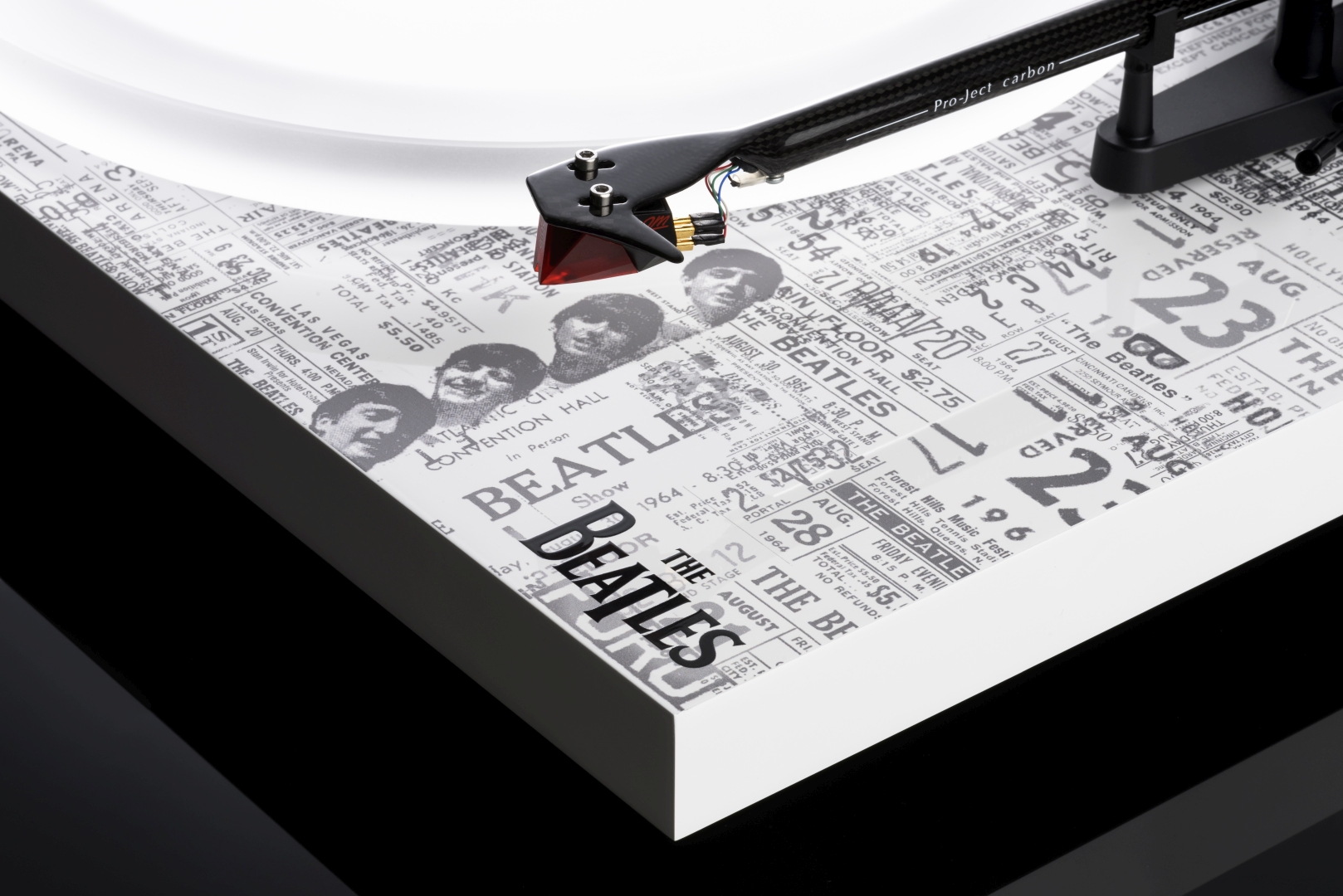
Pro-Ject’s current global turntable directory names “The Beatles 1964” and links to a dedicated page headed “The Beatles 1964 Recordplayer.” That page identifies a complete limited-edition deck based on the Debut Carbon Esprit SB, with tour-ticket artwork, an acrylic platter, a carbon-fibre arm and a pre-mounted Ortofon 2M Red. The checked manufacturer page shows it as sold out. This assessment describes the named global model from Pro-Ject’s documentation; it does not establish a current U.S. offer, regional package or the contents of any used listing.
The artwork is unusual; the playing system is recognizably Debut
The useful distinction is more than the Beatles graphic. Pro-Ject specifies a belt-drive turntable with electronic 33/45 selection, a 300 mm acrylic platter, an 8.6-inch carbon tonearm and a pre-mounted 2M Red. The page and product sheet identify the underlying platform as the Debut Carbon Esprit SB. The turntable’s plinth artwork reproduces 1964 tour tickets, so the image is helpful for recognizing the edition, but it does not document a bundle of Beatles records or other memorabilia.
The published dimensions are 415 × 118 × 320 mm with the lid closed, and net weight is 4.9 kg. That gives a useful starting point for a shelf check, not the clearance needed to open the lid or reach the tonearm. Measure the installation space rather than using the photo as a scale reference. Pro-Ject’s page lists a dust cover and semi-balanced Connect it E phono interconnect among the supplied components; a maker’s global specification is not a guarantee about a particular seller’s carton or a second-hand unit’s condition.
78 rpm needs more than a speed selection
The edition is unusual among two-speed decks because Pro-Ject lists 78 rpm as well as 33 and 45. The fine print matters: the product information says to use a 78 stylus, while the linked Debut Carbon Esprit SB manual describes changing from the flat belt to the round belt to select 78 rpm. These documents establish a 78-rpm platter route; they do not identify a dedicated 78 stylus as included in every edition’s package. A shellac collector should verify the exact cartridge and stylus requirement before playing records rather than assuming the speed feature alone is a complete 78-rpm setup.
The linked manual is for the matching Debut Carbon Esprit SB / 2M Red platform, which Pro-Ject names as the basis for this edition. It describes hand placement and lifting of the arm, a recommended 17.5 mN tracking force for the 2M Red, and phono-level RCA output. Use a correctly matched MM PHONO input, or add a suitable external phono stage before an ordinary LINE/AUX input or powered speakers. An RCA lead does not itself supply phono equalization. Check the actual cartridge and stylus before applying the manual’s setting to a used example.
Published measurements are not installation guarantees
Pro-Ject lists 68 dB signal-to-noise, 33/45 wow-and-flutter figures of ±0.19% and ±0.17%, and speed-drift figures of ±0.60% and ±0.70%. Those are manufacturer specifications, not independent measurements of an individual table. Belt condition, setup and the state of a used stylus are not assessed here. The product’s power details also need care: the product sheet names a 15 V DC / 1.6 A supply and lists 110/120 V or 230/240 V, 50/60 Hz power versions. That does not tell a U.S. buyer which adapter, plug or edition a seller has. Check the supply label and local package before connecting it.
Who might keep this edition on a shortlist?
The documented combination makes sense as a model to identify for a Beatles collector who values the ticket-art plinth and wants a conventional manual belt-drive table with a named 2M Red cartridge. It is a poor assumption for someone who needs a confirmed U.S. retail package, a ready-to-play 78 stylus, built-in speakers, a built-in phono stage or automatic arm operation. The sources reviewed do not establish auto-return or an end-of-record stop, so those conveniences should not be presumed.
Before considering any regional or used example, confirm the exact edition, installed stylus, both belt arrangements if 78 rpm matters, power-supply voltage and plug, dust cover, phono connection, dimensions and return terms. The official U.S.-selected dealer locator names a distributor and dealers, but is not a model-by-model inventory for this edition. This is a document-based assessment; it does not claim ownership, listening tests, hands-on measurements or current stock.
Primary manufacturer sources: Pro-Ject’s The Beatles 1964 Recordplayer page, its linked product information sheet and the linked Debut Carbon Esprit SB / 2M Red user guide.
Key specifications
Key details at a glance
| Drive | Belt drive |
|---|---|
| Documented record speeds | 33 / 45 / 78 |
| 78-RPM play option | Yes |
| Included cartridge | Ortofon 2m red, pre-mounted |
| Built-in phono preamp | No |
| Manual tonearm cueing | Yes |
| Platter | 300 mm acrylic platter |
| Body width | 16.34 in |
| Body depth | 12.6 in |
| Body height | 4.65 in |
Use the exact model’s instructions for operating limits, supplied equipment and version differences.
Sources for this review
Sources for this assessment

Check your phono route before choosing
Check each model's documented input route, arm operation, and body limits. Use the finder to compare supported phono-system arrangements without assuming adjacent models share features.