
Your needs, this model
Does it fit your priorities?
How does The Classic Reference play 78-RPM records?
The manufacturer user guide requires removal of the flat belt and fitting the round 78-RPM belt before selecting the speed. It is a supported setup with a belt change, not an assumption that one belt covers every speed.
Explore this need in the finder →Can any cartridge use the XLR sockets as a true-balanced connection?
The exact-model manual says full true-balanced XLR operation requires an MC cartridge. The global page does not identify a single fitted cartridge for every package, so confirm the exact cartridge before planning this connection.
What physical dimensions should I plan around?
The product page says 460 x 131 x 351 mm with the lid closed, while its user guide lists the body as 462 x 138 x 335 mm and the matching first set of dimensions as packaging. The maker does not reconcile those labels; verify the physical version before a close fit.
The Classic Reference is a distinct Pro-Ject turntable, not another spelling of The Classic EVO. Pro-Ject says the design is based on the EVO and draws on work for its Vienna Philharmonic record player; the current product page and its own manual give this Reference model a separate identity and equipment list. This is an evidence-based model assessment, not a listening test. Its global page does not establish a particular U.S.-distributed carton, cartridge choice or live local offer, so the model stays outside the U.S. finder.
Three speeds, with a belt change for 78
The Classic Reference uses a belt drive. The speed button selects 33 and 45 electronically; the user guide explains that 78 RPM requires removing the platter, exchanging the flat belt for the included round belt, then selecting the speed. That is a real 78-RPM path, but it is a setup change rather than a one-button switch between all formats. The manual also describes a tonearm lift and manual placement, not a full automatic arm cycle. Automatic return and record-end stopping are not established by the reviewed documents.
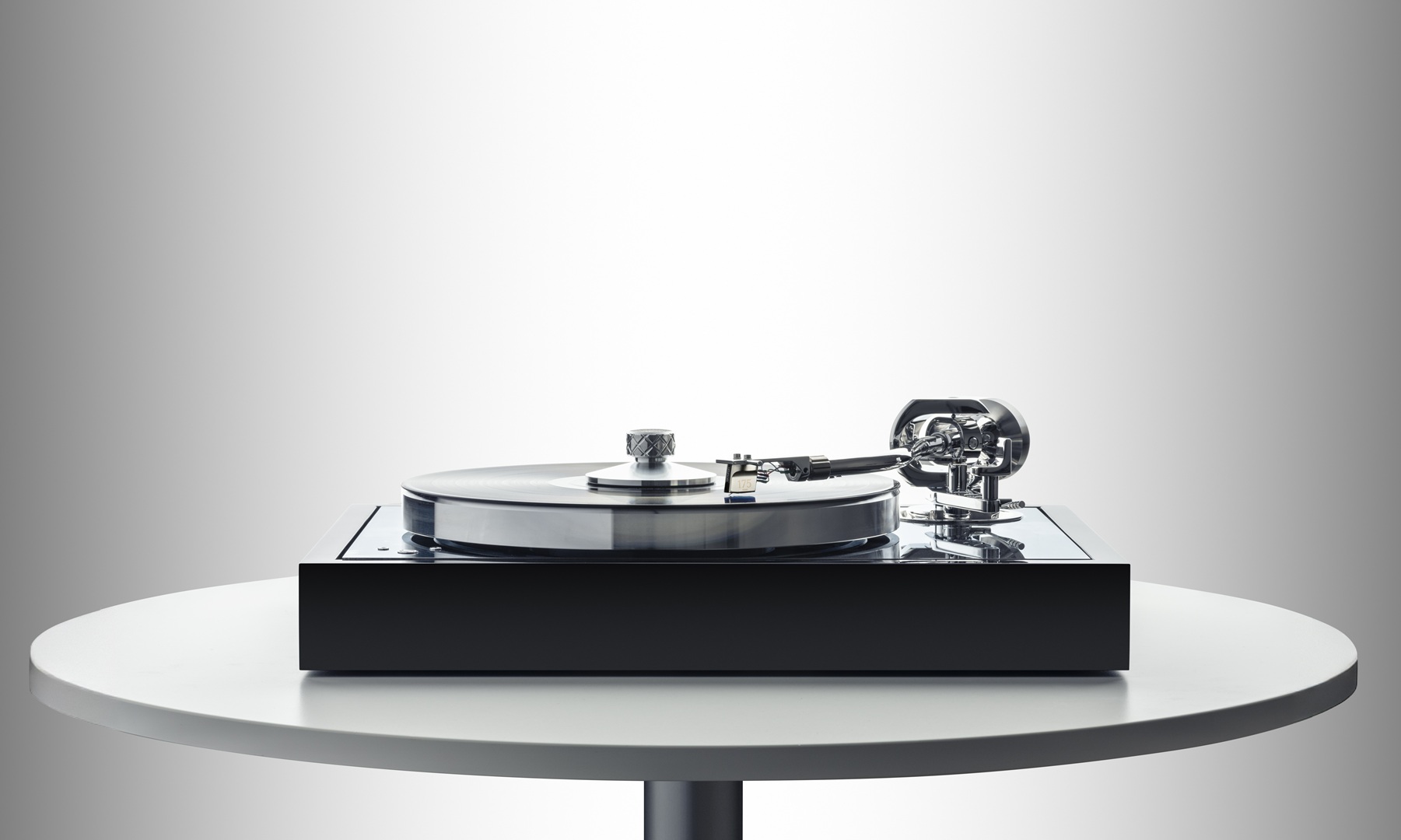
The platter is described as aluminium with a TPE damping ring, while an aluminium sub-platter adds mass to the drive. A floating sub-chassis is decoupled from the main plinth with damping balls. These features make the design more elaborate than a simple plinth-and-platter deck; the practical tradeoff is that cartridge setup, belt changes and the suspended chassis reward careful handling rather than casual plug-and-play use.
Cartridge choice changes the balanced-output story
The model has RCA and balanced XLR sockets and a 9-inch EVO 9 AS HG tonearm. The manufacturer manual is explicit that the XLR path needs an MC cartridge to take full advantage of the true-balanced connection. The current product page and information sheet do not name a single fitted cartridge for every package. Do not assume that an advertised “Classic Reference” includes an MC cartridge, or that the XLR route will be ready to use as balanced without checking the exact package.
The maker lists a Connect it Phono E RCA cable, Leather it mat, Clamp it record clamp, dust cover and power supply among the included accessories for the global model. Its product sheet describes 110/120 V or 230/240 V, 50/60 Hz power-connection options. These are model-level global documents; they do not tell us which adapter, cartridge or box a particular U.S. seller would supply. The turntable needs suitable phono amplification matched to the cartridge. A receiver’s line input alone is not enough; use a compatible PHONO input or an appropriate external phono stage.
Check the stated dimensions, not just the plinth width
Pro-Ject’s product page lists 460 × 131 × 351 mm with the lid closed. Its user guide lists the turntable itself at 462 × 138 × 335 mm and reports a 6 kg weight, while labeling 460 × 131 × 351 mm as the package dimensions. The maker does not reconcile why the product page uses the packaging-sized figures for the lid-closed deck. For a shelf or cabinet, treat those as conflicting manufacturer references, leave generous room for the lid and arm, and verify the exact version before planning a tight fit.
The page offers Acacia/Brass and Piano/Silver appearances. The photograph here is Pro-Ject’s official Piano/Silver version; it identifies the model’s appearance, not a local retail finish or included cartridge.
Where this model reference is useful
The Classic Reference is worth identifying if you want a model with documented 78-RPM belt capability, a substantial suspended architecture and both RCA and XLR outputs. The conditions matter: 78 playback needs the round belt change, the balanced XLR route needs an MC cartridge, and the exact cartridge package is not settled by the global page. The word “Reference” in its name should not be read as an independent performance ranking.
For a U.S. purchase, verify the exact model name, cartridge installed, whether the 78-RPM belt and global accessories are actually included, the power adapter supplied and the dimensions of the specific version. The current U.S. distributor directory identifies a distributor but does not publish a model-by-model inventory. That means U.S. availability and package contents remain unverified here—not that the turntable is unavailable. Until a precise local configuration is documented, this page is a global model reference rather than a shortlist entry.
Primary sources: Pro-Ject The Classic Reference page, product information, user guide and the official dealer directory.
Key specifications
Key details at a glance
| Drive | Belt drive |
|---|---|
| Documented record speeds | 33 RPM / 45 RPM / 78 RPM with the round belt fitted |
| 78-RPM play option | Yes |
| Built-in phono preamp | No |
| Manual tonearm cueing | Yes |
| Platter | 300 mm aluminium platter with internal tpe damping ring; aluminium sub-platter |
| Platter mat | Leather it mat listed by the global product sheet |
| Body width | 18.19 in |
| Body depth | 13.19 in |
| Body height | 5.43 in |
Use the exact model’s instructions for operating limits, supplied equipment and version differences.
Sources for this review
Sources for this assessment
Check your phono route before choosing
Check each model's documented input route, arm operation, and body limits. Use the finder to compare supported phono-system arrangements without assuming adjacent models share features.