
Your needs, this model
Does it fit your priorities?
What needs to be in the phono signal chain?
The exact user guide says to connect RCA output to a compatible PHONO input or add a separate phono amplifier stage. It does not document a built-in phono preamp; choose a matched phono stage for the exact cartridge.
Explore this need in the finder →Can the listed cartridge be assumed to work in true-balanced mini-XLR mode?
No. The current page and product sheet list Pick it PRO Balanced, but the user guide's cartridge data names Pick it S2 MM and says true-balanced XLR use requires an MC cartridge. Confirm the exact fitted cartridge before relying on mini-XLR as a balanced route.
Does the model document 78-RPM playback?
Yes. Pro-Ject lists 78 RPM and the model-specific setup guide includes a round belt. The manual-change procedure is a setup step, not the same as switching speed without changing the belt.
Explore this need in the finder →Pro-Ject’s X1 B is a separately named turntable in the manufacturer’s current global directory. The letter “B” is meaningful here: the maker documents both RCA output and a mini-XLR output for a true-balanced phono connection. This is not a generic X1 assessment, and specifications from another X1 package should not be substituted. The global model is well documented, but the current U.S. distributor page is a dealer directory rather than an itemized U.S. catalogue; no exact U.S. seller package or electrical adapter has been confirmed.
Manual belt drive with a 78-RPM setup change
The manufacturer lists 33, 45 and 78 RPM and describes electronic speed control. The model-specific setup guide shows the practical caveat: 78 RPM uses the supplied round belt, so the owner first changes belts and then selects the speed. That is more flexible than the documented 33/45-only Debut Carbon – The Original, but it is not a single-control three-speed arrangement in day-to-day use. The manual shows manual tonearm cueing and adjustment, rather than fully automatic start and return. The documents do not verify a record-end stop.
The documented construction includes a 1.5 kg acrylic platter and an 8.6-inch carbon/aluminium tonearm. Pro-Ject also describes a damped counterweight and an isolated motor. These are design features, not independent listening measurements. The practical attraction is the combination of manual setup with more elaborate arm, platter and connection options; the cost is greater need to confirm the cartridge and signal chain before using the balanced output.
RCA is straightforward; true-balanced use needs more checking
The user guide says the RCA output connects to an appropriate phono input and that a separate phono stage is needed if the amplifier has no compatible phono input. It also warns that the full true-balanced mini-XLR path needs an MC cartridge. Pro-Ject’s current product page lists a pre-adjusted Pick it PRO Balanced cartridge and separately describes upgrading to an MC cartridge for true-balanced use; a nearby tonearm paragraph refers generically to an X1 with a Pick it S2 MM. The linked X1B user guide’s cartridge specification section also lists the S2 MM. Those documents do not settle exactly which cartridge a particular X1 B package contains or reconcile the balanced-cartridge wording with the MC requirement. Treat the fitted cartridge as package-specific and do not assume the included cartridge is ready for balanced mini-XLR use without confirmation.
The information sheet lists a 15 V DC, 0.8 A supply, felt mat, dust cover and Connect it E phono cable. It describes the current global X1 B with a walnut veneer, high-gloss black, satin black and satin white finish; the page also displays an Eucalyptus finish. Those are global model and finish references, not proof of a U.S. package, stock or supply plug. A phono stage is not listed as built in.
Dimensions need version-specific confirmation
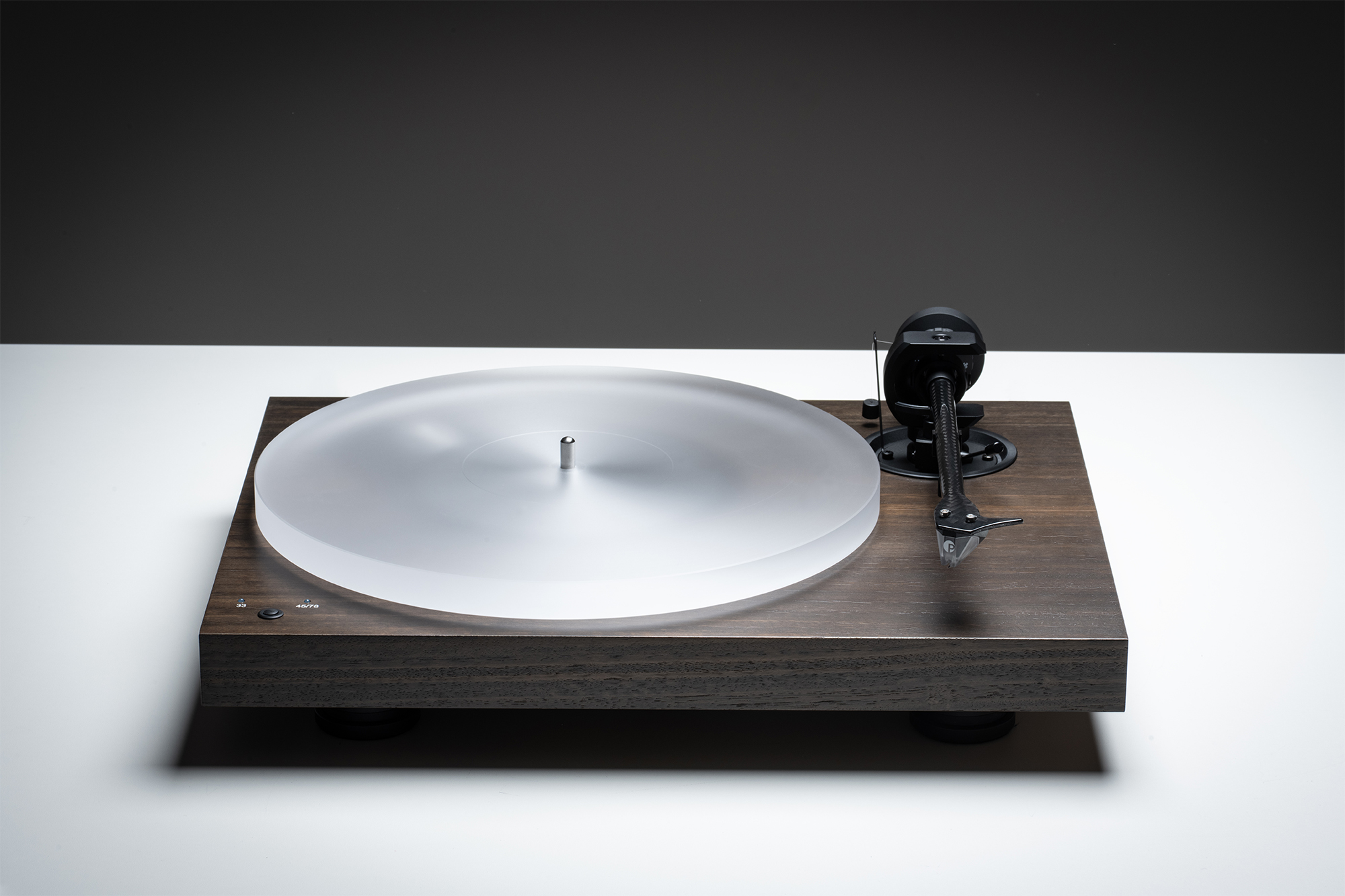
The information sheet gives 415 × 125 × 335 mm (W × H × D); the user guide gives 415 × 130 × 335 mm and lists 415 × 380 × 400 mm with the dust cover open. Both give a 7 kg net weight. The five-millimetre height difference is small but real in the published sources, so a close-fitting shelf should be planned from the specific version’s drawing or seller confirmation. The displayed image is Pro-Ject’s official Eucalyptus-finish X1 B and is included for model appearance only.
Who should use this reference?
This model assessment is useful for a reader comparing an RCA-only deck with one that has both RCA and mini-XLR sockets, or checking whether the 78-RPM belt arrangement is documented. The balanced path is not just a connector choice: the manufacturer manual requires an MC cartridge, and the exact included cartridge is unclear across the official page and manual. Anyone intending to use XLR should verify the cartridge and matching phono stage before treating the feature as ready to use.
There is no hands-on listening result here. Before matching a real offer, confirm that the name is X1 B, identify the exact cartridge, check the power adapter and supplied accessories, and leave clearance for the lid. Until a U.S. seller package and electrical version are tied to this model, it remains a global product reference outside the U.S. buying finder.
Primary sources: Pro-Ject X1 B page, product information, user guide, setup guide and the official dealer directory.
Key specifications
Key details at a glance
| Drive | Belt drive |
|---|---|
| Documented record speeds | 33 RPM / 45 RPM / 78 RPM with the round belt fitted |
| 78-RPM play option | Yes |
| Built-in phono preamp | No |
| Manual tonearm cueing | Yes |
| Platter | 20 mm, 1.5 kg acrylic platter |
| Platter mat | Felt mat listed in the product information sheet |
| Body width | 16.34 in |
| Body depth | 13.19 in |
| Body height | 4.92 in |
Use the exact model’s instructions for operating limits, supplied equipment and version differences.
Sources for this review
Sources for this assessment
Check your phono route before choosing
Check each model's documented input route, arm operation, and body limits. Use the finder to compare supported phono-system arrangements without assuming adjacent models share features.