
Your needs, this model
Does it fit your priorities?
Can the identified Rainier X2 B use an MM PHONO receiver input?
Yes, if that input is compatible with the supplied Rainier MM cartridge. Use the RCA/ground phono output; the turntable has no built-in phono stage.
Explore this need in the finder →What is the Rainier package's powered-speaker route?
Use the RCA/ground phono output through a compatible external MM phono stage and then into the powered speakers' line input.
Explore this need in the finder →Does the Rainier X2 B automate tonearm operation?
No. The model manual describes user-operated tonearm lift and power control. This Satin White Rainier version is a manual-cueing reference package, not an automatic-arm turntable.
Explore this need in the finder →This is an identification assessment for the Pro-Ject X2 B's U.S.-version Sumiko Rainier package, not a current shopping recommendation. Pro-Ject's 2024 Product Guide names an X2 B “Sumiko Rainier US version,” and a U.S. Crutchfield item page identifies a Satin White X2 B with a pre-mounted Rainier moving-magnet cartridge. That page now says the item is no longer available from that retailer. A different U.S.-facing Turntable Lab listing describes a Quintet Red MC package, so the two configurations must not be combined or treated as interchangeable.
Why the Rainier version is a separate system choice
The Rainier is a moving-magnet cartridge; the Quintet Red is moving-coil. That changes the phono-stage match. With this Rainier package, the regular RCA/ground phono output can connect to a compatible MM PHONO input on a receiver or integrated amp. If that input is absent, use a separate MM phono stage before powered speakers' LINE input or before an amplifier's LINE/AUX input for passive speakers. The X2 B does not include a built-in phono stage, and the RCA jacks are not line-level outputs.
The chassis also has a mini-XLR output. Do not infer that a Rainier-equipped table supplies the manufacturer's “True Balanced” route just because the socket is present. Pro-Ject's X2 B manual says its true-balanced connection requires an MC cartridge as well as the relevant separately chosen balanced cable and phono stage. Keep the included MM cartridge on the documented RCA/ground route unless the cartridge and entire balanced chain are deliberately changed to compatible parts.
Manual operation and speed changes
The common X2 B manual describes manual setup and cueing: the platter and belt need installation, the arm needs balancing and tracking-force adjustment, and the listener operates the tonearm lift and main power button. The X2 B is not a hands-off automatic arm. The manual does not specify a record-end auto-stop, so do not assume the platter will stop at the run-out groove. The manufacturer's listed speed set is 33, 45 and 78 RPM, but 78 requires fitting the supplied round belt instead of the flat belt. A separate 78-compatible cartridge or stylus remains a record-specific check; the included Rainier package is not described as a 78 stylus.
Pro-Ject lists a 30 mm, 2 kg acrylic platter, nine-inch carbon/aluminium sandwich tonearm, adjustable azimuth and VTA, and height-adjustable feet. These specifications explain what must be set up and matched. They do not claim a listening outcome or promise that every shelf is isolated from footfall or vibration.
White finish and physical-fit caution
The historical U.S. item page identifies the Satin White finish and a seller product number. Pro-Ject's general X2 B information gives 460 × 150 × 340 mm (W × H × D), approximately 18.11 × 5.91 × 13.39 inches. The Crutchfield listing gives a larger dimension with the cover down; these are not equivalent measurement contexts. Use them as a reason to check the exact unit, dust-cover position and shelf arrangement, not as a guarantee that a tight opening will work. Allow extra room for opening the cover, reaching the cue lift, handling records and routing the rear phono cable.
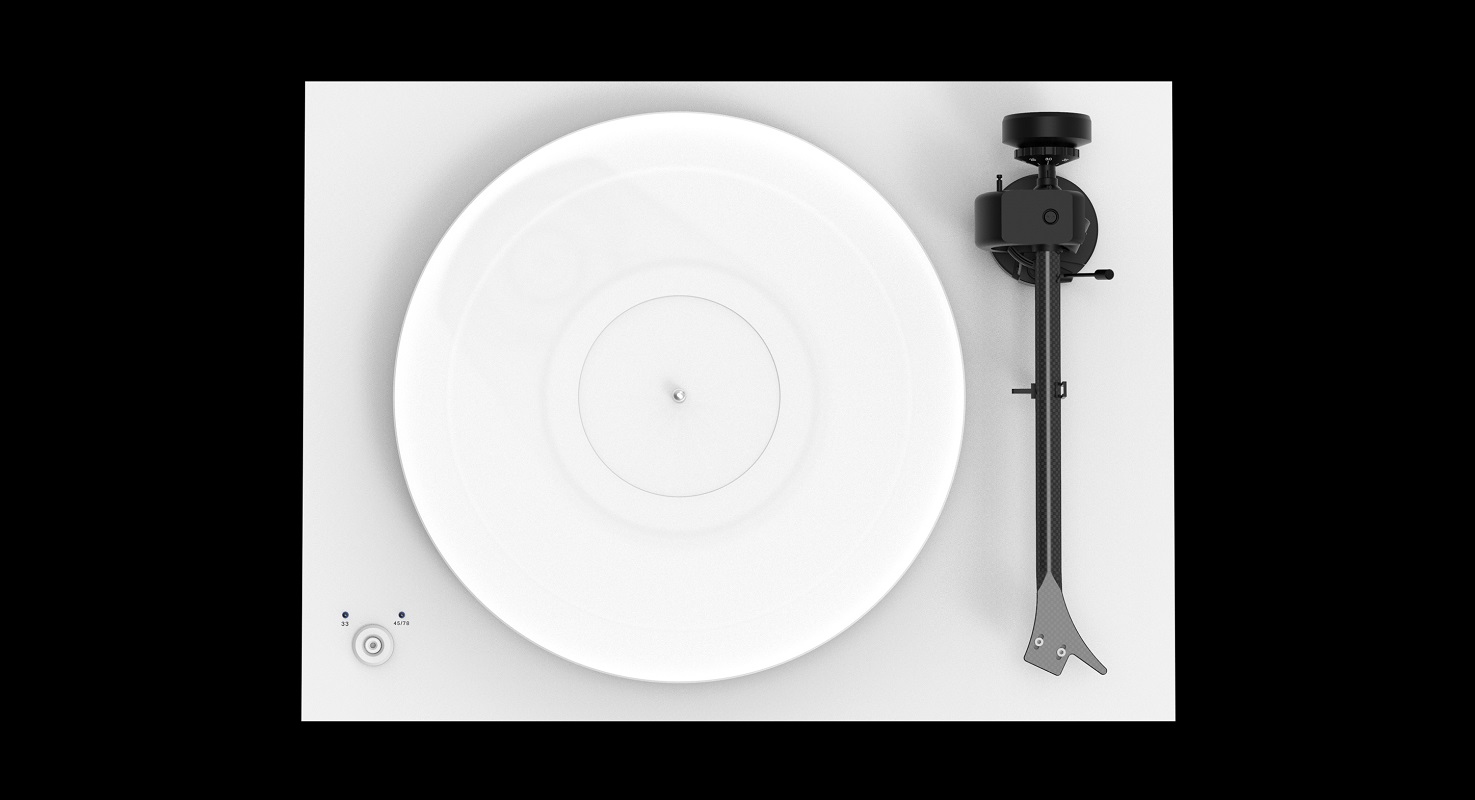
How to identify this version rather than the Quintet package
For an existing unit, compare the cartridge name and seller documentation, not just “X2 B” on the plinth. The U.S. item record assessed here described a pre-mounted Sumiko Rainier MM cartridge in Satin White. Turntable Lab's separate seller variant data identifies a White model barcode ending 3379 and describes the Ortofon Quintet Red MC configuration. The U.S. guide's Rainier note and the exact Crutchfield product record support a Rainier reference package, while the Quintet listing and current global model page support the separately assessed MC product. A retailer record cannot establish a different unit's box contents; check the label and cartridge on the particular turntable.
This evidence is useful for identifying a previous U.S. package or checking an existing item, but the exact Crutchfield record is no longer available there, so this page does not send buyers to a purchase route. It also does not assert the availability or discontinuation status of every X2 B Rainier unit elsewhere. The goal is to prevent a system mismatch: an MM Rainier and an MC Quintet Red need different phono-stage compatibility, even though they share the X2 B chassis and mini-XLR connection.
Key specifications
Key details at a glance
| Drive | Belt drive |
|---|---|
| Documented record speeds | 33 1/3 RPM / 45 RPM / 78 RPM after fitting the round belt |
| 78-RPM play option | Yes |
| Included cartridge | Pre-mounted sumiko rainier moving-magnet cartridge |
| Built-in phono preamp | No |
| Manual tonearm cueing | Yes |
| Platter | Acrylic, 30 mm thick and 2 kg |
| Platter mat | Felt |
| Body width | 18.11 in |
| Body depth | 13.39 in |
| Body height | 5.91 in |
Use the exact model’s instructions for operating limits, supplied equipment and version differences.
Sources for this review
Sources for this assessment

Check your phono route before choosing
Check each model's documented input route, arm operation, and body limits. Use the finder to compare supported phono-system arrangements without assuming adjacent models share features.