
Your needs, this model
Does it fit your priorities?
Does the exact Xtension 9 Evolution documentation agree on 78-RPM playback?
No. The 2023 Pro-Ject guide lists 33/45/78, but the current exact page, 2024 product sheet and model manual list 33/45 only. The manual does not resolve the difference, so confirm the exact unit's own 78-RPM instructions before relying on it.
Which cartridge and tonearm can be assumed for a specific Xtension 9 Evolution listing?
No single seller package can be assumed from the global page. Pro-Ject offers configuration choices, and its documents show cartridge-free and Pick it DS2 MC options; the official image also shows an S-shaped-arm option. Verify the exact unit.
Can it connect directly to powered speakers with only a LINE input?
No. The exact user guide requires a compatible PHONO input or an external cartridge-matched phono stage before a LINE input; the current sources do not document a built-in phono preamp.
Explore this need in the finder →How does speed selection work in the current exact-model sources?
The current product page and model guide describe electronic 33/45 selection. The model is manually cued; do not infer automatic arm return or a record-end platter stop.
Explore this need in the finder →Pro-Ject lists the Xtension 9 Evolution as a separate turntable in its current global directory and gives it a dedicated product page, exact product sheet and user guide. The name is not a shorthand for the Xtension 10 or Xtension 12, and its specifications should not be filled in from those larger models. The U.S. distributor directory identifies a distribution route but does not show an exact U.S. SKU, seller configuration or local offer. This page is therefore a source-based global reference, not a claim of U.S. availability.
The current 33/45 specification has a documented 78-RPM conflict
The current product page, the 2024 model information sheet and the model-specific manual describe electronic 33/45 RPM selection. The 2023 Pro-Ject product guide also lists an Xtension 9 Evolution with electronic 33/45/78 selection. Those are not the same published speed lists, and the current manual does not give a 78-RPM procedure. This assessment therefore treats 33 and 45 RPM as the supported current-page speeds and leaves 78 RPM unresolved. A buyer with 78s should ask for the exact configuration’s own instruction and belt details instead of assuming that the older guide describes every unit now offered.
The electronic selector is a meaningful difference from decks that require a belt to be repositioned for each speed, but it only addresses the speeds documented for this exact setup. The manual also shows manual arm operation and setup; it does not establish automatic start, return or record-end platter stop. A shopper who needs those conveniences should not infer them from the model’s high-end positioning.
Mass-loaded construction with a bonded vinyl playing surface
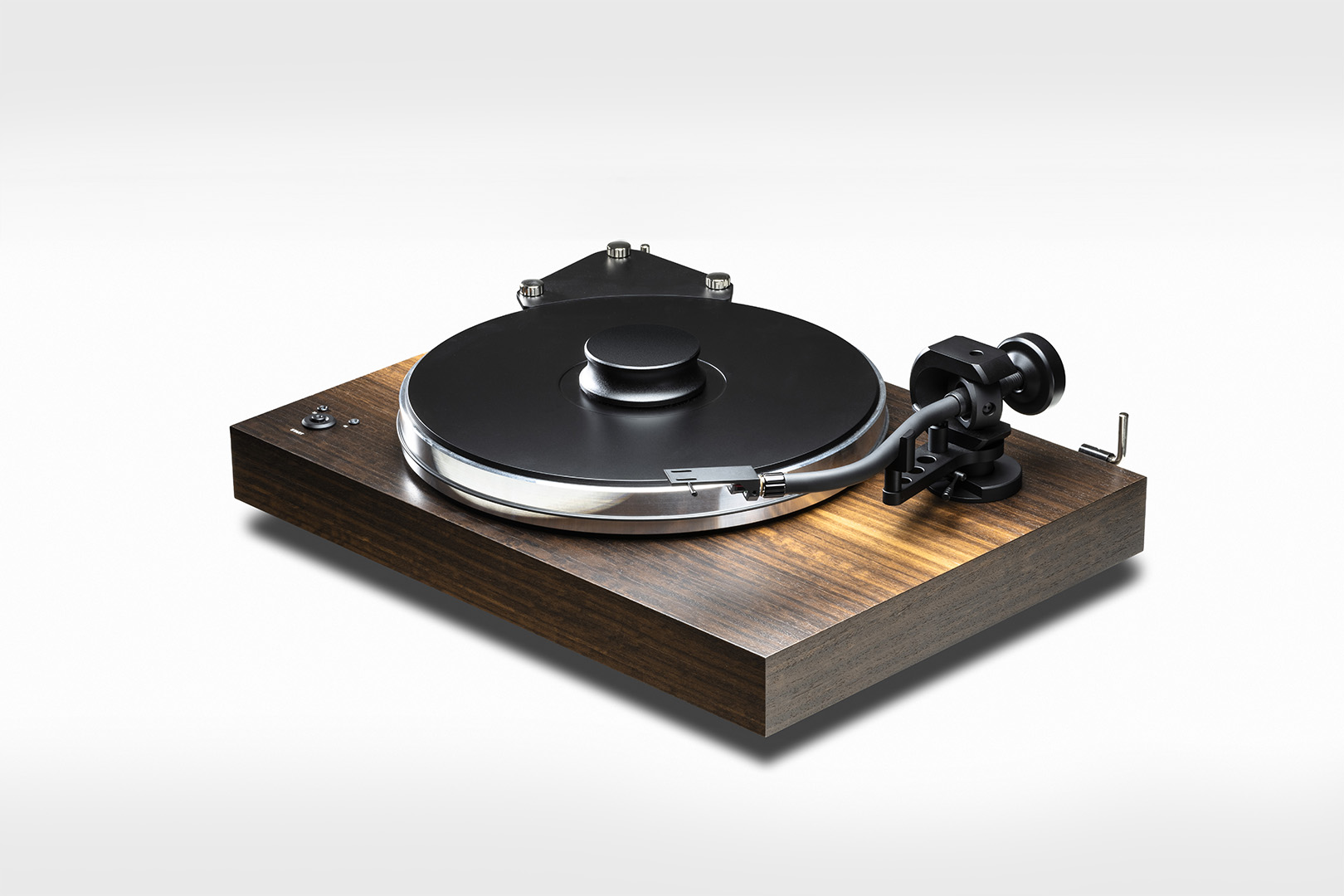
Pro-Ject’s current technical line specifies a 5.4 kg, 300 mm aluminium platter, a TPE damping ring and a vinyl layer on top. The bearing is an inverted ceramic-ball design with magnetic support, and the maker describes three magnetic feet as a suspension that decouples the deck from its support. The product sheet also describes a heavy CNC-machined MDF chassis. These are the documented design choices; they are not independent measurements of noise or sound quality.
That fixed top surface is a useful distinction from the X8 B, whose current product sheet describes a felt mat that can be exchanged. Pro-Ject says the Xtension 9’s bonded vinyl surface is not intended for the same mat-swapping approach. Its magnetic feet also differ from the height-adjustable, TPE-damped feet described for the X8 B. The difference matters most when comparing configuration and setup: the Xtension 9’s feet need careful positioning and leveling, while its platter surface is not a routine mat-selection point.
Tonearm and cartridge choices are not one universal carton
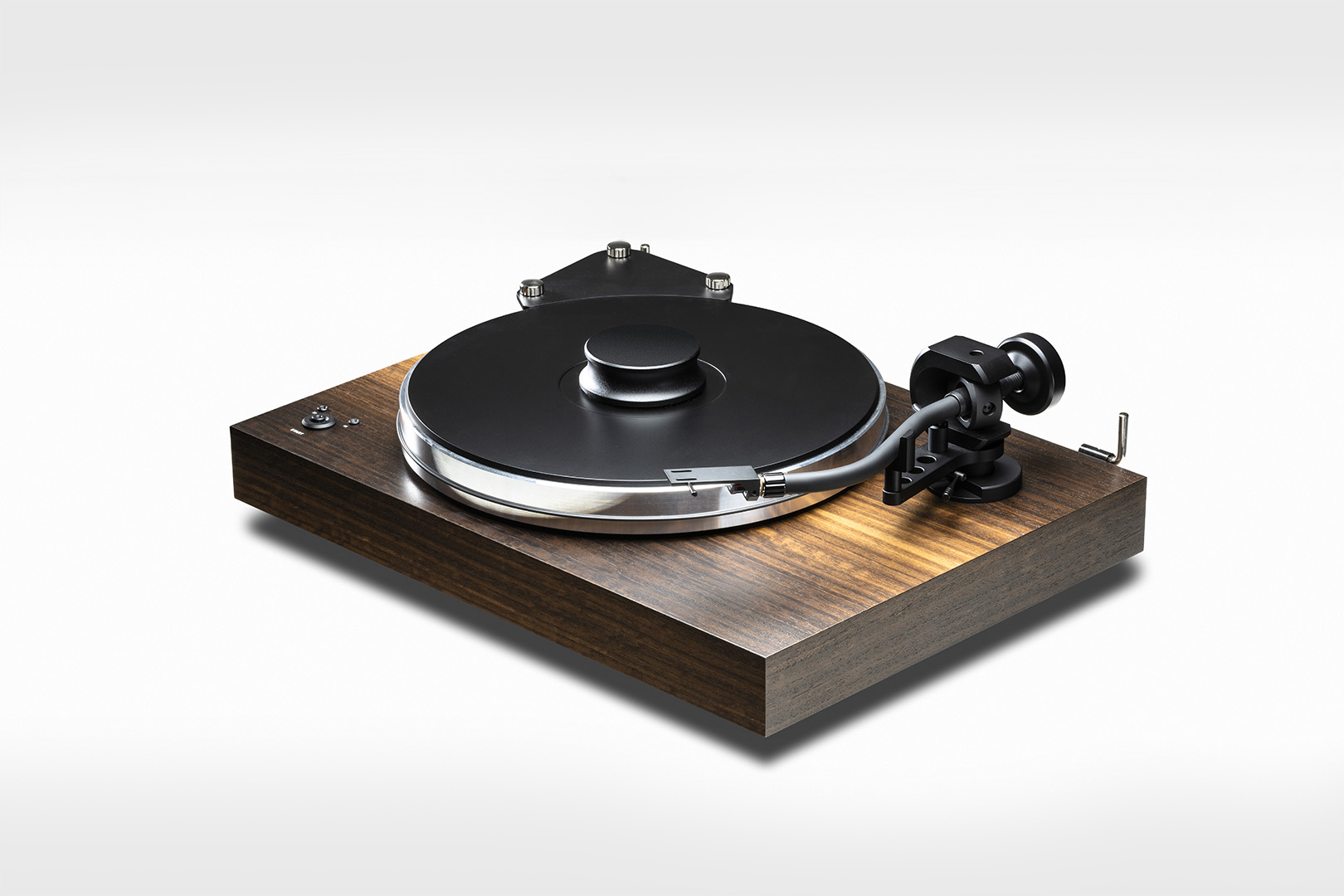
The current page’s technical line lists a 9-inch, one-piece carbon-fibre tonearm, but it also invites the buyer to configure the tonearm and cartridge. The 2024 product sheet discusses cartridge-free and Pick it DS2 MC versions; the older product guide likewise describes a DS2 MC configuration. The official photograph used here is specifically captioned by the manufacturer as an S-shaped tonearm option. These sources support the Xtension 9 Evolution identity, not a claim that every seller package contains the pictured arm or one fixed cartridge. Confirm the actual tonearm, cartridge and their adjustment instructions for the exact unit.
The included signal lead is listed as a DIN-to-RCA phono cable. As with other turntables that output at cartridge level, the manual directs the user to a compatible PHONO input or a separate phono stage before a line input; it does not describe an internal phono preamp. A cartridge-equipped MC version needs an appropriately matched stage, while a cartridge-free unit needs a separately selected cartridge as well. The chosen configuration has to be resolved before the system chain can be specified.
Power and space deserve a local check
The current page lists a 465 × 185 × 350 mm closed-lid body and 16 kg net weight. The older model manual gives a larger cover-open envelope, so a shelf needs room beyond the closed-body figure for the cover, arm movement, connections and safe support. Pro-Ject’s current page prints the external supply line as “220–240V/50Hz / 15V/1600mA DC,” while the older manual describes a universal supply with interchangeable country plugs. Those statements do not identify the adapter included with a particular U.S. seller package. Treat the exact local power supply as a confirmation point rather than assuming a plug or mains version from the global material.
There is a second source difference worth retaining: the 2023 product guide lists 18 kg and 78-RPM operation, whereas the current page, 2024 sheet and older model manual list 16 kg and only 33/45. No documentation reviewed explains whether the guide describes a different revision or package. The current dedicated materials are the clearest description of the global page’s present configuration, but the discrepancy should stay visible when a used or older unit is being identified.
What this assessment can and cannot settle
The Xtension 9 Evolution is a distinct whole turntable with a heavy damped platter, electronic speed selection and a configurable arm/cartridge path. Those facts help separate it from the X8 B and other Xtension models. They do not establish a current U.S. retail offer, exact package, cartridge, power adapter or the older 78-RPM description for a specific unit. No listening test, ownership, independent measurement or hands-on setup is claimed here. Use the exact model manual and ask a local dealer to identify the configuration before treating the global reference as a match for a specific listing.
Primary sources: Pro-Ject Xtension 9 Evolution product page, Xtension 9 Evolution product information, Xtension 9 Evolution manual, Pro-Ject product guide and the official dealer directory.
Key specifications
Key details at a glance
| Drive | Belt drive |
|---|---|
| Documented record speeds | 33 RPM / 45 RPM |
| Built-in phono preamp | No |
| Manual tonearm cueing | Yes |
| Platter | 5.4 kg precision-balanced aluminium platter with tpe damping ring and bonded vinyl surface |
| Body width | 18.31 in |
| Body depth | 13.78 in |
| Body height | 7.28 in |
Use the exact model’s instructions for operating limits, supplied equipment and version differences.
Sources for this review
Sources for this assessment
- Pro-Ject current global turntable directory
- Pro-Ject Xtension 9 Evolution product page
- Pro-Ject Xtension 9 Evolution product information
- Pro-Ject Xtension 9 Evolution user guide
- Pro-Ject Product Guide 2023, Xtension 9 Evolution entry
- Official Pro-Ject Xtension 9 Evolution image, S-shaped tonearm option
- Pro-Ject official U.S. distributor directory
Check your phono route before choosing
Check each model's documented input route, arm operation, and body limits. Use the finder to compare supported phono-system arrangements without assuming adjacent models share features.