
Your needs, this model
Does it fit your priorities?
Does Hotaru include a phono preamp and speakers?
Yes. The official AT-FTT manual and product information describe an integrated phono equalizer, amplifier and speakers. Its RCA output is already-equalized LINE level, not PHONO; a PHONO receiver input is not the documented external route.
Explore this need in the finder →Is Hotaru fully automatic or does it stop at the record end?
No automatic arm start, return or platter stop is documented. Select 33 1/3 or 45 RPM, move and lower the arm manually, then raise and return it and turn the control knob OFF.
Explore this need in the finder →What shelf size does Hotaru need?
The manufacturer lists a 430 x 430 mm body, about 16.93 x 16.93 inches wide and deep. It first passes the 0.5-inch questionnaire steps at a 17-inch cap in each direction; this is body size only, so leave additional clearance.
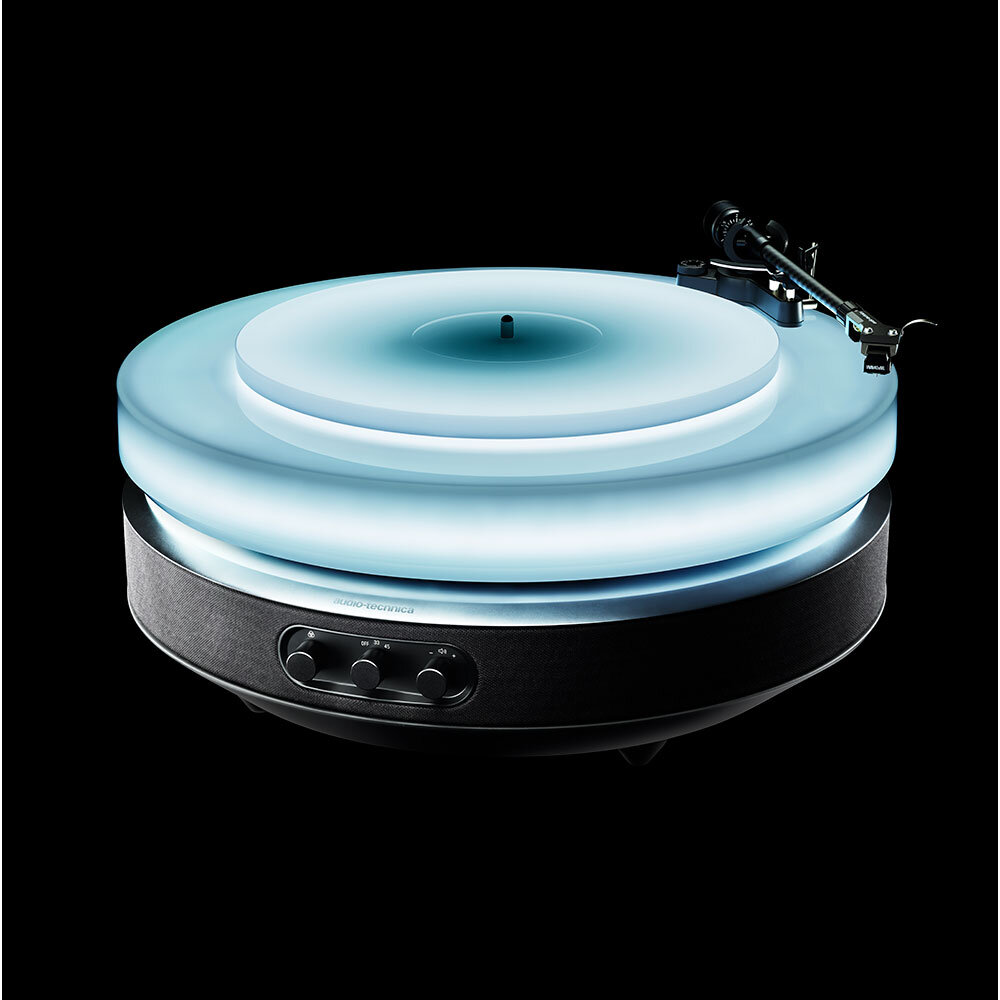
Explore this need in the finder →Hotaru is the Audio-Technica AT-FTT: a turntable, phono equalizer, amplifier and speakers combined in one substantial design. Its floating acrylic platter and synchronized lighting make the product unlike a conventional deck, but the buying decision is still about signal path, arm routine, placement and what arrives in the box. This assessment uses the manufacturer’s English manual and official Global/Japan product information; it is not a listening test or an ownership report. The U.S. directory lists Hotaru, but exact U.S. package details and present availability are not established here.
One integrated listening system, not a separate bundle
The internal system can play records through its built-in speakers and amplifier without a receiver or separate speaker pair. The AT-FTT also has a built-in phono equalizer with MM and MC settings, and the maker lists 36 dB MM and 56 dB MC gain. The supplied AT-VM740xML is a VM cartridge, so the manual says to use the MM position. RCA stereo outputs provide already-equalized LINE level; the documentation does not describe a PHONO-level output. That distinction matters: for external analog playback, use an amplifier/pre-main amplifier LINE input, not a receiver’s PHONO input and not another separate phono stage.
Powered speakers with a compatible line input are another documented route. They need their own volume control: the manual says Hotaru’s knob controls its built-in speakers and linked subwoofer, but not external speakers. An external RCA cable is not included. If adding a powered subwoofer to Hotaru’s internal-speaker route, use the dedicated subwoofer output and check the manual’s low-pass guidance. If external speakers are connected through an amplifier, the manual instead directs the subwoofer to that amplifier’s LINE output to avoid output timing or phase mismatch. Do not assume a single connection diagram covers both setups.
Manual cueing and stopping are the tradeoff
Despite the integrated electronics, playback is hands-on. Choose 33⅓ or 45 RPM, position and lower the tonearm with the lift control, and raise and return it when finished before turning the control knob to OFF. The English manual does not document automatic start, automatic arm return or an end-of-record platter stop. A separate 30-minute idle standby behavior is not auto-stop. The product supports two speeds, not 78 RPM. If you require fully automatic start/return or a documented platter stop, Hotaru does not meet that requirement.
The tonearm is a static-balanced straight carbon-fiber design. Audio-Technica supplies the AT-VM740xML cartridge with a 2.2 × 0.12 mil nude Microlinear stylus and lists the AT-VMN40xML BK as a replacement stylus sold separately. The maker’s manual gives 2.0 g as the standard tracking force and a 300-hour rule of thumb for stylus replacement. Those are published specifications, not a prediction of how long a particular listener’s stylus or records will last. The manual also warns against operating this cartridge as a DJ cartridge or subjecting it to damaging handling.
Plan for a 17-inch square body and magnetic safety
The manufacturer lists the body at 430 × 430 × 235 mm (about 16.93 × 16.93 × 9.25 inches) and approximately 13.6 kg. The questionnaire’s half-inch steps therefore first include it at a 17-inch maximum for both width and depth. That is body size, not a complete shelf plan: allow access to the manual arm, controls, rear cables and room around the unit, and use a stable surface suited to its weight. Its conspicuous magnetic floating structure brings an important safety limit. Audio-Technica warns users to keep it away from magnetic objects, not use it within 15 cm (5.9 inches) of pacemakers, and avoid nearby medical equipment and automatic control devices such as automatic doors and fire alarms. Follow the manual rather than treating the floating platter as merely decorative.
Design and light are part of the product, not proof of sound quality
The official product information describes an acrylic platter, aluminum enclosure, brass feet and a hidden-belt sub-platter drive. It also describes synchronized illumination with 20 color palettes and basic, gradient and link modes. These details explain why Hotaru occupies a different niche from a basic entry-level deck; they do not independently establish that it will sound better in a particular room. Published speaker specifications list two 63.5 mm drivers, two 31 mm tweeters and 50 W maximum output. Compare the integrated-speaker arrangement with your own listening environment, and use the line output if your existing system is the better fit.
Verify the exact offer before treating it as available
Audio-Technica’s Japan page describes a worldwide production limit of 1,000 and marks the product production-complete, while its U.S. turntable directory has a Hotaru card. Those facts are not the same as proof of current U.S. stock or a specific U.S.-market box. The manufacturer lists a 100–240 V, 50/60 Hz requirement and a 12 V adapter, but the manual cautions that the correct cable and plug depend on the country of sale. Before buying, confirm the exact model code AT-FTT, product condition, power adapter and cable, supplied headshell/cartridge, platter, counterweight, 45 RPM adapter, gloves and any warranty or service coverage. The manual’s external-speaker RCA cable is not supplied. No current price, stock, seller condition, ASIN or customer rating is asserted here.
Who should consider Hotaru?
Consider it if a single all-in-one turntable with built-in speakers, a selectable phono stage, external line outputs and music-linked lighting fits your system and design priorities—and you accept manual arm handling, no end-stop, a roughly 17-inch-square body and careful power/safety checks. Pause if your essential need is fully automatic operation, a compact shelf footprint, a raw PHONO output, 78 RPM or a confirmed in-stock U.S. package. Its best-supported distinction is the way turntable, speakers, amplifier and lighting are integrated, not a promise that every buyer will prefer its sound.
Key specifications
Key details at a glance
| Drive | Belt drive |
|---|---|
| Documented record speeds | 33 1/3 RPM / 45 RPM |
| 78-RPM play option | No |
| Built-in phono preamp | Yes |
| Manual tonearm cueing | Yes |
| End-of-record platter stop | No |
| Built-in speakers | Yes |
| Platter | Acrylic |
| Body width | 16.93 in |
| Body depth | 16.93 in |
| Body height | 9.25 in |
Use the exact model’s instructions for operating limits, supplied equipment and version differences.
Sources for this review
Sources for this assessment
Check your phono route before choosing
Check each model's documented input route, arm operation, and body limits. Use the finder to compare supported phono-system arrangements without assuming adjacent models share features.