
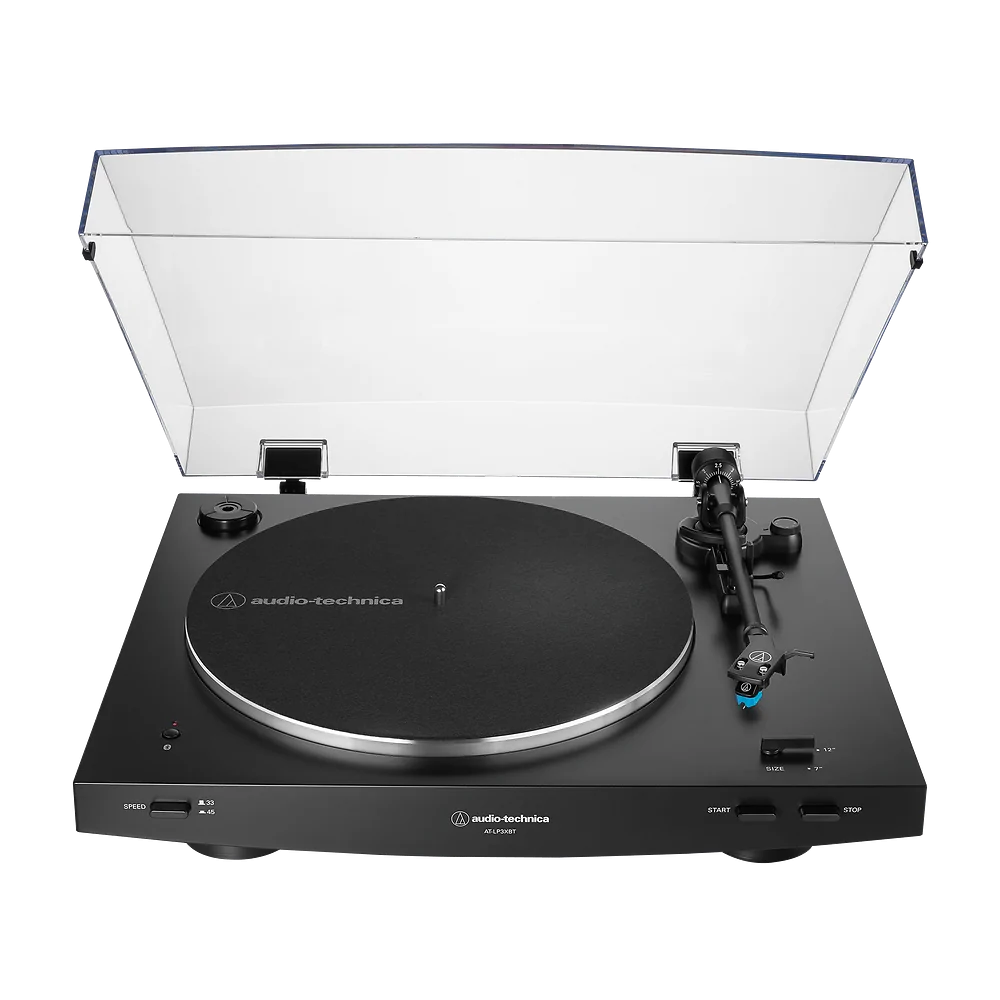
Your needs, this model
Does it fit your priorities?
Does the AT-LP3XBT offer automatic play and manual cueing?
Yes. START initiates automatic playback and the arm returns at record end; the manual also shows manual lift-lever cueing. The owner must follow the correct record-size and speed settings.
Explore this need in the finder →Can the AT-LP3XBT work with both a receiver PHONO input and Bluetooth?
Yes, as separate documented routes. Select PHONO for a compatible receiver PHONO input, or LINE for Bluetooth, powered speakers or an amplifier line input. Check the receiving Bluetooth device rather than assuming codec compatibility.
Explore this need in the finder →Can I change the AT-LP3XBT cartridge?
Yes. The AT-HS3 headshell detaches and the installed AT-VM95C can be removed. A replacement cartridge requires correct overhang, arm balance and tracking-force adjustment; stylus-only replacement is the simpler service step.
Explore this need in the finder →The AT-LP3XBT is the largest and most configurable of the three automatic Audio-Technica decks assessed here. The reviewed U.S. black edition combines Bluetooth with analog RCA output, a built-in switchable phono stage and a removable AT-HS3 headshell carrying an AT-VM95C cartridge. That final point separates it from the LP70X and LP70XBT: this is not merely a fixed cartridge body with a replaceable stylus. This assessment is based on the manufacturer's U.S. product page and model-specific manual, not personal use or sound testing.
Automatic start and return, with manual cueing available
The LP3XBT is described as fully automatic. Its START control begins playback and the end-of-record routine lifts and returns the arm. The user manual also provides a manual-cueing procedure using the tonearm lift lever, so the automatic mechanism does not prevent deliberate hand placement. This is different from a manually operated deck with only a platter stop: the LP3XBT automates the main start/end sequence. Unlike the LP70X/LP70XBT manuals, the LP3XBT manual does not include the same explicit caution that automatic handling may fail on some record starts or ends, but it remains sensible to observe unfamiliar discs and follow its STOP procedure if the arm does not return.
Two speeds are listed: 33⅓ and 45 RPM. There is no documented 78-RPM mode. The supplied cartridge is the AT-VM95C, but the removable universal headshell means the cartridge itself can be changed. Audio-Technica's manual makes clear that a cartridge replacement entails rechecking overhang and rebalancing the arm and tracking force. The included cartridge's nominal tracking force is 2.0 g. The VM95 stylus family offers an easier stylus-only upgrade, but a full cartridge swap is a more involved adjustment rather than a plug-in sound upgrade.
Bluetooth and analog connections
The transmitter uses Bluetooth 5.2 with A2DP and the manual lists SBC and Qualcomm aptX-family codecs. Pairing is separate from the wired connection and the maker does not guarantee operation of every third-party Bluetooth device. Check the receiving device's codec/profile compatibility and pairing behavior; a Bluetooth logo alone is not proof of a particular end-to-end codec path.
For wired use, the built-in preamp is switchable. PHONO output goes to a compatible receiver or amplifier PHONO input, with the ground lead connected as its manual directs. LINE output goes to powered speakers or the line input of an amplifier that drives passive speakers. The table model is not itself a speaker or power amplifier. This gives the LP3XBT an analog fallback if wireless pairing is inconvenient, but the correct selector setting still matters. Do not send LINE output into a PHONO input. The page's nominal figures are 4.0 mV phono, 252 mV line and 36 dB preamp gain; these are published specifications, not independent measurements.
Why the larger platform may matter
Audio-Technica lists the body at 17 × 15 × 5 inches and about 11 pounds. That is a clear step up in shelf depth from the 16 × 13-inch LP70 models, but dimensions still omit cover movement, cable bends, controls and room to cue safely. Measure the shelf with those clearances in mind before choosing the LP3XBT simply for its removable headshell. Its supplied aluminum platter and felt mat, removable hinged cover, 45 adapter, RCA cable and power adapter are part of the documented package; verify the exact offer's included parts, especially if buying a used unit.
Setup is more than unpacking and pressing START. The manual instructs the owner to assemble platter/belt, install the counterweight and headshell, balance the tonearm, set tracking force and choose PHONO or LINE for the connected equipment. Changing cartridge or headshell means revisiting overhang and arm balance. For an automatic turntable that is expected to stay with its original cartridge, that extra capability can remain unused; for a buyer planning future cartridge changes, it is a useful distinction rather than a claim of better sound.
How it compares with LP70X and LP70XBT
All three offer automatic start/end operation, a switchable built-in stage, two speeds, a 45 adapter and a felt-covered aluminum platter. The LP70X is the compact wired option, while the LP70XBT adds wireless playback without changing its fixed-body cartridge. The LP3XBT adds Bluetooth too, but its more substantial case and removable headshell change the service and upgrade path. If a shallow shelf or minimal cartridge setup is the priority, the LP70XBT's smaller listed body may be the better fit; if cartridge interchangeability is essential, the LP3XBT is the documented choice among these models.
Shortlist the LP3XBT when full automation, both wireless and analog connections, and an interchangeable cartridge mount all matter—and the deeper 15-inch body plus setup work are acceptable. No hands-on performance comparison or unverified availability claim is intended.
Primary references: Audio-Technica AT-LP3XBT U.S. product page and AT-LP3XBT U.S. user manual.
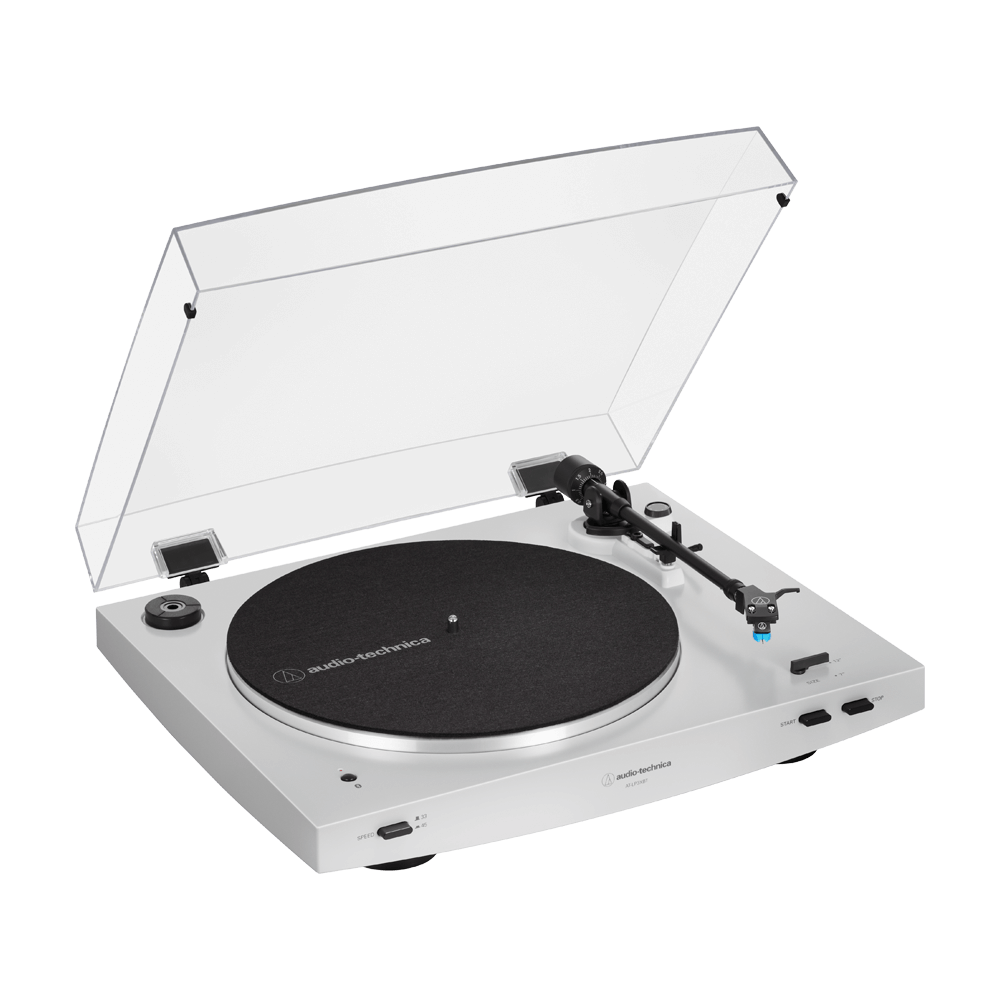
White finish is a separate exact edition
The official U.S. product selector lists AT-LP3XBT-WH alongside the reviewed black BK. That page groups the options under one model feature and specification set, while the English manual covers the LP3XBT operating configuration; the reviewed sources do not identify a function or package change attached to the WH color code. The white image below is the exact manufacturer gallery edition, not a recolored BK photograph. The registered buying-details link on this reviewed page is for BK; it does not select WH. Confirm the WH suffix and supplied package on the exact listing; an image establishes finish, not current stock or a separate retail barcode.
Key specifications
Key details at a glance
| Drive | Belt drive |
|---|---|
| Documented record speeds | 33 1/3 RPM / 45 RPM |
| 78-RPM play option | No |
| Included cartridge | Audio-technica at-vm95c moving-magnet cartridge mounted to at-hs3 bk headshell |
| Built-in phono preamp | Yes |
| Manual tonearm cueing | Yes |
| End-of-record platter stop | Yes |
| Removable cartridge body or headshell | Yes |
| Bluetooth audio transmission | Yes |
| Platter | Die-cast aluminum |
| Platter mat | Felt |
| Body width | 17 in |
| Body depth | 15 in |
| Body height | 5 in |
| Published phono output | 4 mV |
Use the exact model’s instructions for operating limits, supplied equipment and version differences.
Sources for this review
Sources for this assessment
Check your phono route before choosing
Check each model's documented input route, arm operation, and body limits. Use the finder to compare supported phono-system arrangements without assuming adjacent models share features.