
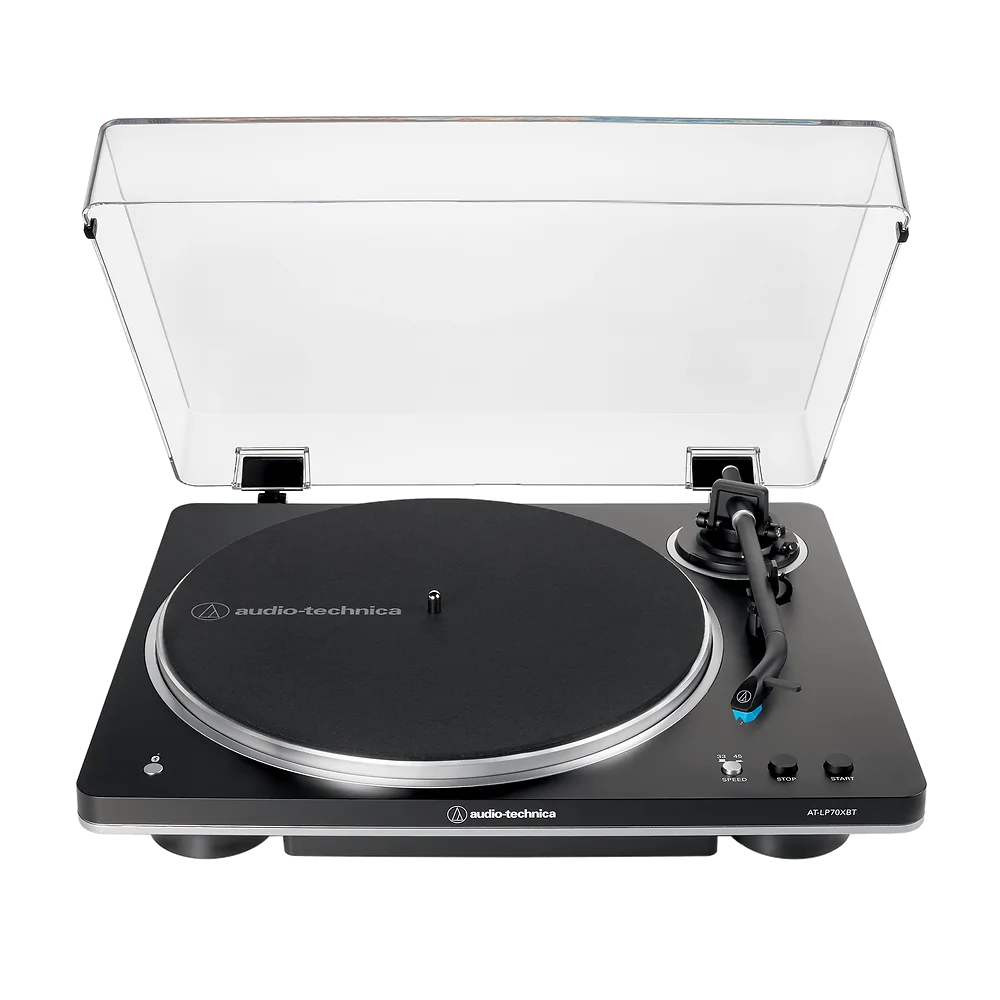
Your needs, this model
Does it fit your priorities?
Does the AT-LP70XBT return its arm automatically, and can I cue it by hand?
Yes. Automatic START and arm lift/return are documented; manual cueing with the lift lever is also possible. The manual cautions that some record starts or ends may not operate as expected.
Explore this need in the finder →Does Bluetooth mean I do not need to check the wired output?
No. Bluetooth uses LINE mode, while analog receiver-PHONO use needs PHONO mode. The manual notes that a connected Bluetooth device and wired outputs can both play, so turn on only the intended listening device and confirm the receiver input.
Explore this need in the finder →Can I swap the AT-LP70XBT cartridge for a different one?
No removable cartridge body is documented; the installed AT-VM95C is fixed. You can replace its stylus with compatible VM95-series styli, but cartridge changes are not the LP70XBT upgrade path.
Explore this need in the finder →The AT-LP70XBT is the wireless version of Audio-Technica's compact LP70X platform, but Bluetooth is only one part of its system flexibility. The reviewed U.S. Black/Silver edition also has a switchable phono/line output, automatic start and arm return, and a fixed-body AT-VM95C cartridge whose stylus can be replaced. This research-based assessment is grounded in Audio-Technica's U.S. product page and model manual; it does not report personal listening, tests or ownership.
Wireless is an option, not a complete stereo
The Bluetooth transmitter sends audio to a compatible receiver such as wireless speakers or headphones. The manual identifies Bluetooth 5.2, A2DP and SBC, Qualcomm aptX and aptX Adaptive codecs. Those codec names describe supported transmission formats, not a promise that every headphone or speaker will pair or use a particular codec. Confirm the receiving device's profile and codec support, pairing behavior and whether it accepts a turntable's Bluetooth connection before buying on wireless convenience alone.
The wired route remains available through the RCA output. The built-in phono selector should be set to LINE for Bluetooth operation, and it can feed a powered-speaker line input or an amplifier's AUX/LINE input. For a receiver PHONO input or separate phono preamp, use the PHONO output instead. A receiver PHONO stage and turntable LINE stage should not be cascaded. One practical manual detail is easy to miss: when Bluetooth is connected, audio is also sent to wired equipment attached to the RCA output. Audio-Technica advises turning on only the device you want to use, so check the system's input and power state rather than assuming wireless mode mutes every cable.
Automatic operation and record edge cases
Press START and the mechanism begins playback; when the arm reaches the end area it is designed to lift and return to the rest. Manual cueing is also described: the lift lever can place the arm over a selected groove. That makes this model suitable for a listener who needs automatic handling but sometimes wants to cue manually. The qualification is significant: the manual says automatic operation may not work well at the start or end of some records. Users should remain attentive rather than treat arm automation as a substitute for checking a record's unusual lead-in or runout.
At two speeds (33⅓ and 45 RPM), the LP70XBT is not a 78-RPM deck. It also is not a record changer or a speaker system. Unlike the manual-only Fluance options in this library, its end behavior includes lift and return; unlike a basic auto-stop, its START button initiates the playing cycle. All three functions are documented, but the maker's caveat still applies to difficult records.
What can and cannot be changed
The AT-VM95C cartridge body is built into the J-shaped tonearm and is explicitly listed as non-removable. Its stylus is replaceable, including with other compatible VM95-family choices. Do not confuse this stylus-upgrade path with a standard headshell swap. The AT-LP3XBT is the alternative among these three if changing cartridges is part of the plan: its detachable AT-HS3 headshell accepts a removable cartridge, but a new cartridge needs correct alignment, overhang and tracking-force adjustment. The LP70XBT is less configurable at the cartridge mount; its more useful distinction over the non-Bluetooth LP70X is wireless output.
Space, setup and fit checks
The listed body is 16 × 13 × 4.3 inches, about 6.4 pounds. Add shelf clearance for the hinged dust cover, RCA and power leads and access to controls; the body rectangle is not an operating envelope. The listed package includes a die-cast aluminum platter, felt mat, belt, removable cover and hinges, 45 RPM adapter, RCA cable with ground and AC adapter. Setup requires fitting the platter and belt, then connecting the selected output to the correct input. Do not plug LINE output into a receiver's PHONO input.
Audio-Technica notes that the supplied adapter may differ by country, so inspect the actual adapter label and confirm the exact North American edition when considering a retail package. Bluetooth pairing is an additional setup step and depends on the receiving equipment; a wired fallback is built in. That dual path can be useful when a household has both wireless headphones and powered speakers, but the manual's simultaneous-output note makes output-device selection worth checking.
Shortlist decision
Choose the LP70XBT when an automatic two-speed deck with a built-in stage and Bluetooth is the combination you actually need, and when its fixed cartridge body is acceptable. Choose the LP70X if the wireless path adds no value and you want the same general LP70 operation without that radio feature. Choose the LP3XBT if cartridge interchangeability is more important than the LP70's shorter listed footprint. The documents support those use-case distinctions; they do not establish a sound-quality ranking.
Primary references: Audio-Technica AT-LP70XBT U.S. product page and AT-LP70XBT user manual.
Finish options checked separately
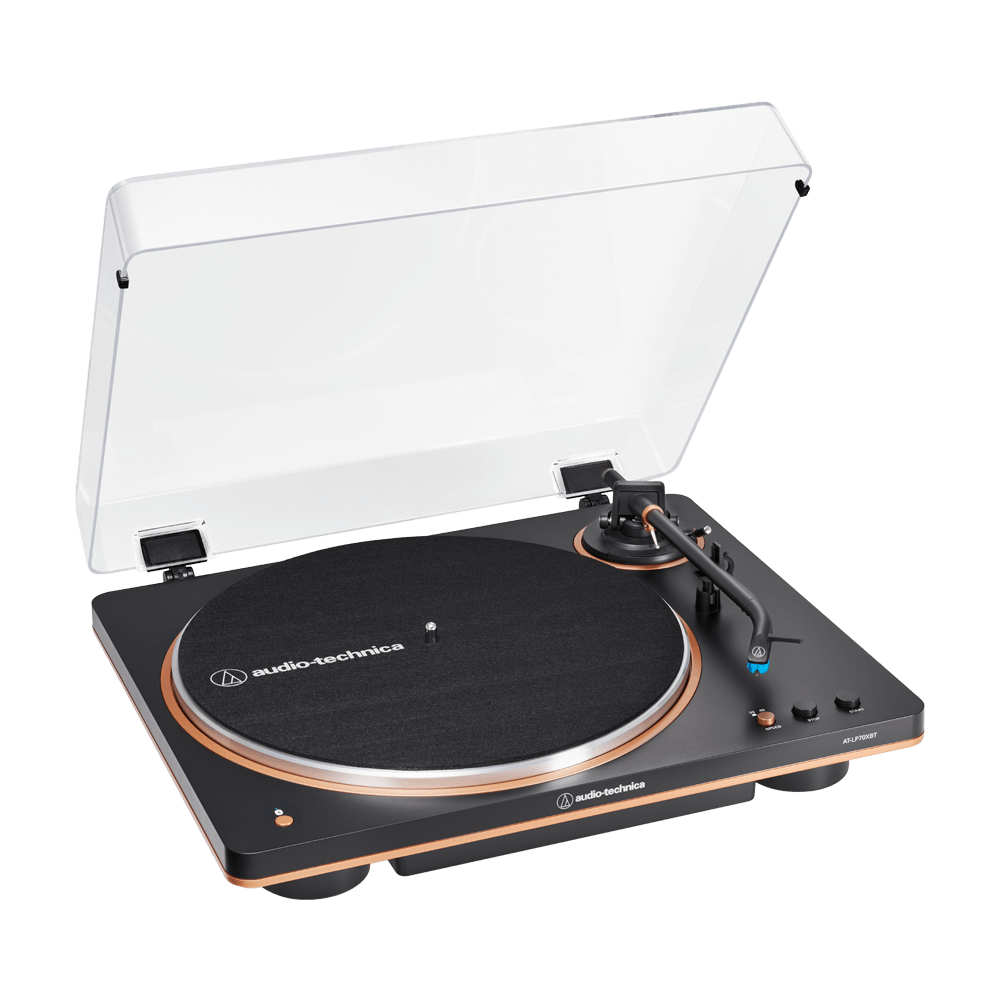
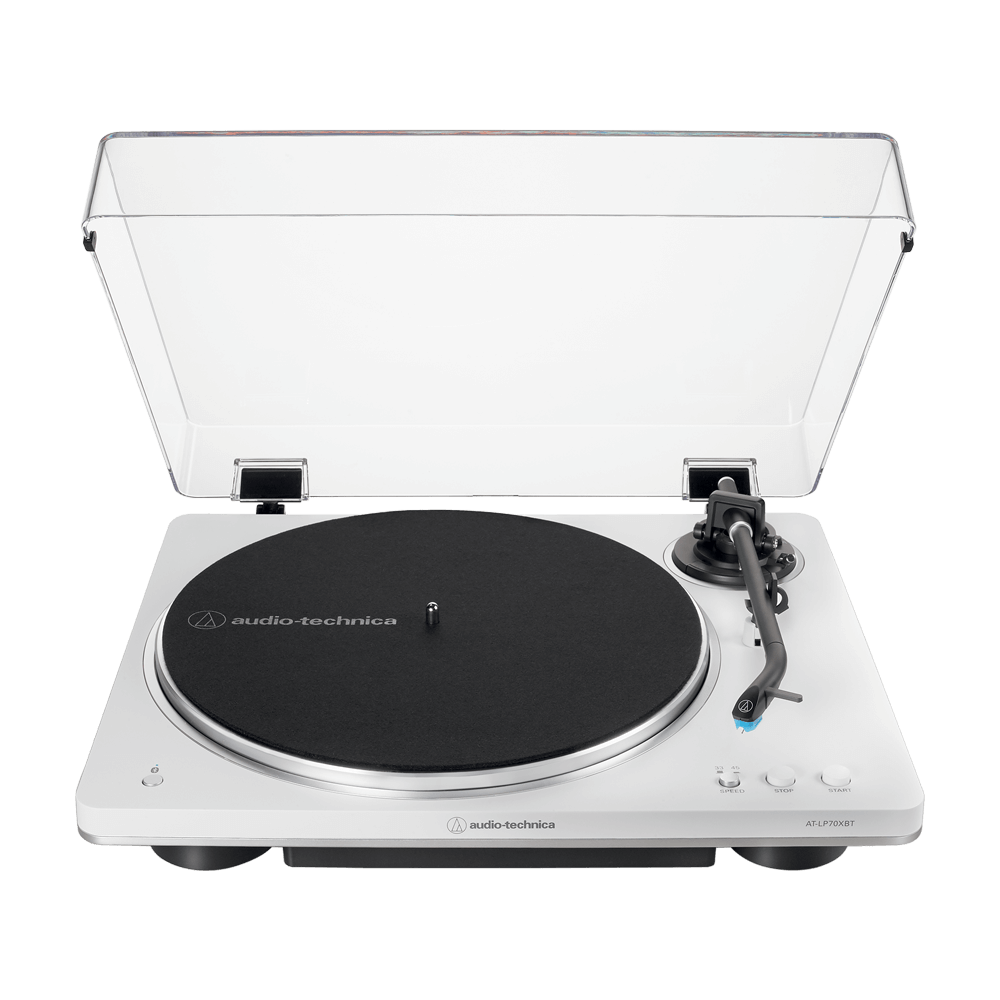
The official U.S. selector lists the reviewed Black/Silver BS beside Black/Bronze BZ and White/Silver WS. The U.S. page groups these options under one feature and specification set, and the shared LP70XBT manual describes one operating configuration; the reviewed sources do not establish a different mechanism or supplied functional package for either color code. Treat BZ and WS as distinct finish identities under this assessment, not as independently tested performance variants. The registered buying-details link on this reviewed page is for BS; it does not select the BZ or WS edition. Match the exact suffix to any order listing and confirm the physical finish; the images below establish appearance only, not stock or retailer SKU.
Key specifications
Key details at a glance
| Drive | Belt drive |
|---|---|
| Documented record speeds | 33 1/3 RPM / 45 RPM |
| 78-RPM play option | No |
| Included cartridge | Audio-technica at-vm95c dual moving magnet cartridge with 0.6 mil bonded conical stylus |
| Built-in phono preamp | Yes |
| Manual tonearm cueing | Yes |
| End-of-record platter stop | Yes |
| Removable cartridge body or headshell | No |
| Bluetooth audio transmission | Yes |
| Platter | Die-cast aluminum |
| Platter mat | Felt |
| Body width | 16 in |
| Body depth | 13 in |
| Body height | 4.3 in |
| Published phono output | 4 mV |
Use the exact model’s instructions for operating limits, supplied equipment and version differences.
Sources for this review
Sources for this assessment
Check your phono route before choosing
Check each model's documented input route, arm operation, and body limits. Use the finder to compare supported phono-system arrangements without assuming adjacent models share features.