
Your needs, this model
Does it fit your priorities?
Can the AT-LP7X connect directly to powered speakers?
Yes, if the speakers have a compatible line input and built-in amplification. Set the turntable's preamp selector to LINE and connect its RCA output to the speaker line input; the manual notes that some active speakers may need a conversion cable. The speakers are not included.
Explore this need in the finder →Can I use the AT-LP7X with a receiver that has a PHONO input?
Yes. Switch the turntable output to PHONO, connect the RCA cable and ground lead to the receiver's PHONO input and ground terminal, and let the receiver provide the phono stage. Do not select LINE into a PHONO input, because that would apply phono equalization twice.
Explore this need in the finder →Does the AT-LP7X provide automatic tonearm handling?
No. Audio-Technica describes fully manual operation. The manual's stop sequence has the listener lift and return the arm, lower the lift lever, then turn the control knob to STOP; the turntable does not document auto-stop or automatic arm return. It also has no 78 RPM speed.
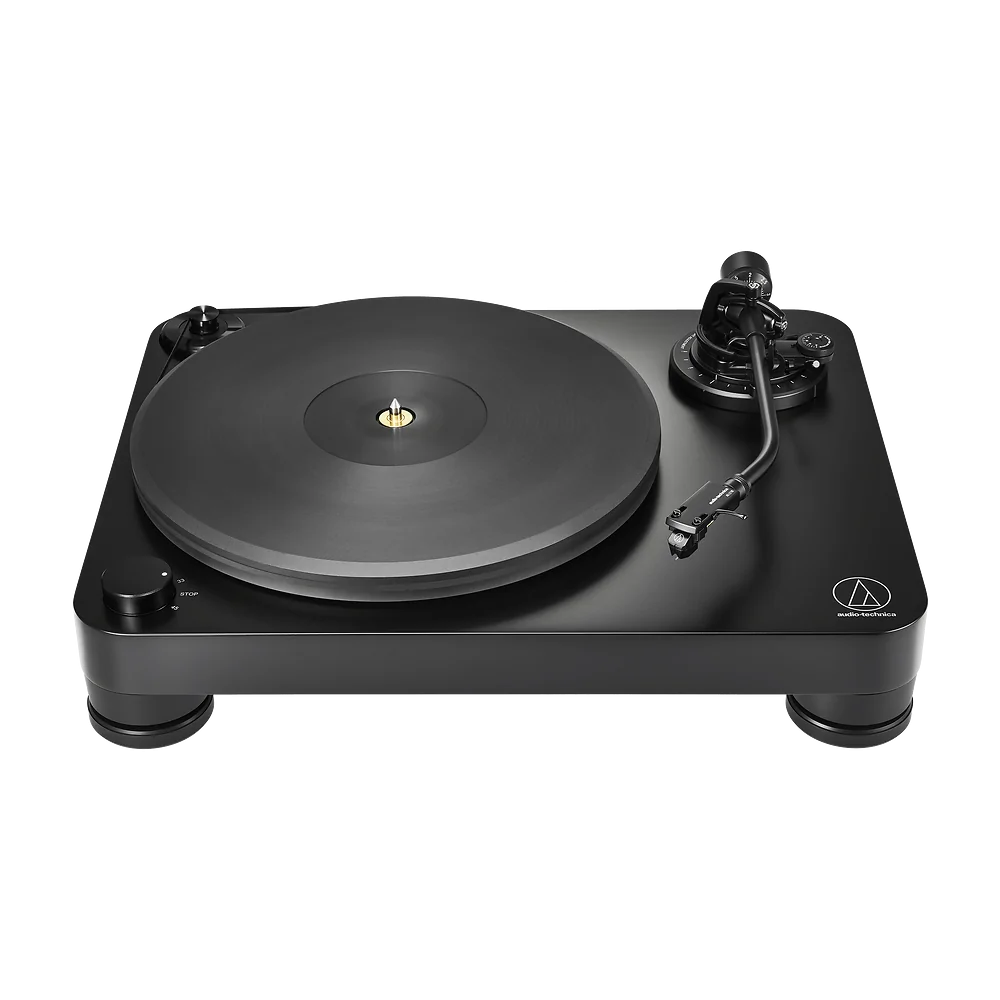
Explore this need in the finder →The AT-LP7X is a fully manual, two-speed belt-drive turntable with a useful distinction built into its rear panel: you can route the cartridge signal through its internal phono stage to a line-level input, or bypass that stage for a receiver's PHONO input. That flexibility makes the system connection easier to plan, but it does not make the deck a self-contained stereo. You still need amplification and speakers, and the tonearm must be handled by hand. This assessment is based on Audio-Technica's current US product page, linked manual and quick-start guide; it is not a listening test or report of ownership.
Choose the right output before you connect anything
The turntable includes a switchable phono equalizer with MM/MC selection and RCA output. For a receiver or integrated amplifier with a dedicated PHONO input, select PHONO and connect both RCA plugs and the ground lead to the appropriate inputs. That sends the cartridge-level signal to the receiver's phono stage. For powered speakers with a line input—or an amplifier's AUX/LINE input—select LINE so the turntable's internal stage raises and equalizes the signal first. Sending LINE output into a PHONO input would run the signal through a phono stage twice; selecting PHONO for an ordinary line input would leave it too weak and incorrectly equalized.
Audio-Technica's quick-start guide illustrates direct connection to active speakers, while the manual notes that some speaker inputs may need an adapter cable. The speakers and amplifier are not part of this turntable package. If you prefer an outboard phono stage, the PHONO output can feed a suitable stage before the rest of the system, but that is an extra component rather than a requirement for every setup.
Fully manual means you remain part of the playback routine
The LP7X has a tonearm lift, clamp and speed/start knob, not a push-button automatic arm cycle. The maker describes it as fully manual; the manual's playback sequence has you release the arm clamp, place the stylus at the desired groove and lower the cueing lever. To pause, lift the arm yourself. At the end, the instructions have you lift and return it, then turn the knob to STOP. No automatic end-of-record platter stop, arm lift or return is documented. If a hands-off start-and-finish routine matters, this is a mismatch; if you want to cue records manually, its lift and lock give you a clearly defined operating sequence.
This is a meaningful contrast with the Fluance RT82 already in this library. That model also needs manual cueing but documents a platter auto-stop with a delay and a warning that some records may not trigger it. The LP7X's current documentation does not identify that stop function. Neither approach is universally preferable: decide whether you want to tend the arm yourself and check the exact model manual rather than treating every manual deck as having the same stop behavior.
What the included cartridge and tonearm do—and do not—promise
The reviewed US configuration arrives with Audio-Technica's AT-VM95E BK cartridge pre-mounted on the removable AT-LT10 headshell. The manual specifies a bonded elliptical stylus, a 2.0-gram standard tracking force and a 1.8-to-2.2-gram range. Its stylus is replaceable with the separately sold AT-VMN95E BK. The VTA adjustment, anti-skate control and supplied light subcounterweight create options for a careful cartridge change, and the manufacturer publishes different cartridge-plus-headshell weight ranges for the arm with no subweight, the included light one, and an optional heavier one. These figures are setup limits, not a blanket guarantee that any cartridge will fit, align or pair well electrically. The heavier subcounterweight is an extra purchase, and a replacement stylus still needs the correct model and careful handling.
The stock cartridge is a moving-magnet design, but the built-in stage also offers an MC setting for a compatible moving-coil cartridge. That switch alone does not make every MC cartridge suitable: check its output, loading and weight against the cartridge and turntable manuals. The product page's cartridge flexibility is best read as an opportunity for deliberate system matching rather than a promise of plug-and-play compatibility.
Construction, size and setup checks
Audio-Technica lists a 40 mm MDF cabinet, 20 mm high-density acrylic platter and an optical sensor-monitored motor. The platter does not require a separate mat, according to the maker. Those are design descriptions, not independent evidence of a particular sound, speed accuracy or vibration result. The specified body is 18 inches wide, 14 inches deep and 6.2 inches high; leave extra clearance for RCA and power leads, access to the rear switches and raising the dust cover. A stable, level surface matters, and the manual says to avoid placing the deck next to speakers where vibration and acoustic pressure can affect it.
Initial setup involves more than plugging in: fit the belt and platter, install the headshell and counterweight, level the body, balance the arm, set the stock cartridge's tracking force and matching anti-skate, then choose the correct phono output and speed. The included light subcounterweight, RCA cable, ground lead, adapter, gloves, dust cover and 45 RPM adapter are listed in the manual. But Audio-Technica cautions that the included adapter can vary by country, so inspect the rating label and plug in the exact US package. The manual specifies 33⅓ and 45 RPM, not 78 RPM, and explicitly says the product is not intended for DJ scratching.
Who should shortlist it?
Consider the AT-LP7X if you want a manual deck, the supplied VM95E cartridge, adjustable tonearm setup and a phono stage that can be switched between PHONO and LINE. It can work with a receiver that has a PHONO input or use its own stage with powered speakers or an amplifier's line input. Pause if you expect automatic tonearm movement, automatic end-of-record stopping, built-in speakers, 78-RPM support or DJ-style scratching. The reviewed maker materials document an analog phono/line connection; verify any requested wireless or USB route rather than assuming one is included. Before buying, confirm the exact LP7X model, included adapter, headshell/cartridge, subcounterweight and condition; a used or open-box offer may not contain every part listed in the maker's new-package manual.
No comparative sound verdict follows from the construction features alone. The useful question is whether the LP7X's manual workflow, selectable phono route and cartridge setup fit your actual system. For a new cartridge or a system with uncertain inputs, read the manual first and confirm each exact connection rather than relying on a model-family resemblance.
Key specifications
Key details at a glance
| Drive | Belt drive |
|---|---|
| Documented record speeds | 33 1/3 RPM / 45 RPM |
| 78-RPM play option | No |
| Included cartridge | Audio-technica at-vm95e bk vm moving-magnet cartridge |
| Built-in phono preamp | Yes |
| Manual tonearm cueing | Yes |
| End-of-record platter stop | No |
| Platter | High-density acrylic |
| Platter mat | None required per manufacturer |
| Body width | 18 in |
| Body depth | 14 in |
| Body height | 6.2 in |
| Published phono output | 4 mV |
Use the exact model’s instructions for operating limits, supplied equipment and version differences.
Sources for this review
Sources for this assessment
Check your phono route before choosing
Check each model's documented input route, arm operation, and body limits. Use the finder to compare supported phono-system arrangements without assuming adjacent models share features.