
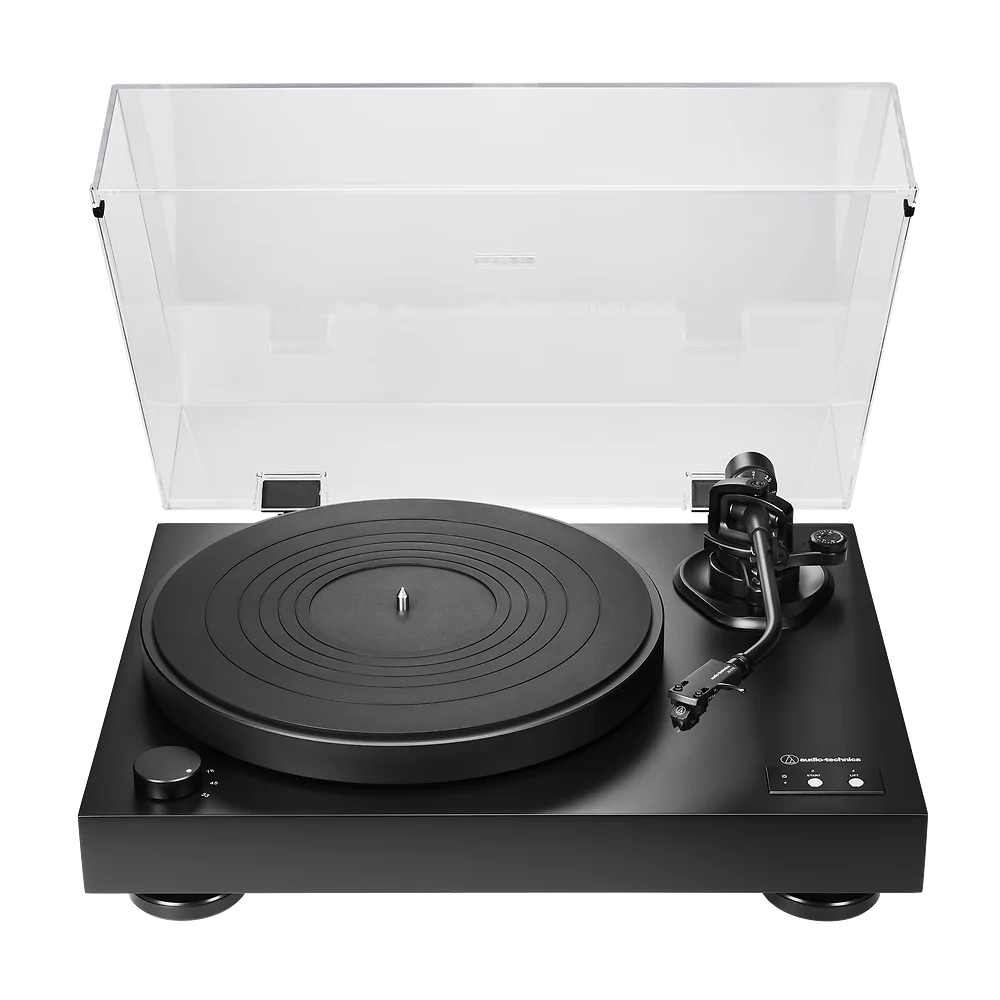
Your needs, this model
Does it fit your priorities?
Does the AT-LP8X connect directly to powered speakers?
Not to an ordinary line input by itself. The exact model outputs phono level and has no built-in phono equalizer, so use a receiver PHONO input or place a compatible phono stage before the powered speakers' line input.
Explore this need in the finder →Does its automatic stop make the AT-LP8X fully automatic?
No. The manual has you start the platter, position the tonearm and lower it. AUTO STOP can lift the arm and stop the platter at the end, but it does not start or return the arm and can miss some records.
Explore this need in the finder →Can the supplied cartridge play 78-RPM records?
The deck selects 78 RPM, but Audio-Technica specifies a dedicated SP cartridge or AT-VMN95SP replacement stylus for 78s. Check that the exact cartridge/stylus is right for your records; speed selection alone is not enough.
Explore this need in the finder →The AT-LP8X sits between a fully manual deck and a push-button automatic model. Audio-Technica calls it semi-automatic: you start the platter, choose a speed, position the arm and lower it yourself; at the end of a side, a selectable feature can raise the tonearm and stop the platter. That distinction matters more than the word “automatic” in a listing. The stop does not place the arm at the beginning or return it to its rest. This assessment is based on the manufacturer's U.S. page and English manual, not a listening test or claim of ownership.
Arm handling remains a manual job
The manual's routine asks the listener to turn on the deck, select 33⅓, 45 or 78 RPM, press START, position the J-shaped tonearm over the intended groove, then use LIFT to lower it. A tonearm rest clamp and lift button help control the movement, but the user remains responsible for starting playback and choosing where the stylus lands. At the end of a compatible record, AUTO STOP lifts the arm and stops the motor; the switch can be turned off when the maker's detector does not suit a particular disc. Audio-Technica warns that some 12-inch singles and SP records may not trigger the stop correctly. It is useful protection when it works, not a reason to leave an unattended record collection without checking the exact record behavior.
That makes the LP8X a distinct fit from the fully automatic LP60X and LP70X models in this library: those models automate the initial arm cycle, while the LP8X automates only the end lift/stop. It also differs from the fully manual LP7X, which asks the listener to stop the platter by hand. The review distinction is about operating sequence, not a sound-quality ranking.
Three speeds, with a cartridge caveat for 78s
The U.S. product page and manual list 33⅓, 45 and 78 RPM. The included AT-VM95E BK is a moving-magnet cartridge with a bonded elliptical stylus, mounted on the removable AT-LT10 headshell. Audio-Technica says the stylus is part of the VM95 replacement family, but its 78-RPM note specifically calls for a dedicated SP cartridge or the AT-VMN95SP stylus. Do not treat the speed selector as proof that the supplied stylus is suitable for shellac or every 78. If older records are central to your collection, verify the stylus, cartridge alignment and groove requirements before using them.
Choose the phono stage before you plan the speakers
The LP8X outputs a cartridge-level PHONO signal and has no built-in phono equalizer. With a compatible receiver or integrated amplifier PHONO input, connect the RCA lead and ground as the manual directs. If your destination is powered speakers with a line input, add a compatible phono stage between the deck and speakers. For passive speakers, that stage must feed an amplifier's line input; the turntable provides neither speaker power nor a complete stereo system. A separate stage's cartridge compatibility also matters if you later change the supplied cartridge.
This differs from the AT-LP5X, which has a selectable built-in stage and a separate computer-capture path, and from Audio-Technica's entry fully automatic models with a built-in stage. The LP8X is a direct-drive, manual-start option for someone who already understands the receiver PHONO versus line-input distinction and values an end stop without giving up manual cueing.
Setup, 78-RPM use and cartridge changes take care
The manual lists the platter, mat, cover and hinges, counterweight, subcounterweight, headshell/cartridge, 45 adapter, RCA cable and power cable. Initial setup includes placing and leveling the body, attaching the platter and mat, fitting the headshell and counterweight, balancing the arm, and setting tracking force and anti-skate. The supplied cartridge's standard tracking force is 2.0 g, within its documented 1.8–2.2 g range. The detachable headshell makes a cartridge change physically possible, but it does not remove the need to confirm cartridge weight, alignment, tracking force and the correct counterweight. Audio-Technica's manual cautions against DJ scratching and strong impacts during playback.
There is one source discrepancy worth resolving at purchase: the U.S. product page lists a 100–240 V supply requirement, while the linked English manual's specification table lists 100 V. The manual says the exact cable can vary by country, so check the actual U.S. unit's rating label and supplied cable rather than assuming a listing image or a seller's bundled adapter is correct.
Measure the body, then leave operating room
The U.S. page and manual list an 18-inch width, 14-inch depth and 6.3-inch height, with a weight of about 10.4 kg. Those are body dimensions, not clearance recommendations. Allow room for the hinged cover's travel, access to the tonearm, RCA and power-cable bends and lifting the platter during setup. The 18-by-14-inch shape is larger than the LP70 or LPW bodies in this reviewed set; a shelf that barely meets the numbers may still be impractical.
Who should consider it?
Consider the AT-LP8X if you want direct drive, three selectable record speeds, an included removable-headshell cartridge, hands-on cueing and an end-of-record arm lift/stop, and if you can supply the phono stage and amplification the system needs. Pause if you require automatic start and return, a built-in stage, a smaller shelf footprint, or stock-stylus 78 compatibility without an additional change. Before buying, confirm the exact AT-LP8X package, included cartridge and counterweights, cover and cables, the power-rating label, and the 78-RPM stylus path if relevant. No current price, stock, ASIN, rating, hands-on use or measured listening result is claimed.
Primary references: Audio-Technica's U.S. AT-LP8X page and English user manual.
Key specifications
Key details at a glance
| Drive | Direct drive |
|---|---|
| Documented record speeds | 33 1/3 RPM / 45 RPM / 78 RPM |
| 78-RPM play option | Yes |
| Included cartridge | Audio-technica at-vm95e bk moving-magnet cartridge on at-lt10 detachable headshell |
| Built-in phono preamp | No |
| Manual tonearm cueing | Yes |
| End-of-record platter stop | Yes |
| Platter | Die-cast aluminum with rubber damper |
| Platter mat | Rubber |
| Body width | 18 in |
| Body depth | 14 in |
| Body height | 6.3 in |
| Published phono output | 4 mV |
Use the exact model’s instructions for operating limits, supplied equipment and version differences.
Sources for this review
Sources for this assessment
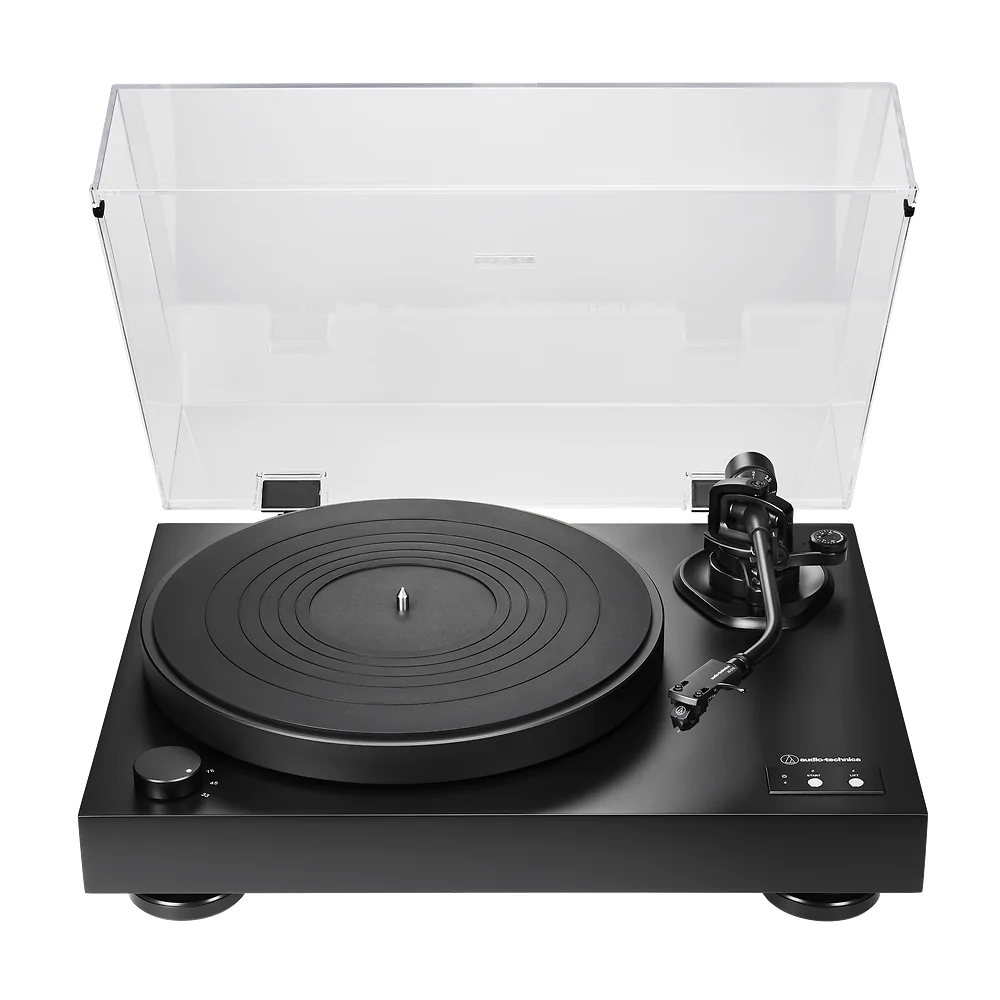
Check your phono route before choosing
Check each model's documented input route, arm operation, and body limits. Use the finder to compare supported phono-system arrangements without assuming adjacent models share features.