
Your needs, this model
Does it fit your priorities?
Can the AT-LPA2 use a typical receiver PHONO input?
Only if that input supports the included AT-OC9XEN moving-coil cartridge. Audio-Technica says its 0.35 mV output needs an MC-compatible phono equalizer or step-up transformer; an MM-only input is not enough.
Explore this need in the finder →Can the AT-LPA2 connect to powered speakers?
Yes, with a compatible MC phono stage or step-up transformer between its PHONO output and the speakers' line input. The deck has no built-in equalizer and does not supply speaker power.
Explore this need in the finder →How much space does the turntable need?
The body measures 16.54 by 13.39 inches, and its control unit is a separate 5.24 by 8.98 inch box. Allow additional room for cables, arm access and cover movement; the listed body footprint alone is not the full installation area.
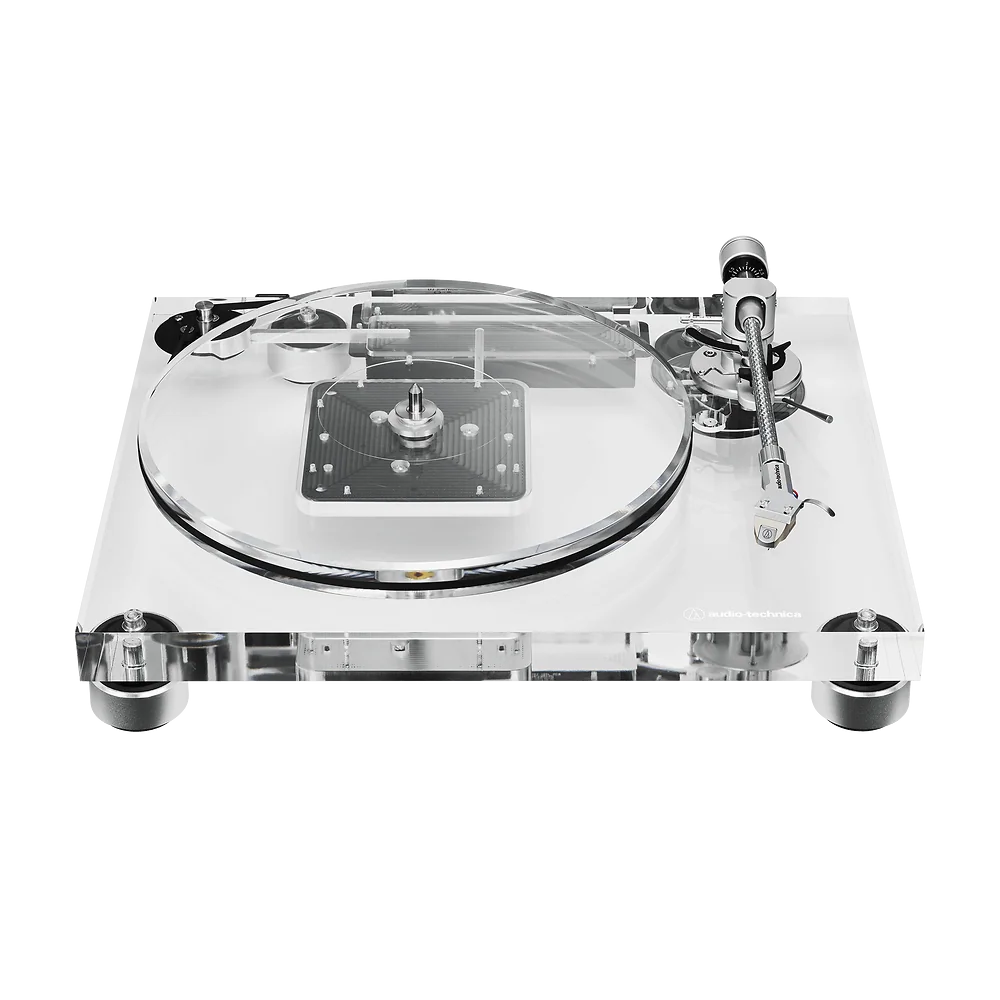
Explore this need in the finder →The AT-LPA2 is a fully manual belt-drive turntable whose most consequential system decision is not its transparent acrylic construction: it ships with a low-output moving-coil cartridge and has no built-in phono equalizer. Audio-Technica includes the AT-OC9XEN, a 0.35 mV MC cartridge, and explicitly calls for an MC-compatible phono equalizer or step-up transformer. That makes the input check essential. An ordinary moving-magnet-only PHONO input may not be the right partner. This is a source-based assessment of the U.S. product page and model manual, not a listening test or ownership report.
Plan the moving-coil signal path first
The manual says the AT-LPA2 sends phono level directly from its cartridge; no phono equalizer is built in. If you want to use a receiver or integrated amp's PHONO input, confirm that the input supports a moving-coil cartridge. If it does not, the maker's stated alternatives are an MC-compatible phono stage or a suitable step-up transformer. To reach powered speakers, put that compatible component before their line input. For passive speakers, the stage or transformer must feed a line input on an amplifier, which then supplies speaker power.
The box includes RCA and ground cables, but their presence does not make every receiver phono input suitable for the stock cartridge. Follow the manuals for the exact components and connect the ground lead when the system provides a corresponding terminal. Don't send a phono-level output straight to an ordinary AUX/LINE input, and don't assume a high-output MM preamp is compatible with the AT-OC9XEN just because it has RCA sockets. This system requirement is the main difference from built-in-stage options such as the LP7X and many automatic entry models.
Manual setup is part of the ownership routine
The turntable does not automate playback. The manual has the listener turn on the separate control unit, choose 33⅓ or 45 RPM, start the platter, raise the arm, place it over the chosen groove and lower it. Stopping is also manual: lift and return the arm, secure it, then press START/STOP. The manual does not document an automatic end-of-record lift or platter stop. If you want a hands-off start/return cycle, look at a fully automatic machine; if you want an end stop but accept manual cueing, the AT-LP8X offers a different semi-automatic routine.
Initial assembly includes the platter and belt, cover, control unit, arm counterweight, string-type anti-skate, supplied headshell/cartridge and the cable connections. The manual lists both light and heavy counterweights and specific cartridge-mass ranges for each, excluding the headshell. Its included cartridge uses a 2.0 g standard tracking force within a 1.8–2.2 g range. Cartridge substitution is possible, but the manual requires overhang and arm-balance/tracking-force adjustment after a change. The AT-OC9XEN stylus assembly is not field-replaceable; Audio-Technica describes an exchange service rather than a simple user-installed stylus.
Acrylic and separated controls add size, not a shortcut
Audio-Technica specifies a 30 mm clear acrylic chassis and a 20 mm acrylic platter, with an optical sensor monitoring rotation and the power/control electronics in a separate unit. The model-specific U.S. page and manual list the body as 420 × 340 × 135 mm—about 16.54 × 13.39 × 5.31 inches—and the control box as another 133 × 228 × 50 mm, or about 5.24 × 8.98 × 1.97 inches. The body weighs about 8.4 kg and the control unit about 1.1 kg. These measurements show why the separate controller should be included in shelf planning rather than treated as a hidden cable accessory.
The clear chassis may suit a system where its visible construction is part of the choice, but the manufacturer's material description is not independent proof of a listening advantage. The practical points are the two-speed belt-drive format, MC cartridge package, separate electronics, arm adjustment and the extra space for the controller. Allow clearance for the hinged cover, tonearm movement, wiring and access to the controller in addition to the published body dimensions.
What to verify before choosing it
Check that the exact offer is the AT-LPA2 rather than an accessory or differently bundled system, and confirm the included AT-OC9XEN, headshell, two counterweights, anti-skate weights, control box, power/control/ground/RCA cables, cover, belt, platter and setup items. The U.S. product page lists a 100–240 V supply, while the manual notes regional power cables can differ; verify the rating label and plug supplied with the actual unit. If buying used, inspect the stylus assembly, cartridge, belt, acrylic surfaces and whether the separate controller and all dedicated cables are present. No current price or availability is asserted here.
Who should consider it?
Consider the AT-LPA2 if you want the supplied moving-coil cartridge and fully manual operation, are prepared to learn careful arm setup, have a confirmed MC-compatible receiver input or plan to buy an appropriate MC phono stage, and can accommodate both the deck and controller. Pause if you need a built-in preamp, automatic start or stop, a simple MM-only PHONO connection, a replaceable stylus assembly or a small single-box footprint. Its appeal is a specific system and setup choice, not a claim that acrylic or MC construction guarantees a preferred sound.
Primary references: Audio-Technica's U.S. AT-LPA2 page and English user manual.
Key specifications
Key details at a glance
| Drive | Belt drive |
|---|---|
| Documented record speeds | 33 1/3 RPM / 45 RPM |
| 78-RPM play option | No |
| Included cartridge | Audio-technica at-oc9xen dual moving-coil cartridge with nude elliptical stylus |
| Built-in phono preamp | No |
| Manual tonearm cueing | Yes |
| End-of-record platter stop | No |
| Platter | 20 mm clear acrylic |
| Body width | 16.54 in |
| Body depth | 13.39 in |
| Body height | 5.31 in |
| Published phono output | 0.35 mV |
Use the exact model’s instructions for operating limits, supplied equipment and version differences.
Sources for this review
Sources for this assessment

Check your phono route before choosing
Check each model's documented input route, arm operation, and body limits. Use the finder to compare supported phono-system arrangements without assuming adjacent models share features.