
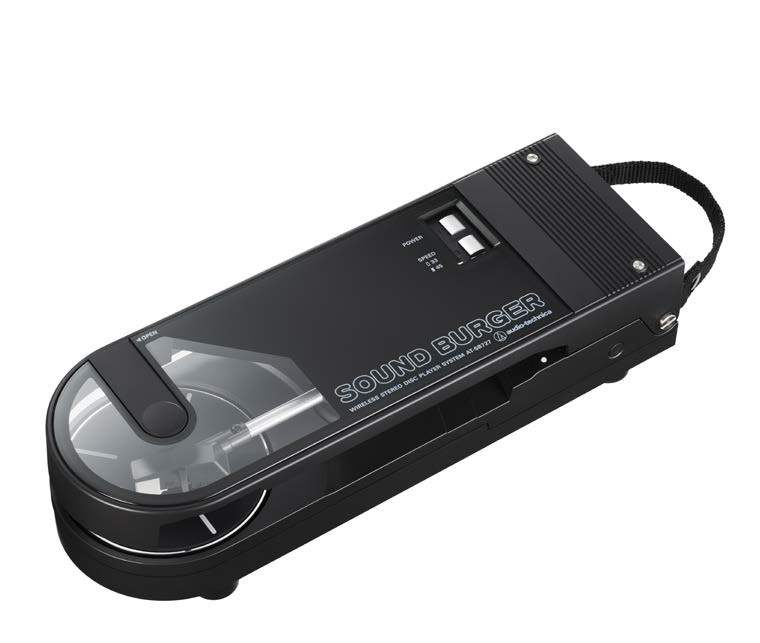
Your needs, this model
Does it fit your priorities?
Does the Sound Burger need a receiver PHONO input?
No. It has a built-in 36 dB RIAA phono stage and outputs line level over its 3.5 mm jack or Bluetooth. Use powered speakers or an amplifier/receiver line input, not a PHONO input.
Explore this need in the finder →Is the AT-SB727 fully automatic?
No. Moving the tonearm starts the platter and the user places and lifts the stylus by hand. The manual's separate 30-minute idle auto-power-off is not an end-of-record platter stop.
Explore this need in the finder →Does the Sound Burger fit a narrow surface?
Its published body is about 3.94 inches wide and 11.42 inches deep. It fits the review's 10-inch width and 11.5-inch depth caps, but those are body dimensions only; use a flat, level surface and allow additional access room.
Explore this need in the finder →The AT-SB727 Sound Burger is a portable turntable with a very different system job from a full-size deck. It runs on a rechargeable battery, sends audio to Bluetooth headphones or speakers, and includes a short analog line cable for powered speakers or an amplifier. It also has a built-in RIAA phono stage, so its 3.5 mm jack is line-level rather than a raw PHONO output. The tradeoff is a manual arm routine, no built-in speakers, no 78-RPM selection and no end-of-record platter auto-stop. This assessment uses Audio-Technica's English manual and U.S.-indicated regional catalog, not a personal listening test.
Compact does not mean hands-off
The manual describes a simple but active sequence: place the record, turn on the unit, select 33⅓ or 45 RPM, connect the chosen output, remove the stylus protector, then move the arm over the record. Moving the arm starts platter rotation; you lower the stylus gently by hand. To stop, lift the stylus, pull the arm back until it clicks and turn off power. There is no end-of-record arm lift or platter stop documented. The manual's 30-minute auto-power-off applies when a record is not playing; it is not a substitute for an end-of-side auto-stop.
This differs from the LP8X's switchable end-of-record lift and from the fully automatic LP60X family. The Sound Burger asks for manual handling even though its convenience features include wireless playback and battery operation. It is also not a portable speaker: Audio-Technica shows connections to separate wireless devices, active speakers or an amplifier.
Built-in phono stage, two distinct output routes
The manual specifies 36 dB of RIAA phono-preamp gain and a 150 mV nominal line output, explicitly noting that there is no phono output. For a wired system, use the included 3.5 mm-to-dual-RCA cable to send line level to powered speakers with a line input or to AUX/LINE on an amplifier that drives passive speakers. Do not choose a receiver PHONO input for this signal: the built-in stage has already equalized it. The speakers or amplifier still need their own volume and speaker-power functions.
Bluetooth 5.2 is an alternative route to compatible wireless headphones or speakers. The manufacturer lists A2DP/AVRCP, SBC codec and an approximate 10 m line-of-sight communication range. Audio-Technica does not promise that every device will pair or operate identically, so check the receiver's Bluetooth profile and instructions. Bluetooth connection is separate from the included analog cable; using the RCA cable switches the Sound Burger to wired output.
Battery life and care are real ownership details
Audio-Technica's manual lists a built-in 3.6 V lithium-ion battery, with about 12 hours of operation and about 12 hours of charging depending on conditions. The included cable is USB-A to USB-C, and charging uses the unit's USB Type-C input. The manual advises charging at least once every six months to protect a battery during long storage, and describes replacement if the rechargeable pack reaches the end of its service life. This is not a permanently powered desk deck: include charge planning in a portable listening routine.
The unit should be used on a flat, level surface, and the manual advises against touching or moving it during playback. Keep the stylus protector, 45 RPM adapter and arm secured under the cover when storing it. The AT-3600L cartridge uses a replaceable ATN3600L stylus listed in the official regional catalog; the manual explains how to check or replace the stylus. Neither the compact shape nor the carry handle turns it into a DJ/scratching deck, which Audio-Technica explicitly says it is not intended to be.
Check the exact color and package
The U.S. product directory lists AT-SB727 with a color selector. Audio-Technica's regional catalog identifies three discrete codes: black AT-SB727-BK, white AT-SB727-WH and yellow AT-SB727-YL. The photographs below are separate original manufacturer catalog images matched to those exact labels. This assessment and its BuyerShortlists purchase route are for the black BK version; the white and yellow entries are finish-only editions, not additional function assessments.
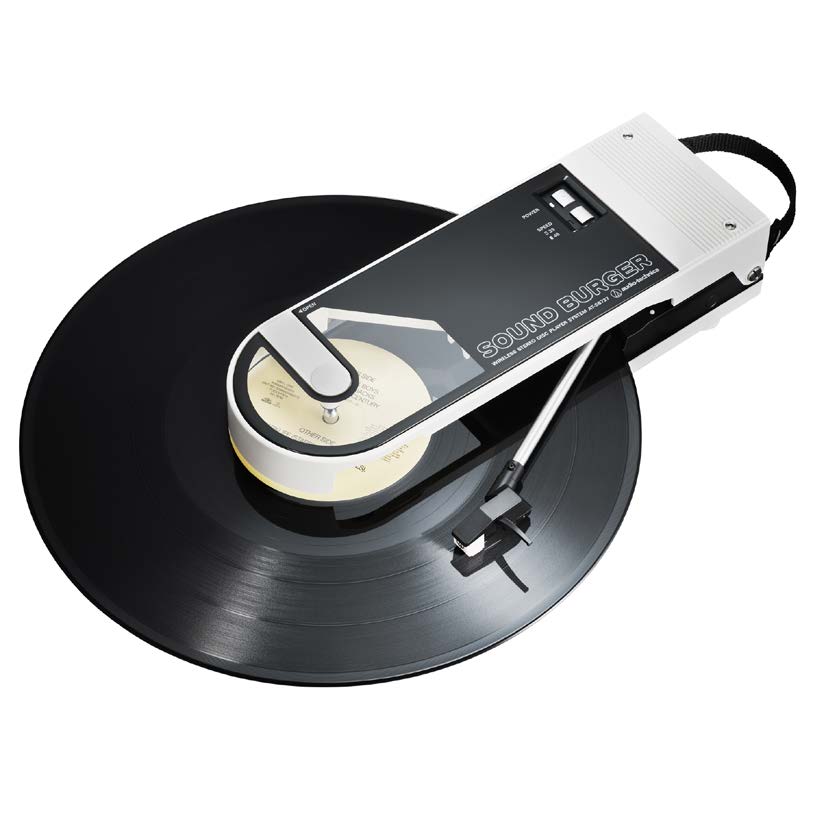
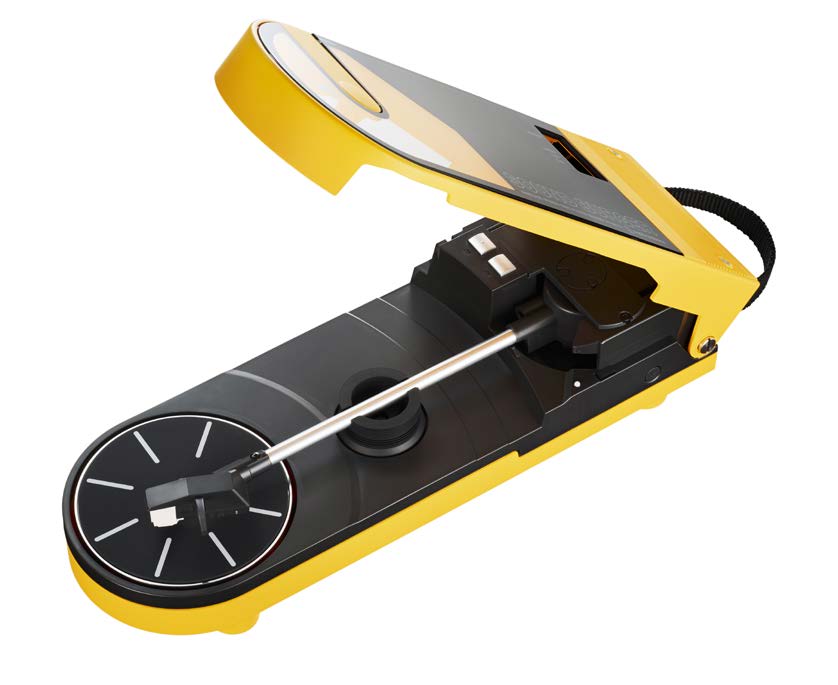
For a new-box offer, verify the exact suffix, the 45 adapter, 3.5 mm-to-dual-RCA lead and USB-A-to-USB-C cable. For an open-box unit, check battery charging, cover/arm movement, cartridge/stylus, cable completeness and the exact color before comparing a listing. The catalog's images establish visual identity, not current availability.
Surface fit and limitations
The English manual lists a body at 100 × 290 × 70 mm, about 3.94 inches wide, 11.42 inches deep and 2.76 inches tall, with a weight of about 900 g. The separate regional catalog gives approximate dimensions with a slightly different height figure; for fit, use the exact unit and preserve enough surface for stable placement and access. A narrow width cap does not remove the depth requirement. Measure the usable surface and allow room to open the cover, reach controls and connect cables. It supports only 33⅓ and 45 RPM, so it is not the right choice for a collection that requires 78s.
Who should consider it?
Consider the black AT-SB727 if portability, a rechargeable battery, built-in phono equalization, Bluetooth and a small footprint answer a real need, and if you accept manual cueing and external headphones or speakers. Pause if you need an integrated speaker, receiver-PHONO-level output, 78 RPM, auto-stop, analog cartridge upgrades or an uninterrupted always-on system. Confirm the exact color suffix and supplied cable set, and check the intended Bluetooth device or wired line input before buying. No current price, stock, ASIN, rating or hands-on result is claimed.
Primary references: Audio-Technica's U.S. turntable directory, official catalog, page 15 and English user manual.
Key specifications
Key details at a glance
| Drive | Belt drive |
|---|---|
| Documented record speeds | 33 1/3 RPM / 45 RPM |
| 78-RPM play option | No |
| Included cartridge | Audio-technica vm stereo cartridge; official regional catalog identifies at-3600l |
| Built-in phono preamp | Yes |
| Manual tonearm cueing | Yes |
| End-of-record platter stop | No |
| Bluetooth audio transmission | Yes |
| Platter | Aluminum alloy |
| Body width | 3.94 in |
| Body depth | 11.42 in |
| Body height | 2.76 in |
Use the exact model’s instructions for operating limits, supplied equipment and version differences.
Sources for this review
Sources for this assessment
Check your phono route before choosing
Check each model's documented input route, arm operation, and body limits. Use the finder to compare supported phono-system arrangements without assuming adjacent models share features.