
Your needs, this model
Does it fit your priorities?
Can I connect the RT80 directly to powered speakers?
Yes, if their input accepts line-level RCA: set the turntable's switch to LINE so its built-in phono stage is active. The RT80 still needs external speakers; it has no built-in speaker amplifier. Do not route its LINE output through another phono stage.
Explore this need in the finder →Can the RT80 use my receiver's PHONO input?
Yes. Set the turntable switch to PHONO to bypass the internal stage, connect its RCA leads and ground as your receiver manual specifies, then use the receiver's speaker outputs. Do not leave the turntable on LINE into a PHONO input, which would place two phono stages in series.
Explore this need in the finder →Does the RT80 automatically lift the arm when a record ends?
No. Fluance describes the platter stopping after about 30 seconds when auto-stop is enabled, and warns that some records may not trigger it correctly. The tonearm is manually cued and the stop does not lift or return it.
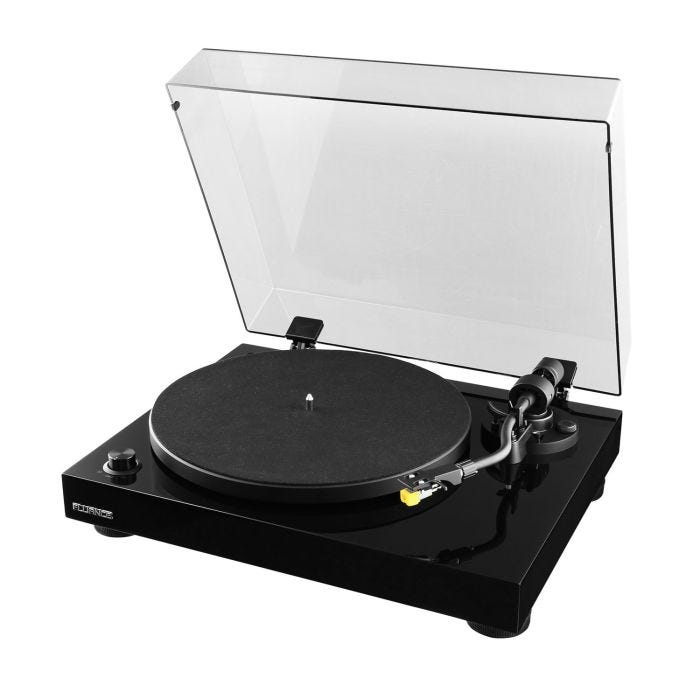
Explore this need in the finder →The RT80 is the simplest of the current Fluance RT80, RT81 and RT81+ group, but “simple” here describes its package, not a one-touch routine. The official US page identifies a Piano Black, two-speed belt-drive turntable with an Audio-Technica AT91 moving-magnet cartridge, a felt mat and a built-in phono stage that can be switched between LINE and PHONO. It has no built-in speakers or speaker amplifier. This assessment compares documented setup and package choices; it is not a listening test or a claim of hands-on use.
A built-in stage, with two ways to wire it
The RT80 can serve a system whose receiver already has a suitable PHONO input, or one whose only input is AUX/LINE. For the first, set the rear selector to PHONO so the turntable bypasses its own electronics, then run RCA and ground to the receiver’s moving-magnet PHONO input. For powered speakers or an amplifier’s line input, set the switch to LINE and let the RT80’s built-in stage do the equalization. Fluance’s connection guide illustrates the route through a separate stage as well, but cautions against adding an external phono stage when a built-in stage or system PHONO input is already in use. Misplacing that selector can put two stages in series.
None of these routes supplies the speakers themselves. A receiver or integrated amplifier must drive passive speakers; powered speakers need a compatible line input. The RT80 provides analog RCA outputs and a ground terminal, but Fluance does not list wireless playback as built in. A powered-speaker setup is therefore a signal-chain choice, not a feature that makes the turntable a speaker system.
Manual cueing is not automatic playback
The RT80 plays 33⅓ and 45 RPM records; the manufacturer does not list 78 RPM. You place and lift the arm with the cueing lever. Auto-stop is a separate convenience: the manual describes a delay of roughly 30 seconds before the platter stops at the end of a record and warns that some record pressings may not activate it correctly. The function does not start playback hands-free, lift the stylus or return the arm. Anyone who needs automatic tonearm start and end handling should not treat this platter stop as a substitute.
The manual’s setup sequence includes fitting the platter and belt, installing the headshell and counterweight, balancing the arm, setting tracking force and anti-skate, and connecting the power and RCA cable. Fluance gives the included AT91 a 2.0-gram recommended tracking force and a 2.0 anti-skate setting. Those are starting instructions for this supplied cartridge, not a universal value for replacement cartridges. The detachable headshell makes cartridge changes possible, but a different cartridge also requires compatible weight, alignment and setup; the advertised 3.5-to-6.5-gram support range alone does not guarantee that any cartridge will work well.
What the RT80 package does—and does not—change
Its aluminum platter sits under a felt slip mat, and its stock AT91 uses a bonded conical stylus with a carbon-fiber cantilever. That is a different supplied package from the RT81, which adds an AT95E and uses a rubber mat, and the RT81+, which moves to an AT-VM95E, a damped aluminum platter, acrylic mat and three adjustable feet. Those are tangible selection differences; a change in mat or stylus profile is not evidence, by itself, of an audible result in a particular room or system. The RT80 is the one to compare when those included parts and the AT91 replacement-stylus path are what you want. If height-adjustable feet or a different cartridge family matter more, inspect the adjacent reviews before choosing.
Fit and installation checks
The current product page publishes a 16.5-inch body width and a 14.25-inch depth, with height shown as 5.75 inches plus or minus a half inch. The shared RT80/RT81/RT81P v2.6 manual instead prints a 13.75-inch depth and 5.5-inch height. Width agrees, but depth does not; the finder uses the current product-page depth and this review preserves the difference rather than pretending the documents agree. Either figure omits the extra room needed for cables, access to the controls, safe cueing and cover movement. The fixed isolation feet have only limited horizontal motion; Fluance suggests separate pads or a platform for larger leveling corrections. Check the actual shelf and keep the unit level before relying on the manufacturer’s setup instructions.
Before purchase, confirm that the offer is a standalone RT80 in the intended finish and includes the expected cartridge, counterweight, belt, felt mat, dust cover, 45 adapter, RCA/ground cable and adapter. A listing for a speaker bundle or accessory is not this product. No price, stock condition or sound-quality conclusion is inferred here. The original Fluance product page and its linked manual are the controlling sources for the exact package and setup steps.
For a model-specific sequence and the cartridge/mat distinctions, see the RT80 setup guide.
Key specifications
Key details at a glance
| Drive | Belt drive |
|---|---|
| Documented record speeds | 33 1/3 RPM / 45 RPM |
| 78-RPM play option | No |
| Included cartridge | Audio-technica at91 moving-magnet, bonded conical diamond stylus |
| Built-in phono preamp | Yes |
| Manual tonearm cueing | Yes |
| End-of-record platter stop | Yes |
| Platter | Aluminum |
| Platter mat | Felt |
| Body width | 16.5 in |
| Body depth | 14.25 in |
| Body height | 5.75 in |
| Published phono output | 3.5 mV |
Use the exact model’s instructions for operating limits, supplied equipment and version differences.
Sources for this review
Sources for this assessment
- Fluance US standalone turntables catalogue
- RT80 Classic High Fidelity Vinyl Turntable — Black
- Fluance RT80/RT81/RT81P High Fidelity Vinyl Turntable User Manual v2.6
- Fluance Turntable Connection Guide
- What is the difference between Fluance turntables?
- How do I level my turntable?
- RT80 Piano Black official US product image
Check your phono route before choosing
Check each model's documented input route, arm operation, and body limits. Use the finder to compare supported phono-system arrangements without assuming adjacent models share features.