
Your needs, this model
Does it fit your priorities?
Can the RT81 go straight to powered speakers?
Yes, when the speakers have an RCA line input: use LINE so the built-in phono stage raises the cartridge output to line level. The deck has no speaker amplifier of its own. Do not add a separate phono stage to that LINE signal.
Explore this need in the finder →Can I use the RT81 with an existing receiver PHONO input?
Yes. Set the selector to PHONO to bypass the built-in stage, then connect RCA and the ground wire to the receiver's compatible moving-magnet PHONO input. That input supplies equalization; the receiver still drives passive speakers. Avoid LINE into PHONO because it would cascade stages.
Explore this need in the finder →Is RT81 auto-stop full automatic operation?
No. The manual requires moving the arm over the record before the platter starts, and says the platter may take about 30 seconds to stop at record end. Some records may not trigger the function correctly; it does not lift or return the arm.
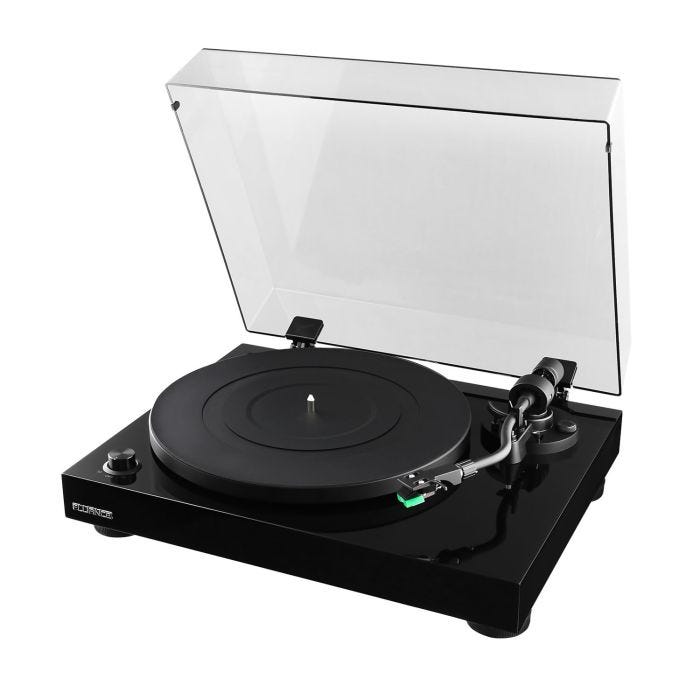
Explore this need in the finder →The RT81’s case is clearest when it is compared with the RT80 and RT81+, rather than described as a generic “entry-level” turntable. The current US Piano Black page identifies item RT81T and supplies an Audio-Technica AT95E moving-magnet cartridge, an aluminum platter with a rubber mat, and a built-in phono stage with LINE and PHONO settings. Fluance also lists Natural Walnut (item RT81) and Piano White (RT81WH) routes. They retain the same RT81 functional package; their distinct finish and item identities are preserved here instead of treating the photographs as interchangeable.
Connection flexibility without built-in speakers
The internal phono stage is useful because the signal route can be selected to match equipment already at home. With powered speakers or an amplifier that offers a line input but no PHONO socket, switch the RT81 to LINE and connect its RCA outputs to that line input. With a compatible receiver PHONO input, switch to PHONO to bypass the turntable’s own stage and connect RCA plus ground according to both manuals. The turntable’s ground lead is not required for every LINE connection; Fluance’s instructions say to connect it when using an external phono stage and follow the relevant equipment’s grounding guidance.
An optional external phono stage remains possible: set the RT81 to PHONO, route the deck to the separate stage, then send the stage’s line output to powered speakers or an amplifier driving passive speakers. Fluance’s connection guide explicitly shows these separate-stage arrangements and cautions against stacking a second stage on a built-in LINE output or a system PHONO input. The built-in stage is not a power amplifier. Passive speakers still need an amplifier, and powered speakers still need a line input.
Arm routine, stop feature and record speeds
The RT81 is belt-driven and documented for 33⅓ and 45 RPM, not 78 RPM. Its arm is manually cued even though an auto-stop switch is present. The shared v2.6 manual describes the platter stopping about 30 seconds after the end of a record, and warns that some records may not work correctly with the feature. It also says playback starts after the tonearm is moved over the record when auto-stop is enabled. That is not an automatic start, arm lift or return system. If the routine itself needs to be hands-off, the RT81 does not meet that need.
Setup involves installing the platter and belt, fitting the counterweight and headshell, balancing the arm, setting tracking force and anti-skate, and selecting the proper output. The included AT95E has a published recommended force of 2.0 grams; the manual uses anti-skate setting 2 as the corresponding setup. Keep these values tied to the supplied cartridge. Fluance describes the RT81 tonearm as accepting compatible cartridges in a 3.5-to-6.5-gram range, but cartridge weight is only one condition; alignment, mounting and tracking requirements still matter. The removable H-4 headshell makes compatible half-inch-mount changes possible, not automatic or self-calibrating.
Why select RT81 over the neighboring models?
Against the RT80, RT81 changes the stock cartridge from AT91 to AT95E and the mat from felt to rubber. Against RT81+, the RT81 retains the AT95E/rubber-mat package but lacks the plus model’s AT-VM95E cartridge family, damped platter with acrylic mat, adjustable feet and included bubble level. These documented package differences matter more than treating ascending model numbers as a guaranteed performance ranking. A buyer who wants the exact AT95E package has a specific reason to keep RT81 on the list; someone prioritizing the VM95 stylus family or easier leveling should inspect the RT81+ instead. The RT81 is a manual deck without Fluance’s servo speed control noted for the Reference line; neither its DC motor label nor its feature list supports a sound-quality promise.
Body fit and finish-specific checks
Fluance’s current black page lists a 16.5-inch width and 14.25-inch depth, with a 5.75-inch height subject to a half-inch tolerance. The shared manual’s dimensions are 16.5 × 5.5 × 13.75 inches in width-height-depth order. This depth discrepancy is retained in the fact record; the finder uses 14.25 inches for the listed current-page body measurement and does not treat that as the room required to operate the deck. Allow for cable bends, the arm’s sweep, access to the switch and raising or removing the dust cover. The RT81 has four fixed feet with limited horizontal movement. For a larger leveling correction, Fluance advises considering separate pads or a platform rather than assuming adjustable feet are included.
The current routes identify Piano Black, Natural Walnut and Piano White as separate finish/item editions. Match the finish and manufacturer item ID to the actual offer, then check that its AT95E cartridge, rubber mat, counterweight, belt, dust cover and cables are present—especially on an open-box or used listing. The RT81 product is the standalone turntable, not the separate speaker bundle or a maintenance accessory. This is a research-based comparison of official specifications and instructions, not a listening review or a claim about any current seller’s price or stock.
For a model-specific sequence and the cartridge/mat distinctions, see the RT81 setup guide.
Key specifications
Key details at a glance
| Drive | Belt drive |
|---|---|
| Documented record speeds | 33 1/3 RPM / 45 RPM |
| 78-RPM play option | No |
| Included cartridge | Audio-technica at95e moving-magnet with bonded elliptical diamond stylus |
| Built-in phono preamp | Yes |
| Manual tonearm cueing | Yes |
| End-of-record platter stop | Yes |
| Platter | Aluminum |
| Platter mat | Rubber |
| Body width | 16.5 in |
| Body depth | 14.25 in |
| Body height | 5.75 in |
| Published phono output | 3.5 mV |
Use the exact model’s instructions for operating limits, supplied equipment and version differences.
Sources for this review
Sources for this assessment
- Fluance US standalone turntables catalogue
- RT81 Elite High Fidelity Vinyl Turntable — Piano Black
- RT81 Elite High Fidelity Vinyl Turntable — Natural Walnut
- RT81 Elite High Fidelity Vinyl Turntable — Piano White
- Fluance RT80/RT81/RT81P High Fidelity Vinyl Turntable User Manual v2.6
- Fluance Turntable Connection Guide
- What is the difference between Fluance turntables?
- What is the difference between RT81, RT81+, and RT82?
- How do I level my turntable?
- RT81 Piano Black official US product image
Check your phono route before choosing
Check each model's documented input route, arm operation, and body limits. Use the finder to compare supported phono-system arrangements without assuming adjacent models share features.