
Your needs, this model
Does it fit your priorities?
Can the RT81+ play into powered speakers without another preamp?
Yes. Set the built-in phono switch to LINE and connect the RCA outputs to compatible line inputs on powered speakers. The stage raises the cartridge signal; the turntable has no speakers of its own. Avoid adding a second phono preamp to the LINE output.
Explore this need in the finder →Can I use a receiver PHONO input with the RT81+?
Yes. Set the RT81+ switch to PHONO so its internal stage is bypassed, then connect RCA and ground to the receiver's compatible PHONO input. Check the receiver's manual for its moving-magnet compatibility and grounding terminal; use LINE/AUX instead only when the turntable's internal stage is active.
Explore this need in the finder →Does the RT81+ auto-stop return the tonearm?
No. The manual's auto-stop instructions concern the platter: it may take roughly 30 seconds to stop, and some records may not activate it correctly. The listener still cues and handles the arm by hand.
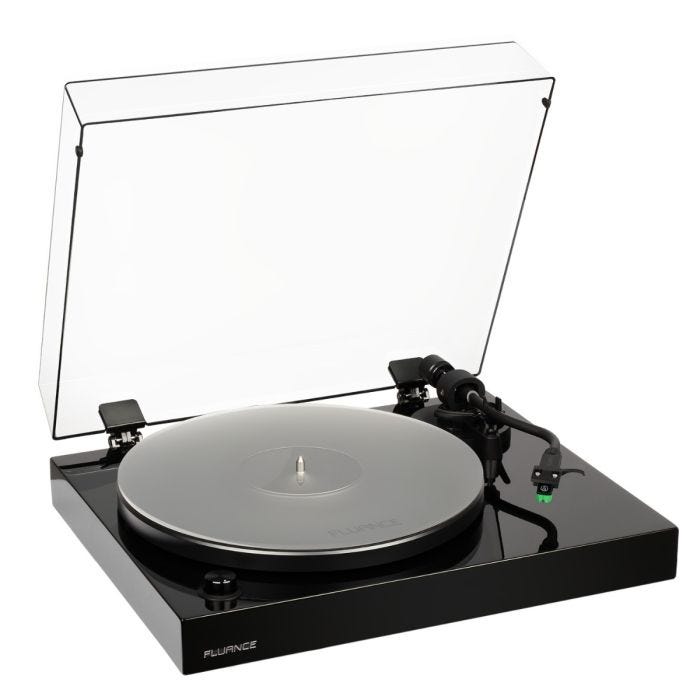
Explore this need in the finder →The RT81+ keeps the RT81’s general system approach—a belt-driven, manually cued two-speed turntable with a switchable built-in phono stage—but changes several supplied parts. The current US Piano Black product page identifies item RT81PT and specifies an Audio-Technica AT-VM95E cartridge, a damped aluminum platter and acrylic mat. The category card also links Natural Walnut (item RT81P) and Piano White (RT81PWH); those are separate page and finish identities for this same functional package. The shared manual calls the configuration RT81P, so the page’s finish-specific IDs should be checked against an actual offer rather than read as three different mechanisms.
One deck, two sensible phono routes
For a line-level input on powered speakers or an amplifier without a PHONO input, use the RT81+ selector’s LINE setting. The internal phono stage then delivers line-level RCA output; it does not power passive speakers, and it does not include speakers at all. If the receiver or integrated amplifier already has a compatible moving-magnet PHONO input, choose PHONO so the turntable bypasses its built-in stage, then connect RCA and ground as directed by the system manuals. This prevents feeding a pre-amplified signal into another phono stage.
Fluance’s connection guide also shows an external phono stage before powered speakers, and an external stage followed by an amplifier driving passive speakers. Those routes use PHONO from the RT81+ so the internal preamp is bypassed; the added stage must be compatible with the moving-magnet cartridge and connected as its own instructions require. Choosing a built-in stage does not settle speaker amplification, and a built-in receiver PHONO input is not the same thing as an AUX or LINE socket.
What the “plus” package actually supplies
The AT-VM95E is a bonded elliptical moving-magnet cartridge. Fluance lists compatible replacement stylus options from the VM95 family, which can make the upgrade path easier to identify than a cartridge change based only on body shape. The published included-cartridge tracking force is 2.0 grams; the shared manual pairs that with anti-skate setting 2. The arm is described as supporting compatible cartridge weights from 3.5 to 6.5 grams. That range is not a universal fit guarantee: a replacement still has to suit the headshell, alignment, stylus geometry and setup instructions.
The damped aluminum platter, acrylic mat, three adjustable isolation feet and included bubble level distinguish RT81+ from RT81’s aluminum platter/rubber mat and fixed feet. They are tangible construction and setup differences, but the manufacturer feature language alone cannot establish what a listener will hear in a particular system. RT80 remains another comparison point: it uses an AT91, felt mat and fixed feet. Fluance’s support comparison describes RT81+ as sharing the RT81 preamp and tonearm while changing those parts and the cartridge family. That is the useful reason to compare the versions, rather than assuming that “plus” means every buyer will benefit.
Manual operation and the meaning of auto-stop
The RT81+ plays 33⅓ and 45 RPM; the manufacturer does not list 78 RPM. You still move the arm with the cueing lever. The auto-stop feature addresses the platter at the end of a record, not the tonearm: the shared manual estimates roughly 30 seconds before rotation stops and notes that some records may not activate the feature properly. It does not automatically start playback, lift the stylus or return the arm. If those actions need to happen without the listener, the RT81+ is not a substitute for a fully automatic design.
The setup manual calls for fitting the platter and belt, attaching the headshell and counterweight, balancing the arm, setting force and anti-skate, then selecting LINE or PHONO for the intended system. The adjustable feet can help correct an uneven support surface; use the supplied bubble level rather than assuming the furniture is flat. A cartridge change or an altered force setting requires a deliberate setup check, not a guess based on the model name.
Fit, dimensional discrepancy and buying checks
The current product page lists the RT81+ body as 16.5 inches wide and 14.25 inches deep, with height 6 inches plus or minus a half inch. The shared v2.6 manual instead lists 16.5 × 5.5 × 13.75 inches in width-height-depth order. Width agrees; depth and the nominal height differ. The fact record uses the current page’s listed depth for body-only matching, while retaining the manual values for comparison. Neither set includes the extra operating space needed for leads, controls, the moving arm and a raised cover.
Before choosing, match the offered finish—Piano Black, Natural Walnut or Piano White—and its item identifier to the RT81+ package. Verify the AT-VM95E, acrylic mat, damped platter, bubble level, counterweight, belt, adapter, RCA/ground cable and cover are included if condition is not new. A speaker bundle has different scope from the standalone deck, and a stylus or brush is an accessory. No current price, inventory, seller condition or sound result is asserted. For an answer tailored to this cartridge and output switch, use the setup guide and the manufacturer manual linked with this assessment.
For a model-specific sequence and the cartridge/mat distinctions, see the RT81+ setup guide.
Key specifications
Key details at a glance
| Drive | Belt drive |
|---|---|
| Documented record speeds | 33 1/3 RPM / 45 RPM |
| 78-RPM play option | No |
| Included cartridge | Audio-technica at-vm95e moving-magnet with bonded elliptical diamond stylus |
| Built-in phono preamp | Yes |
| Manual tonearm cueing | Yes |
| End-of-record platter stop | Yes |
| Platter | Damped aluminum |
| Platter mat | Acrylic |
| Body width | 16.5 in |
| Body depth | 14.25 in |
| Body height | 6 in |
| Published phono output | 4 mV |
Use the exact model’s instructions for operating limits, supplied equipment and version differences.
Sources for this review
Sources for this assessment
- Fluance US standalone turntables catalogue
- RT81+ Elite High Fidelity Vinyl Turntable — Piano Black
- RT81+ Elite High Fidelity Vinyl Turntable — Natural Walnut
- RT81+ Elite High Fidelity Vinyl Turntable — Piano White
- Fluance RT80/RT81/RT81P High Fidelity Vinyl Turntable User Manual v2.6
- Fluance Turntable Connection Guide
- What is the difference between Fluance turntables?
- What is the difference between RT81, RT81+, and RT82?
- RT81+ Piano Black official US product image
Check your phono route before choosing
Check each model's documented input route, arm operation, and body limits. Use the finder to compare supported phono-system arrangements without assuming adjacent models share features.