
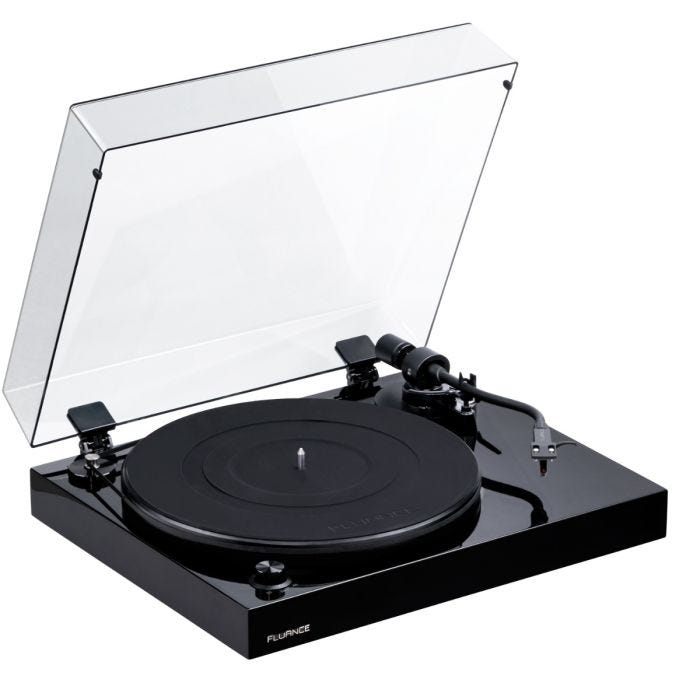
Your needs, this model
Does it fit your priorities?
Can I use the RT82 with a receiver that already has a PHONO input?
Yes. Use the turntable's RCA outputs and ground lead at the receiver's PHONO input. Fluance says a separate phono preamp is not needed when the amplifier or receiver has a PHONO input. Connect the receiver to speakers appropriate to that system.
Explore this need in the finder →Can the RT82 connect straight to my powered speakers?
Not to a normal line input by itself: the RT82 has no built-in phono stage. Add a compatible external phono preamp between the turntable and the speakers' line input, and connect the ground lead as directed. Fluance lists a phono-preamp-plus-powered-speaker arrangement.
Explore this need in the finder →Does its auto-stop make the RT82 fully automatic?
No. The documented auto-stop stops the platter after a record ends (about 30 seconds); the manual says to move the tonearm over the record to start playback, and some records may not trigger the stop correctly. It is a manual-cueing design, not a fully automatic start-and-return system.
Explore this need in the finder →The RT82 is a manual-cueing belt-drive turntable built around an Ortofon OM 10 cartridge, but its most important system question is what will provide phono amplification. The deck has no built-in phono preamp. If your receiver or integrated amplifier has a PHONO input, that input can supply the needed stage; otherwise, plan for an external phono preamp before connecting ordinary line-level speakers or an AUX input. This is a research-based assessment of Fluance's current Piano Black listing, official manual and setup guidance—not a listening test or claim of ownership.
Start with the signal chain, not the cabinet
The RT82 sends a cartridge-level phono signal through RCA outputs and has a ground terminal. It is not a self-contained record player with speakers or a line-level preamp built in. That distinction is easy to miss when shopping by turntable alone. A compatible receiver's PHONO input gives one straightforward path: connect the RCA plugs and ground lead to that input, then let the receiver drive its speakers. If the system has powered speakers with only a line input, a separate phono stage must sit between the turntable and those speakers. With passive speakers, the chain needs both a phono stage and an amplifier/receiver. Fluance's own setup pages describe these arrangements and caution against putting a separate stage into another PHONO input.
The tradeoff is deliberate: the RT82's analog route keeps the phono stage outside the turntable, but it asks the buyer to confirm one more component and the correct input. Before ordering, check the rear panel labels on the receiver or speakers. A socket marked AUX, LINE or CD is not the same as PHONO. When adding an external stage, follow its grounding and output instructions; do not assume that an RCA cable alone solves the connection.
What changes compared with the RT81+?
The current Fluance comparison chart makes the product-family differences more useful than a broad claim that one model is automatically “better.” It lists the RT81+ with a built-in phono preamp, an Audio-Technica AT-VM95E cartridge and an acrylic mat, while the RT82 comes without an internal stage and is supplied with an Ortofon OM 10 over an aluminum platter and rubber mat. Those are concrete differences in setup and included parts, not evidence of a measured sound advantage. If avoiding another component is central to your setup, the RT81+ may fit that requirement more directly. If your amplifier already has a suitable PHONO input—or you are intentionally selecting a separate stage—the RT82's different cartridge package may be the more relevant configuration to investigate.
Within the Reference range, the manufacturer lists RT83 with a 2M Red, RT84 with a 2M Blue, and RT85/RT85N with an acrylic platter and different cartridges. Fluance also lists two RT87 packages with different supplied cartridges. These are not finish-only distinctions: the included cartridge or platter changes what arrives and what replacement parts or setup choices matter. Verify the exact model suffix and included cartridge in the offer rather than assuming every Reference table is the same package.
Manual cueing with a narrower kind of automation
The RT82 includes a cueing lever and an auto-stop switch. The manual's start instructions require moving the tonearm over the record before the platter begins when auto-stop is enabled. At the end, the platter is designed to stop spinning; the manual says the delay is about 30 seconds and warns that some records may not trigger the feature correctly. So auto-stop is a modest convenience, not fully automatic playback: it does not establish hands-off start, tonearm lift or return. Plan to cue and handle the arm yourself, and do not treat the switch as a substitute for staying attentive to a record.
This separation matters when choosing for a household. Someone looking for a one-button start-and-return routine should require a model with that exact documented behavior. Someone comfortable lowering the arm manually may value the RT82's auto-stop, but should understand its record-dependent caveat. The two needs are different, and the questionnaire keeps them separate.
Cartridge, setup and physical fit
The Piano Black page specifies an Ortofon OM 10 moving-magnet cartridge. The manual maps the RT82 to the Stylus 10 replacement and lists a 1.5-gram recommended tracking force. It gives a supported cartridge-weight range of 5.0 to 7.5 grams for the arm. That is a useful boundary for future cartridge changes, not a blanket compatibility guarantee: a replacement must also suit the arm geometry and be aligned and set up correctly. Fluance's support guidance says it cannot ensure compatibility outside its named options. Anyone who wants to experiment with cartridges should read the compatibility advice and setup instructions before buying an alternative.
The supplied setup is not entirely “take it out and play.” The manual covers fitting the headshell and counterweight, balancing the tonearm, installing the platter and belt, leveling the unit, connecting RCA and ground, and setting the speed. Those are manageable jobs for a careful reader, but they are still assembly steps. The manufacturer lists a 16.5-inch width, 13.75-inch depth and 5.5-inch body height. Leave additional room for cable bends, control access and the dust cover opening; the listed body depth is not a complete operating clearance. Its printed weight is internally inconsistent between kilograms and pounds, so this assessment does not use it for a space or carrying comparison.
Who should shortlist it—and who should pause?
Shortlist the RT82 if the phono route is already solved, you want the supplied OM 10 configuration, and manual cueing is acceptable. Its belt drive supports 33⅓ and 45 RPM; the manual explicitly says 78 RPM is not supported. Pause if your only input is AUX/LINE and you do not want an external phono stage, if your system has no speakers/amplification, if you need hands-off tonearm handling, or if you play 78s. Also check whether the specific offer is the Piano Black or Piano White edition and whether it is new, complete and sold with the expected parts.
No sound-quality verdict can be responsibly inferred from the manufacturer's feature language alone. This review therefore focuses on published construction, setup demands and system fit. Check the current product page and manual for the exact configuration before purchase; no current price, stock status or seller condition is asserted here.
Key specifications
Key details at a glance
| Drive | Belt drive |
|---|---|
| Documented record speeds | 33 1/3 RPM / 45 RPM |
| 78-RPM play option | No |
| Included cartridge | Ortofon om 10 moving-magnet |
| Built-in phono preamp | No |
| Manual tonearm cueing | Yes |
| End-of-record platter stop | Yes |
| Platter | Aluminum |
| Platter mat | Rubber |
| Body width | 16.5 in |
| Body depth | 13.75 in |
| Body height | 5.5 in |
| Published phono output | 4 mV |
Use the exact model’s instructions for operating limits, supplied equipment and version differences.
Sources for this review
Sources for this assessment
- Fluance US standalone turntables catalogue
- Fluance RT82 Reference Turntable — Piano Black
- Fluance RT82, RT83, RT84 Reference Turntable User Manual v2.5
- What do I need to set up a Reference Series turntable?
- Fluance RT82/RT83/RT84/RT85 Turntable First Time Set Up and FAQs
- RT82 Reference Turntable with Ortofon OM10 Cartridge — Piano White
Check your phono route before choosing
Check each model's documented input route, arm operation, and body limits. Use the finder to compare supported phono-system arrangements without assuming adjacent models share features.