
Your needs, this model
Does it fit your priorities?
Can I connect the RT83 to a receiver that has a PHONO input?
Yes, if the receiver PHONO input is compatible with a moving-magnet cartridge. Connect the RT83 RCA outputs and ground lead as the manuals direct; the receiver PHONO input supplies the phono stage. Fluance says an external phono preamp is not needed for this arrangement. The receiver and speakers still provide amplification and sound output.
Explore this need in the finder →Can the RT83 feed powered speakers directly?
Not into a normal line input without an added phono stage. The RT83 has no built-in phono preamp, so place a compatible external phono stage between its RCA/ground connection and the speakers' line input. Check both manuals for grounding and input details; powered speakers must supply their own amplification.
Explore this need in the finder →Is the RT83 fully automatic because it has auto-stop?
No. The manual describes manual tonearm placement and a platter stop after a record finishes. It says the stop takes about 30 seconds and that some records may not trigger it correctly. It does not document automatic tonearm start, lift or return, so choose it only if you are comfortable cueing and handling the arm yourself.
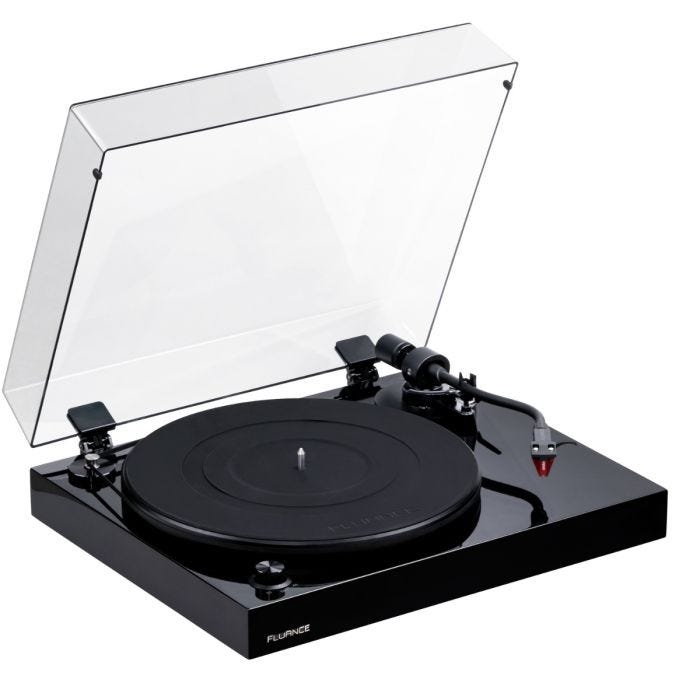
Explore this need in the finder →The Fluance RT83 Piano Black is a manual-cueing belt-drive deck whose defining package choice is its supplied Ortofon 2M Red moving-magnet cartridge. The critical fit question is not its gloss finish: this Reference model has no built-in phono preamp, so it needs a receiver or integrated amplifier with a PHONO input, or an external phono stage. This assessment uses Fluance's current US product page, model-specific entries in its shared Reference manual, and its setup support. It is not a listening test, ownership account, or claim of hands-on use.
Know what the RT83 includes—and what it does not
The US listing identifies the RT83T in Piano Black with the Ortofon 2M Red cartridge. Fluance's manual places the RT83 alongside the RT82 and RT84 in the same general Reference construction: a belt-driven, 12-inch aluminum platter with a rubber mat, 33⅓ and 45 RPM speeds, and a DC motor with servo control. It also documents a cueing lever and end-of-record auto-stop. But the deck is not a self-contained stereo system. There are RCA outputs and a ground terminal, no built-in phono stage, and no speakers or system amplifier. A turntable has to meet the rest of the chain at the right signal level.
Finish editions: check the exact identifier
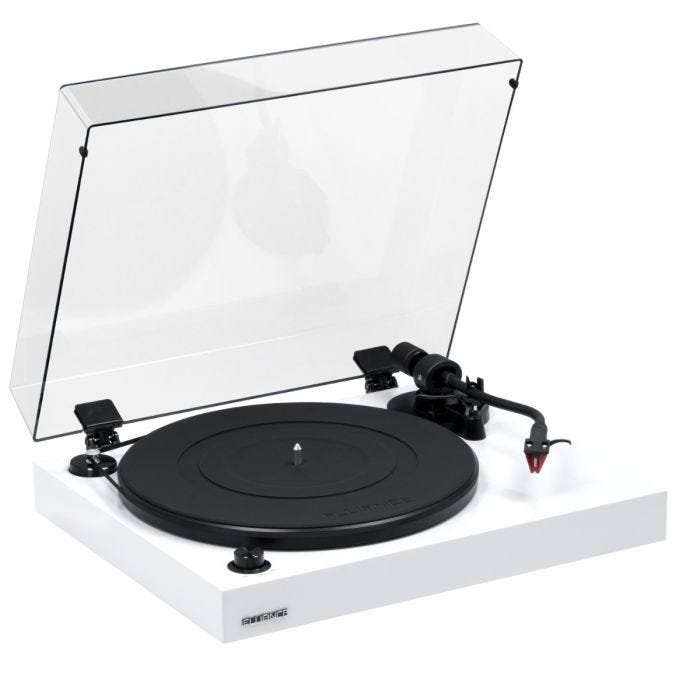
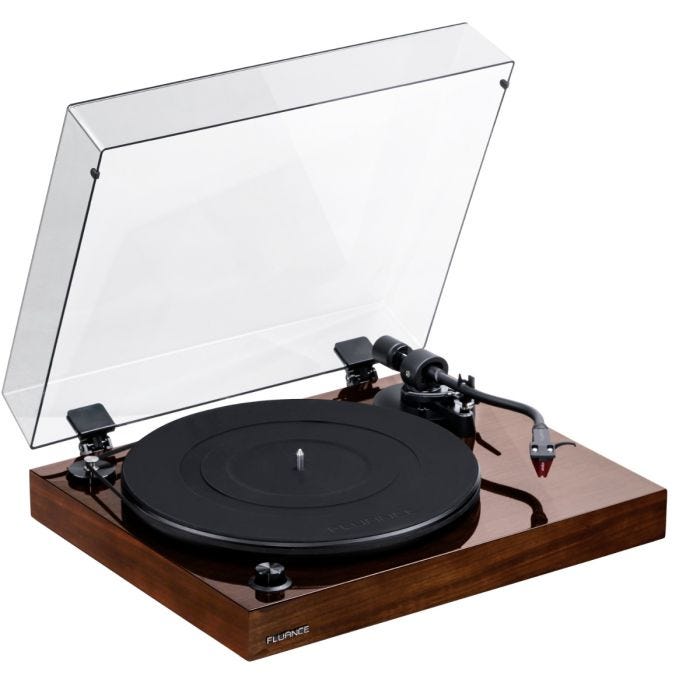
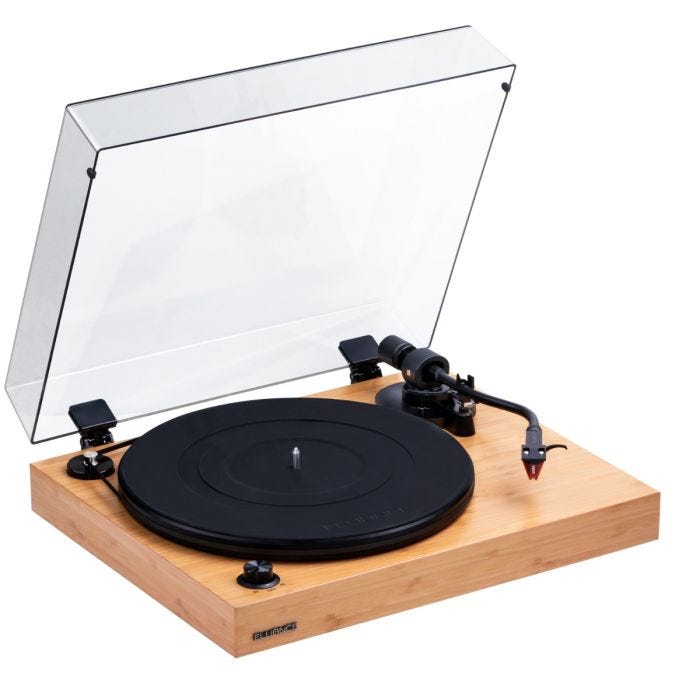
The RT83 is also listed on separate Fluance US pages as Piano White (RT83WH), Natural Walnut (RT83W), and Lucky Bamboo (RT83B). Each page names the RT83 and the Ortofon 2M Red package; its feature text documents the same belt-drive, two-speed, aluminum-platter and no-built-in-phono-stage configuration as the black edition. Those are real finish-specific page identities, not extra cartridge or speaker bundles, and this review's operating assessment applies to those documented RT83 finish variants. The separate manufacturer item identifiers should still be checked in an offer; the sources do not establish independent retail barcodes. A page-level oddity deserves caution: the black, white and bamboo pages declare the Walnut URL as their canonical, even while each has its own title, visible finish and product-item identifier. I therefore rely on the individual page titles, colors and identifiers—not that shared canonical—to keep the editions distinct. The official images below show the three alternate finishes; they are not images of the black unit.
Resolve the phono route before shopping
If your receiver has a compatible PHONO input, connect the RT83's RCA leads and ground wire there; that input provides the phono amplification. For powered speakers that take only a line signal, put a separate phono stage between turntable and speakers. With passive speakers, the chain needs both a phono stage and an amplifier or receiver. Fluance documents these system paths and says all its turntables require external speakers. An AUX, CD or LINE input is not a substitute for PHONO when the turntable itself has no stage.
This is the RT83's main practical tradeoff. People whose systems already include PHONO may not need another component. Someone starting with powered speakers should price, place and connect a separate phono stage as part of the system plan—not discover the requirement after choosing the deck. When using an external stage, follow its grounding instructions and avoid routing phono-level output into a line input before amplification/equalization.
Its model-specific advantage is a cartridge package, not a promise
The RT83 differs from the nearby RT82 and RT84 most clearly in the supplied cartridge: Fluance lists an OM10 on RT82, a 2M Red on RT83, and a 2M Blue on RT84. All three use the aluminum platter and rubber mat. Fluance's support material says the 2M Red and 2M Blue share a cartridge body and identifies the 2M Blue stylus as an option for the Red. That gives an owner a documented replacement/upgrading path to investigate, but it is not a reason to assume an audible result or skip setup instructions. The RT85 and RT85N change the platter to acrylic and are supplied with different cartridge choices; those are different packages, not just renamed RT83s.
The manual maps the RT83 to a 2M Red replacement stylus, a 7.2-gram supplied cartridge, and a 1.6–2.0 g tracking-force range. Fluance's setup support specifies 1.8 g as the setting for the included 2M Red and uses the same value as the initial anti-skate setting. The broader 5.0–7.5 g supported cartridge-weight range is only one fit condition; cartridge height, geometry, alignment and the manufacturer's compatibility guidance still matter. It should not be read as a guarantee that any cartridge within that weight will work well.
Auto-stop does not remove the manual routine
The RT83 has an auto-stop switch, but the operation remains hands-on. Fluance's manual has the user raise the cue lever, move the arm over the record and lower it. At the end, the platter stop takes about 30 seconds, and the manual warns that some records may not trigger the feature correctly. It does not document automatic arm lift or return. If you need one-button start and automatic end-of-record arm handling, this is the wrong kind of automation; if you are comfortable cueing the arm and want a platter stop, the distinction is more modest.
Budget setup time and shelf space
The shared Reference setup sequence involves fitting the platter and belt, counterweight, headshell and dust-cover hinges, leveling the deck, balancing the arm, setting tracking force and anti-skate, and connecting RCA, ground and power. That is a real setup checklist, not a plug-in-and-play claim. Keep the stylus protected while assembling and use the manual in order; small alignment mistakes can create handling problems or poor tracking. Fluance lists the body at 16.5 inches wide, 13.75 inches deep and 5.5 inches tall. Leave room beyond those numbers for cables, hand access and raising the cover. The manual prints 6.4 kg and 14.99 lb, which do not convert consistently; neither figure is used here as a reliable carrying comparison.
Who should shortlist it?
Consider the RT83 if you have a suitable PHONO input or are willing to add a phono stage, accept manual cueing, and want the 2M Red as the included cartridge rather than the OM10 or 2M Blue packages. Pause if your only available connection is AUX/LINE and you do not want another stage, if you need a fully automatic arm, if you require 78 RPM, or if you expect an all-in-one player with speakers. Also confirm the exact RT83 Piano Black model, cartridge and condition in the offer; a used or open-box package may not contain every setup part.
Fluance's feature descriptions are not independent proof of sound quality, so this review focuses on verifiable setup and package facts. See the manufacturer's RT83 Piano Black page, its Piano White page, Natural Walnut page, Lucky Bamboo page, the RT82/RT83/RT84 manual and Fluance's model comparison support before selecting a specific package. No current price, seller stock or offer condition is asserted.
Key specifications
Key details at a glance
| Drive | Belt drive |
|---|---|
| Documented record speeds | 33 1/3 RPM / 45 RPM |
| 78-RPM play option | No |
| Included cartridge | Ortofon 2m red moving-magnet |
| Built-in phono preamp | No |
| Manual tonearm cueing | Yes |
| End-of-record platter stop | Yes |
| Platter | Aluminum |
| Platter mat | Rubber |
| Body width | 16.5 in |
| Body depth | 13.75 in |
| Body height | 5.5 in |
| Published phono output | 5.5 mV |
Use the exact model’s instructions for operating limits, supplied equipment and version differences.
Sources for this review
Sources for this assessment
- RT83 Reference Turntable with Ortofon 2M Red Cartridge — Piano Black
- Fluance RT82, RT83, RT84 User Manual v2.5
- Which turntable should I buy? — Fluance Support
- How to set up the Reference Turntables from Fluance (RT82, RT83, RT84, RT85)
- Fluance RT82/RT83/RT84/RT85 Turntable First Time Set Up and FAQs
- What do I need to set up a Reference Series turntable?
Check your phono route before choosing
Check each model's documented input route, arm operation, and body limits. Use the finder to compare supported phono-system arrangements without assuming adjacent models share features.