
Your needs, this model
Does it fit your priorities?
Can the RT87 with AT-VM95ML use a receiver's PHONO input?
Yes, when the receiver or integrated amplifier has a compatible moving-magnet PHONO input. Fluance specifies no internal phono stage on this RT87; connect its RCA output and ground lead to the amplifier's PHONO and ground terminals, then use that amplifier for the speakers. Confirm the receiver input and grounding instructions.
Explore this need in the finder →Can the RT87 with AT-VM95ML connect to line-input powered speakers without another box?
No. The turntable outputs phono level and has no built-in preamp. Put a compatible external phono stage between the RT87 and powered speakers' line input, and follow the stage's ground instructions. A line input on powered speakers is not a substitute for cartridge equalization.
Explore this need in the finder →Does the RT87 auto-stop make its AT-VM95ML version an automatic turntable?
No. The RT87 remains manually cued; the v1.0 manual describes an approximately 40-second platter stop after a record end and warns that some records may not trigger it. The feature does not lift or return the arm.
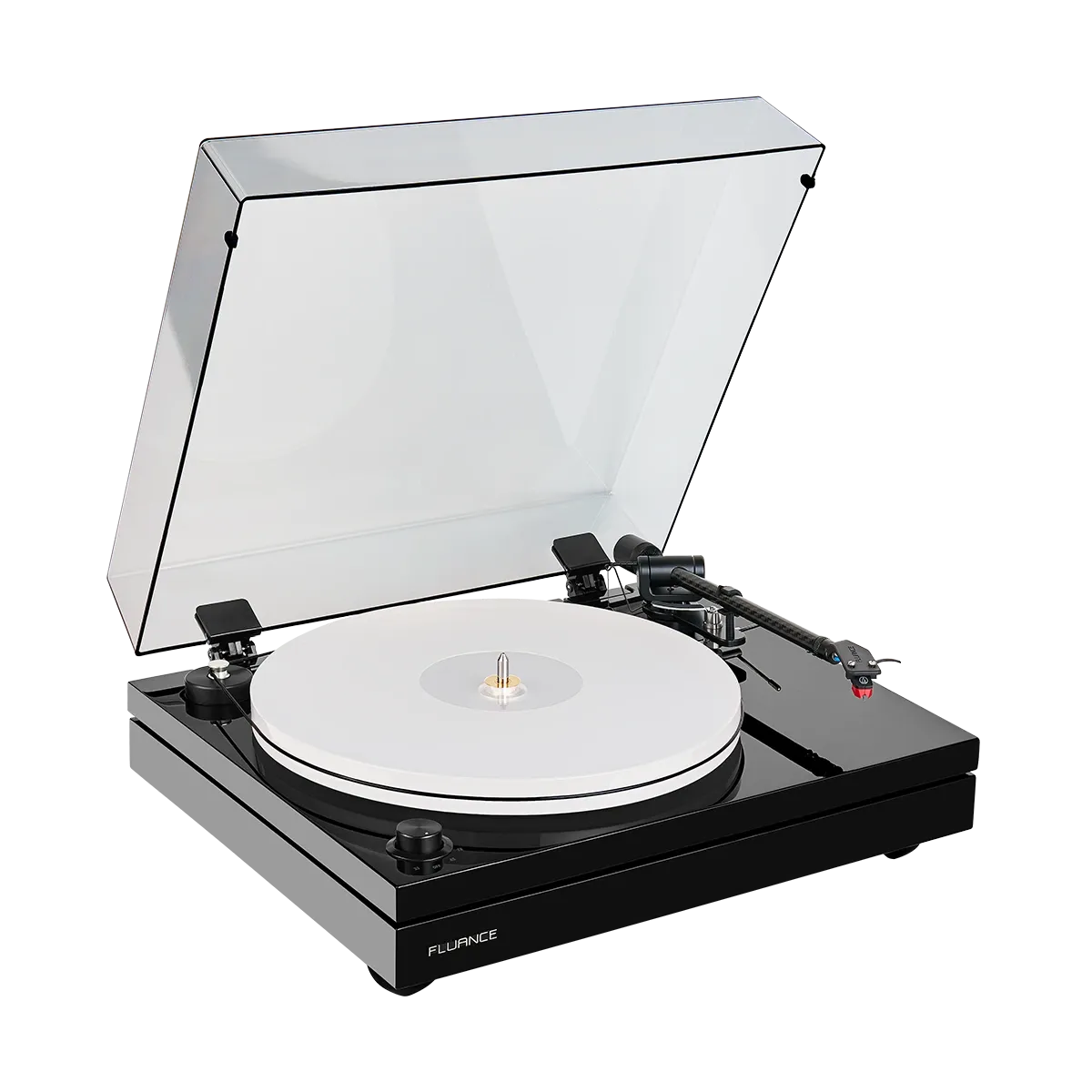
Explore this need in the finder →The Fluance RT87 with Audio-Technica AT-VM95ML is the MicroLine-equipped version of Fluance’s current dual-plinth turntable. It shares the 2M Blue package’s acrylic platter, belt drive and adjustable carbon-fiber arm, but uses different cartridge settings: 2.0 g tracking force and anti-skate notch 3, rather than 1.8 g and notch 2. This is a source-based assessment, not a claim of product use or listening tests.
Exact model and finish identity
This is the current Piano Black item RT87TVM95ML. Natural Walnut (RT87WVM95ML) and Piano White (RT87WHVM95ML) have separate pages and exact images, although their canonicals point to Black; check the visible finish and item ID.
The other RT87 package supplies an Ortofon 2M Blue. Fluance lists 3.5 mV output for this VM95ML versus 5.5 mV for the 2M Blue, and the cartridge identity changes loading and replacement-stylus checks. Both need a compatible MM phono stage. See the separate 2M Blue assessment; the shared RT87 name alone does not identify the cartridge.
Connect the system before comparing features
The deck has no phono preamp or line output. Use its RCA and ground terminal with a compatible receiver PHONO input, or route it through an external phono stage. For powered speakers, use turntable → MM stage → speaker LINE input; passive speakers also need a power amplifier. Do not feed a line-level stage output into an active PHONO input.
The maker lists a 90 pF RCA cable, ground wire and 100–240 V AC / 12 V DC 500 mA adapter. Check the receiver or stage loading and grounding instructions; the AT-VM95ML page specifies 47 kΩ and 100–200 pF. The stage, receiver and speakers are separate equipment.
Cartridge-specific setup and replacement
The supplied AT-VM95ML is a moving-magnet cartridge with a MicroLine stylus; Fluance names AT-VMN95ML as its replacement. The v1.0 manual specifies 2.0 g tracking force and notch 3 (1.9–2.2 g with the included headshell and counterweight). Do not borrow the 2M Blue’s 1.8 g / notch-2 setting. The cartridge is listed at 6.1 g and 17.2 mm high. Rebalancing, alignment and force checks remain necessary after a change; adjust VTA only with the arm locked and stylus off the record.
The RT87 arm is a one-piece carbon-fiber tube with H-4 bayonet headshell and half-inch mount; Fluance lists 16.5 g effective mass and 6 mm VTA adjustment. A compatible mount alone does not establish that a replacement fits: check the supported cartridge weight/height, alignment and phono-stage loading. On a used deck, verify the exact cartridge and stylus rather than relying on the listing title.
What stays the same across the two RT87 packages
The belt-drive servo motor offers 33 1/3, 45 and 78 RPM; the 12-inch acrylic platter weighs 4.1 lb and needs no separate mat, according to Fluance. The deck is manual-cueing with auto-stop. Its listed body is 16.5 inches wide, 14.25 deep and 6.3 inches high (±0.5); its 21 lb weight and operating clearance matter to placement. Allow more room than the body footprint for cables, arm access and cover travel.
For shellac 78s, Fluance recommends a 78-specific stylus and optional CW86 counterweight for its 5–7.2 g, 2–5 g-force cartridge range. The stock VM95ML stylus is not identified as that 78 stylus. Check the full combination before use. A 45 adapter is mentioned when needed but is not named in the included-parts list.
Auto-stop is not automatic arm handling
Fluance labels the RT87 as not fully automatic. The cue lever assists manual placement; the listener still moves the arm and handles it at the record end. The v1.0 manual describes an approximately 40-second delayed platter stop after the stylus reaches the end, but warns that record manufacturing differences can prevent a correct trigger. The feature does not lift or return the tonearm. If automatic arm start, lift or return is essential, the RT87 does not document that routine.
Setup documents differ on transit protection: the online First Time Setup page says to remove three screws, while the July 2026 manual says two. Check the instructions supplied with the exact deck; do not force a screw. Setup also includes belt and platter fit, balance, force and anti-skate, leveling and the selected phono/ground route.
Who should keep comparing
Keep this package in the comparison if the supplied AT-VM95ML is a deliberate choice, the system has a suitable MM stage, manual cueing is acceptable and the heavy body fits with working clearance. Its main costs in the buying decision are the missing internal stage, setup steps and cartridge-specific 2.0 g / notch-3 routine—not a proven sound advantage. Confirm the item ID, finish, AT-VMN95ML stylus condition and included parts. Read the RT87 setup checklist, compare the 2M Blue configuration and use the phono-stage guide.
Key specifications
Key details at a glance
| Drive | Belt drive |
|---|---|
| Documented record speeds | 33 1/3 RPM / 45 RPM / 78 RPM |
| 78-RPM play option | Yes |
| Included cartridge | Audio-technica at-vm95ml moving-magnet cartridge; manufacturer page identifies a microlinear stylus |
| Built-in phono preamp | No |
| Manual tonearm cueing | Yes |
| End-of-record platter stop | Yes |
| Platter | Acrylic |
| Platter mat | None required per manufacturer |
| Body width | 16.5 in |
| Body depth | 14.25 in |
| Body height | 6.3 in |
| Published phono output | 3.5 mV |
Use the exact model’s instructions for operating limits, supplied equipment and version differences.
Sources for this review
Sources for this assessment
- RT87 Reference Dual-Plinth Turntable — AT-VM95ML, Piano Black
- Fluance RT87 User Manual v1.0, July 2026
- Fluance Reference Series RT87 Turntable First Time Set Up and FAQ
- RT87 Frequently Asked Questions
- Fluance US Turntables catalogue and RT87 comparison entries
- RT87 with AT-VM95ML — Natural Walnut
- RT87 with AT-VM95ML — Piano White
Check your phono route before choosing
Check each model's documented input route, arm operation, and body limits. Use the finder to compare supported phono-system arrangements without assuming adjacent models share features.