
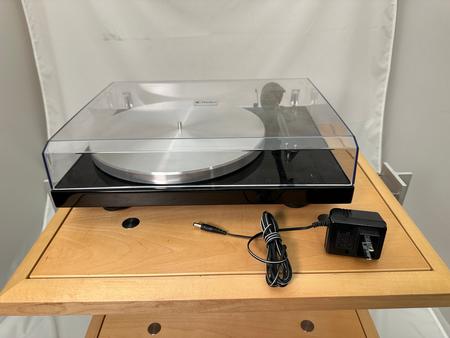
Your needs, this model
Does it fit your priorities?
Can this earlier 1Xpression Carbon Classic use a receiver PHONO input?
Yes, if the exact unit still has a usable Ortofon 2M Silver and the receiver PHONO input accepts a moving-magnet cartridge at the documented 47 kOhm load. The deck has phono-level output and no built-in stage; connect its ground lead as directed.
Explore this need in the finder →Can I connect the 1Xpression Carbon Classic directly to powered-speaker LINE inputs?
No. The exact Carbon Classic manual says ordinary line inputs are unsuitable; add a compatible MM phono stage between the phono-level turntable output and the powered speakers’ LINE input, after confirming the cartridge and exact unit.
Explore this need in the finder →Does the exact 1Xpression Carbon Classic package automatically stop at record end?
The exact manual documents a manual motor switch and arm lift, but I could not verify record-end auto-stop or automatic return. Treat auto-stop as unknown, not as a confirmed absent or present feature; manual cueing is required.
Explore this need in the finder →Can I use the Carbon Classic with passive speakers if my amplifier lacks PHONO?
Yes, with a compatible MM external phono stage before the amplifier’s LINE/AUX input; the amplifier must still drive the passive speakers. Verify the seller unit retains the named 2M Silver and required parts.
Explore this need in the finder →This is a source-led assessment of the Pro-Ject 1Xpression Carbon Classic configuration identified by an Acoustic Sounds item titled “1Xpression Turntable,” marked “With Power Cable,” and described as having a carbon-fiber tonearm with an Ortofon 2M Silver cartridge. The exact seller item does not specify a finish or itemize the complete carton. Pro-Ject’s archive classifies the 1Xpression Carbon Classic among products no longer in manufacture, so this is an earlier-model assessment, not a statement that a particular offer or condition is currently available.
What the exact package evidence establishes
The seller’s title is broader than the model name in Pro-Ject’s matching 2014 manual and product sheet: both identify a 1Xpression Carbon Classic with an Ortofon 2M Silver. The exact manual describes an 8.6-inch Carbon Evo tonearm, a belt-driven platter and a factory-fitted cartridge option; the seller description independently names the Silver cartridge for its item. The dealer’s “With Power Cable” label and its product number, EVTT P1XP, are retailer-specific evidence. They do not establish a Pro-Ject model code, finish, present stock, used/open-box status or every part in a particular box.
Mechanically, the Carbon Classic is a manual two-speed design. The manual explains changing between 33 and 45 RPM by moving the belt between pulley steps. Its 78 RPM entry is explicitly optional and calls for a special pulley, so do not assume that part is included with this seller package. The arm is cued by hand using its lift lever; speed selection and a motor switch are not automatic arm handling. The examined manual does not establish an automatic end-of-record stop or arm return. If automatic operation or a verified stop is essential, this earlier manual deck is not a supported substitute.
Choose a phono route before placing it
The Carbon Classic does not provide a built-in phono preamplifier. Its manual identifies the RCA connectors as phono output sockets, directs the owner to a suitably matched amplifier PHONO input and says ordinary line inputs are unsuitable. If the system has only powered-speaker LINE inputs, or an amplifier’s AUX/LINE input, an external phono stage must go between the turntable and that line-level input. A compatible receiver PHONO input can supply the stage instead. The manual also calls for connecting the tonearm lead’s earth wire when the amplifier has an earth terminal.
The exact seller item names the 2M Silver, and Pro-Ject’s manual describes it as a moving-magnet cartridge for a 47 kΩ/MM input. Ortofon’s historical 2M Silver page also specifies a 47 kΩ load, which is the useful compatibility point. Their published output figures differ: Pro-Ject’s exact manual lists 4 mV while Ortofon’s historical page lists 5.5 mV. I leave that discrepancy explicit rather than treating either number as a settled output measurement. It does not change the documented MM-input requirement. If buying a used unit, check the fitted cartridge and stylus actually match the listing; do not rely on a seller title or photograph alone.
Body size and setup are part of the decision
Pro-Ject lists a 415 × 130 × 335 mm body (width × height × depth), approximately 16.34 × 5.12 × 13.19 inches, and a net weight of 5.5 kg. The same manual gives a 415 × 400 × 400 mm dimension with the dust cover open. That larger operating envelope matters on a shelf: allow room for the raised lid, hand access to the arm, cable bends and stable support, rather than matching only the closed body dimensions. The deck should be leveled on its adjustable feet, and the manual calls for care with belt and cartridge setup.
The product sheet describes an aluminum sandwich platter with TPE damping and a felt mat; the manual documents the arm’s counterweight and anti-skating setup. These details help explain what the design asks of its owner, but they are not a claim about audible performance. This assessment is based on documents and the exact seller description, not hands-on listening, ownership or measurements.
What to verify on an earlier unit
The manufacturer product sheet lists a dust cover and 15 V power supply as model accessories, but the retailer page does not provide a complete carton inventory. Confirm the exact unit includes the correct supply and adapter, cover and hinges, platter, belt, counterweight, anti-skating weight, phono lead and ground connection. Ask whether the optional 78 pulley is present if that speed matters. Check the seller’s condition statement, stylus history, platter bearing, belt state and that the arm lock and setup parts have not been lost in storage or transport. The manual’s required PHONO connection and its MM loading guidance should also be checked against the exact receiver or external stage.
The 1Xpression Carbon Classic is therefore best considered as a manually operated, phono-level, earlier deck for a buyer prepared to verify an older item’s cartridge, parts and condition. Its documented dimensions, 2M Silver package identity and straightforward receiver-PHONO or external-stage routes make the configuration assessable; they do not remove the need to confirm the exact seller unit. Review the phono-stage route guide before matching it to a system.
Key specifications
Key details at a glance
| Drive | Belt drive |
|---|---|
| Documented record speeds | 33 1/3 RPM / 45 RPM / 78 RPM with an optional special pulley; included status and a suitable cartridge/stylus for the exact item are unverified |
| 78-RPM play option | Yes |
| Included cartridge | Ortofon 2m silver moving-magnet cartridge is named by the exact seller listing and exact model manual; verify that the particular earlier unit still has it. |
| Built-in phono preamp | No |
| Manual tonearm cueing | Yes |
| Platter | Aluminum sandwich platter with tpe damping; felt mat described in the official product sheet |
| Body width | 16.34 in |
| Body depth | 13.19 in |
| Body height | 5.12 in |
Use the exact model’s instructions for operating limits, supplied equipment and version differences.
Sources for this review
Sources for this assessment
- Acoustic Sounds exact 1Xpression Turntable item 191090
- Pro-Ject 1 Xpression Carbon Classic / Ortofon 2M Silver user manual, revision 2014-02-25
- Pro-Ject 1Xpression Carbon Classic product information sheet (German)
- Pro-Ject product archive
- Ortofon 2M Silver historical product page
- Acoustic Sounds exact item image-browser page
Check your phono route before choosing
Check each model's documented input route, arm operation, and body limits. Use the finder to compare supported phono-system arrangements without assuming adjacent models share features.