
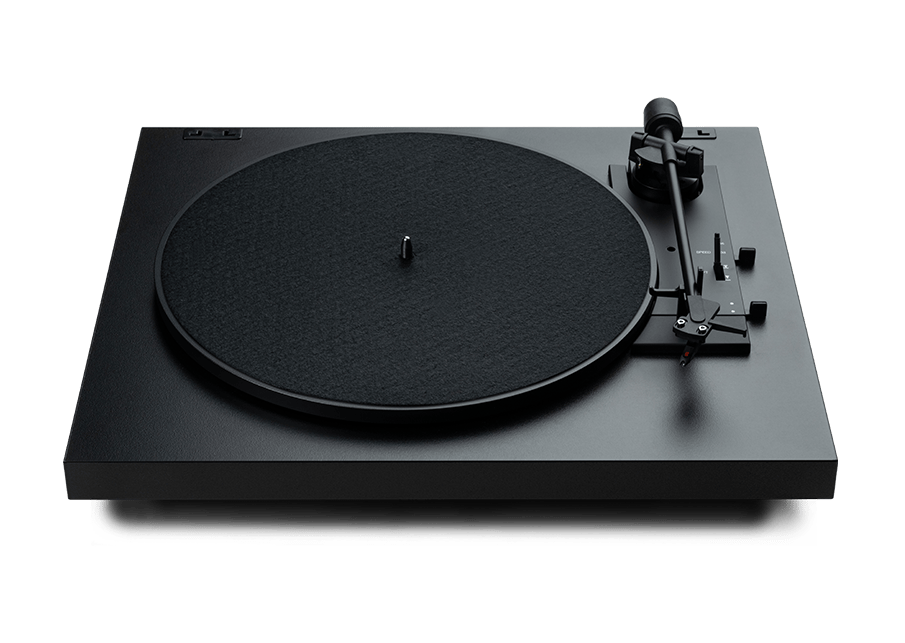
Your needs, this model
Does it fit your priorities?
Can the black U.S.-listed OM10 A1.2 connect to a receiver PHONO input?
Yes, if the receiver input supports the included OM10 moving-magnet cartridge and the A1.2's built-in stage is switched off. With that stage enabled, send its line-level output to a line input instead of another PHONO stage.
Explore this need in the finder →Can I use the A1.2 with line-input powered speakers without buying another phono stage?
Yes. The A1.2's built-in MM stage is switchable; leave it on and connect the supplied RCA lead to the speakers' analog line input. Confirm the speaker input type and don't stack the internal stage into a PHONO input or another stage.
Explore this need in the finder →Will its automatic routine start every 45 RPM disc correctly?
No. The manual says the automatic 45-RPM start position is intended for 7-inch singles. A 45-RPM 10- or 12-inch record needs a manual start, although the model still documents automatic arm return and platter stop at record end.
Explore this need in the finder →The Pro-Ject A1.2 is unusual in this library because it makes the whole record-end routine part of the decision: press start, let the arm find the lead-in groove, and the manual says it lifts and returns at the end while the platter stops. The U.S.-listed black package I could verify pairs that mechanism with an Ortofon OM10 cartridge and a switchable moving-magnet phono stage. This is an evidence-based assessment of the documented package, not a hands-on listening or setup test; current U.S. seller availability is not established.
Automatic start is more than platter auto-stop
The official A1.2 product page describes the current model as fully automatic, and the model-specific user guide explains what that means in operation. With a record and speed selected, the start lever engages the mechanism and positions the arm at the record lead-in. At the end, the arm lifts and returns to its rest; the platter stops. That is materially different from an auto-stop-only machine that still expects the listener to lift and put away the arm. The manual also allows a manual-start routine, so hands-on cueing is possible without turning the A1.2 into a fully manual-only deck.
There is an important format boundary: its automatic 45-RPM start position is arranged for a 7-inch single. Pro-Ject says a 45-RPM 10- or 12-inch record should be started manually. The deck still provides its end routine, but the start position is not a universal size detector. If your collection includes large-format 45s, be comfortable following the manual start procedure and positioning the arm yourself. The published speeds are 33⅓ and 45 RPM; no 78-RPM mode is specified in the checked product information.
A useful connection choice, if the switch is set correctly
The built-in MM phono stage is switchable, which gives the A1.2 two different analog paths. With the internal stage on, its RCA output is ready for a line-level input such as AUX on an amplifier or analog line input on powered speakers. If your receiver already has a compatible moving-magnet PHONO input, or you prefer an external MM phono stage, switch the A1.2's internal stage off and route its phono-level output to that stage. The manual describes the switch as accessible by moving the platter to reach it, so this is a setup choice to check before wiring rather than a front-panel toggle to assume you can change casually in use.
The supplied RCA lead has an earth wire for phono-level use; the user guide says grounding is not needed when the built-in stage is supplying line-level output. Passive speakers still require an amplifier, whether the phono stage is internal or external. Powered speakers need a line input for the built-in-stage route. Avoid running the internal stage into another PHONO input: that stacks equalization and gain. Check the labels on the exact receiver or speaker before choosing a plan.
Package identity and the OM10
The current global manufacturer sheet shows black and white finish options and names both Pick it MM E and Ortofon OM10 cartridge packages, but it does not map the finish to cartridge or establish U.S. distribution. For this U.S. assessment I retained the narrower black OM10 package named by two U.S. retailer product records rather than treating global alternatives as interchangeable stock. The white global finish remains a separate market/package lead, not a confirmed U.S. review or an image-backed match here. One seller record displayed a numeric code that conflicts with the second retailer's displayed model/UPC; neither number is presented here as a resolved manufacturer SKU. Ask the seller to confirm the cartridge in the actual box, especially if a listing reuses a product template. The official picture shown here is an A1.2 image, not proof of a particular seller's current inventory.
Pro-Ject lists the OM10 as an MM cartridge, and the manual describes a factory-installed, pre-aligned cartridge for its usual setup. That reduces initial alignment work compared with a cartridge-less deck, but any replacement or major setup still belongs to the model instructions and the specific cartridge. A bundled phono stage and cartridge do not add speakers, amplifier power for passive speakers, Bluetooth, or USB recording; this is a turntable, not a complete stereo system.
Footprint and first setup
The manufacturer gives body dimensions of 430 × 130 × 365 mm, approximately 16.93 × 5.12 × 14.37 inches, and a net weight of 5.6 kg. Treat that as the body envelope only. Leave extra rear room for the RCA and power connections and enough space to reach the controls and lift or remove the hinged cover. A shelf cap close to 17 inches wide or 14.5 inches deep can accommodate the published body figures, but those values do not establish working clearance.
The user guide starts with unpacking and a level surface, then describes fitting the dust-cover hinges, removing transport protection, and connecting the supplied 15V/0.8A power supply. The included list also names the platter mat, 7-inch adapter and RCA lead. Keep the packaging if future transport is possible, and stop if the unit or contents arrive damaged. The user guide, not the marketing phrase “plug and play,” is the authority for the exact assembly and safe first record.
Who should shortlist it—and what to verify
The A1.2 is worth considering if you want arm automation at both ends of a record, a switchable internal MM stage, and a conventional 33/45 record routine, while accepting its size-specific 45-RPM start limitation. It contrasts with the simpler fully automatic AT-LP60X family by offering a selectable internal stage and a documented manual-start option, though the AT models offer their own cartridge and connectivity differences; this is not a sound-quality ranking. A listener who wants large 45s to start automatically, a 78-RPM option, wireless playback, or a fixed, confirmed seller package code should check alternatives or resolve those points before buying.
Before ordering, confirm the exact A1.2 generation, black finish and Ortofon OM10 contents; ask about the conflicting product code if the seller uses one; check which condition and return terms apply to the actual unit; and verify local stock directly. Match the stage switch to PHONO versus LINE, confirm speaker amplification needs, and reserve operating clearance beyond the published body size. The listing pages checked here showed no reliable live-availability basis, so this review does not claim that the model is currently in stock or state a current price.
Key specifications
Key details at a glance
| Drive | Belt drive |
|---|---|
| Documented record speeds | 33 1/3 RPM / 45 RPM |
| 78-RPM play option | No |
| Included cartridge | Ortofon om10 moving-magnet cartridge in the u.s.-listed black package |
| Built-in phono preamp | Yes |
| Manual tonearm cueing | Yes |
| End-of-record platter stop | Yes |
| Platter | Die-cast aluminium |
| Platter mat | Felt |
| Body width | 16.93 in |
| Body depth | 14.37 in |
| Body height | 5.12 in |
Use the exact model’s instructions for operating limits, supplied equipment and version differences.
Sources for this review
Sources for this assessment
Check your phono route before choosing
Check each model's documented input route, arm operation, and body limits. Use the finder to compare supported phono-system arrangements without assuming adjacent models share features.