
Your needs, this model
Does it fit your priorities?
Can this A2 connect to an ordinary receiver PHONO input?
Yes, if that input is a suitable MM PHONO input: the A2 has no built-in phono stage, and the included Sumiko Rainier is a moving-magnet cartridge. Connect the RCA and earth wire as the A2 manual directs. A receiver with only line inputs would need a separate MM phono stage first.
Explore this need in the finder →Is the A2 ready to play shellac 78s with the stylus in the U.S. package?
Do not assume so. The A2's electronic speed selector includes 78 RPM, but the manual says 10-inch 78s need manual starting, and Sumiko advises against playing shellac with a 33/45 microgroove stylus. Sumiko's RS78 replacement stylus is compatible with Rainier, but it is a separate stylus and is not listed in the A2's documented box contents.
Explore this need in the finder →Does automatic playback mean I never handle the arm?
No. The A2 starts and returns the arm automatically on its documented 7- and 12-inch positions and stops the motor at the end, but the 10-inch 78-RPM case is expressly a manual start. Manual cueing is also described more generally in the guide, so verify each record's speed, size and stylus before playing it.
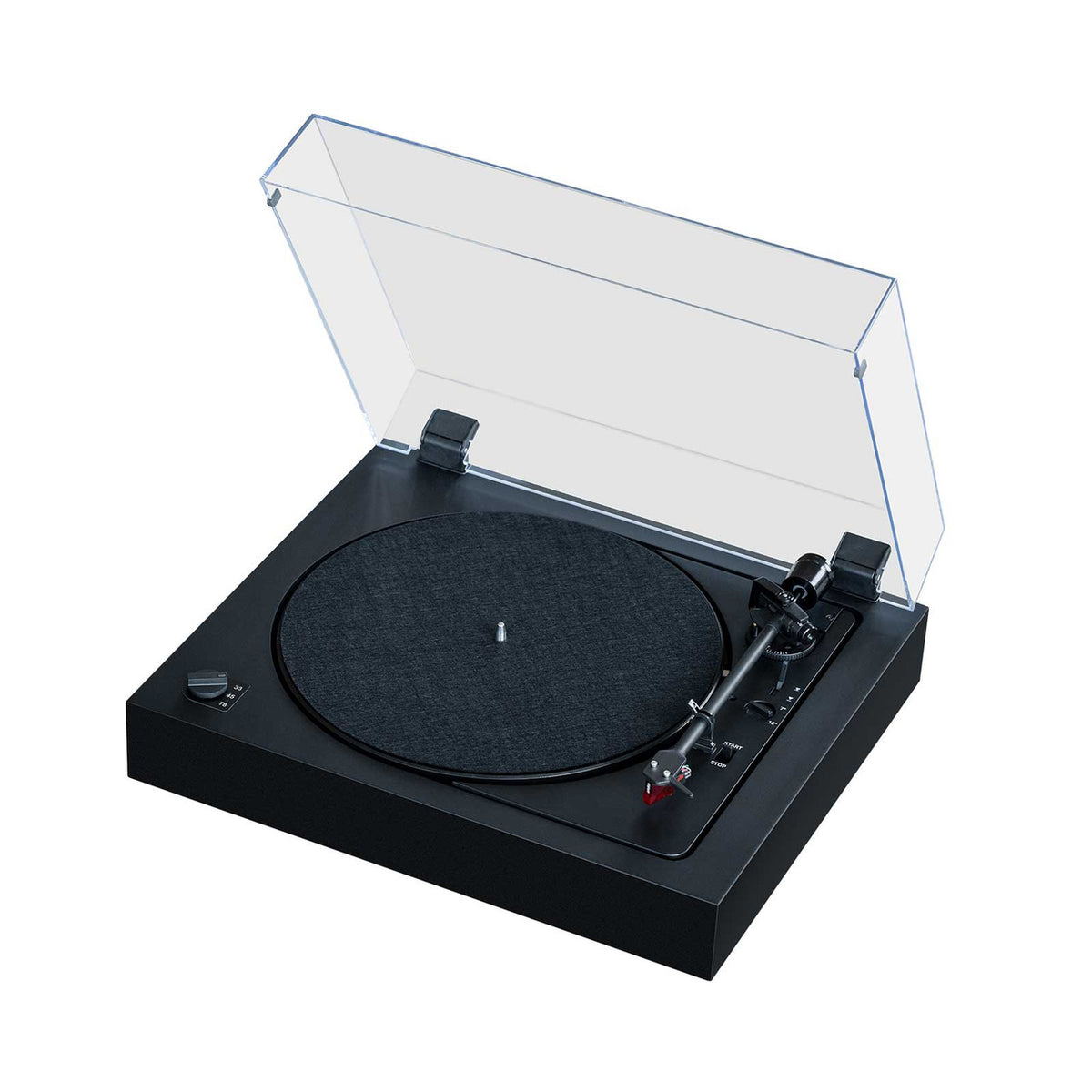
Explore this need in the finder →The Pro-Ject Automat A2 is the more format-flexible sibling to the A1.2 in this library, but it is not simply the A1.2 with another speed button. The documented U.S. package pairs the black A2 with a Sumiko Rainier moving-magnet cartridge; the turntable itself has no built-in phono preamp. It adds electronic 78-RPM selection and retains automatic arm handling, with a manual-start exception that matters for 10-inch 78s. This is an assessment from model-specific documents and U.S. listing records, not a hands-on listening, setup or measurement test. Seller inventory, exact offer condition and current price are not established here.
78 RPM is a speed feature, not a ready-made shellac setup
The A2's electronic speed selector includes 33⅓, 45 and 78 RPM. That is a meaningful expansion over the two-speed A1.2, but speed alone does not make the supplied stylus suitable for every 78 collection. Pro-Ject's user guide identifies the U.S.-shipped cartridge as the Sumiko Rainier. Sumiko describes the ordinary Rainier stylus as an elliptical microgroove tip and advises against using a 33/45 stylus on shellac 78s. Its separate RS78 replacement stylus is made for 78-RPM records and is listed as compatible with Rainier. The A2's documented in-box contents do not list an RS78, so verify whether the seller includes one rather than assuming that selecting 78 is all the format requires. The A2 provides a 2 g setting for the standard Rainier; Sumiko gives the RS78 its own tracking-force range and recommended setting, so changing the stylus also means following the stylus-specific instructions.
There is also a size-and-start boundary. The automatic drop-off control offers 7- and 12-inch positions; Pro-Ject's manual explicitly says a 10-inch 78 must be started manually. Manual placement is therefore part of the real shellac workflow, even though the turntable still returns the arm at the end. On supported automatic starts, select speed and record size deliberately: the guide warns that 12-inch records can be cut at either 33 or 45 RPM. Do not let a size selector stand in for checking the label on the record.
Plan the phono stage before choosing the A2
The manual says the A2 needs either a suitable MM phono preamp or a suitable MM PHONO input on an amplifier. It provides RCA phono output and a ground terminal; it does not document a switchable or built-in stage. With a compatible receiver or integrated amplifier, connect the A2's phono lead to its MM PHONO input and follow both manuals for the earth wire. With powered speakers, put a separate MM phono stage between the turntable and the speakers' line input. Passive speakers need an amplifier too: use a separate stage into the amplifier's LINE/AUX input unless that amplifier already provides the compatible PHONO route. A turntable's RCA plugs alone do not indicate that a line-level input can accept the cartridge's low-level signal.
This is the opposite connection decision from the A1.2's switchable internal MM stage. The A1.2 can send line level directly to powered speakers when its stage is on, while the A2 needs the external stage or receiver input as part of the system plan. That distinction is more consequential than their shared width and depth. If you are trying to avoid another component, the A2 is a poor fit unless your current amplifier already has a suitable MM PHONO input; do not buy a line-only speaker setup on the assumption that “automatic” also means “preamp included.”
Automatic does not mean every start is hands-off
For its selected 7- or 12-inch start positions, the maker describes a mechanical automatic routine: press start, the platter turns, and the tonearm moves to the lead-in groove. At the record's end the arm lifts and returns to its rest, and the motor stops. The manual also describes manual cueing and lets the user stop playback. This is broader than platter auto-stop alone, but the 10-inch 78 exception means the A2 should not be treated as an automatic size detector or as a deck that starts every record without arm handling. If fully automatic operation is essential for your ordinary LPs and singles, the documented start/return behavior is relevant; if hands-off playback is essential for 10-inch shellac, it does not meet that expectation without manual intervention.
What the sub-chassis and body measurements tell you
The official product page describes a floating sub-chassis that carries the tonearm, platter bearing and motor separately from the main chassis. Pro-Ject presents this as a way to isolate those components from outside noise and resonance, especially when speakers are nearby. The A2 also uses an 8.3-inch ultra-light-mass aluminum tonearm, a damped aluminum platter and an eight-layer MDF main chassis. Those are documented design choices, not independent proof of audible superiority in a particular room. Its published specification sheet lists 74 dB signal-to-noise, plus 33/45 speed and wow/flutter figures; it gives no separate 78-RPM wow/flutter or speed-variance figure, so there is no basis here for filling in one or comparing unmeasured performance.
The body measures 430 × 150 × 365 mm (W × H × D), or about 16.93 × 5.91 × 14.37 inches, and weighs 7.3 kg net. Width and depth are the same as the A1.2's published body figures, but the A2 is taller and heavier. These are not shelf-clearance dimensions: leave room for the raised dust cover, access to the speed and drop-off controls, cable bends and nearby equipment. Its size and weight make a level, stable surface and careful unpacking more important than treating it as a small shelf accessory. The manual describes shipping protection, belt installation, platter fitting and a 15 V / 800 mA power supply; use the included setup guide for the actual sequence rather than improvising from a product photo.
Who should shortlist it, and what to check
The A2 is worth comparing if automatic arm start and return matter, you want a documented 78-RPM speed choice, and your system already has a suitable MM phono input or you accept a separate phono stage. It also offers manual cueing when that is useful. Its tradeoffs are concrete: no internal stage, no automatic start for 10-inch 78s, a separate 78 stylus requirement for shellac, and a body that needs working clearance beyond its published dimensions. A2 is not an all-in-one receiver, Bluetooth source or speaker system.
Before choosing an offer, confirm that it is the A2 rather than a different Automat model, that the black U.S.-listed package contains the Sumiko Rainier, and whether a separate RS78 is actually included if shellac playback matters. Check the phono input's MM compatibility, grounding instructions, the measured shelf plus cover/cable clearance, and the exact carton contents and return terms. The three U.S. retailer records checked here establish package listings, not current stock or price. The global manufacturer directory also does not close the Pro-Ject U.S. catalogue, so this review is a bounded A2 package assessment rather than a claim of complete brand coverage.
Key specifications
Key details at a glance
| Drive | Belt drive |
|---|---|
| Documented record speeds | 33 1/3 RPM / 45 RPM / 78 RPM |
| 78-RPM play option | Yes |
| Included cartridge | Sumiko rainier moving-magnet cartridge in the documented u.s. version; factory-mounted according to the user guide. |
| Built-in phono preamp | No |
| Manual tonearm cueing | Yes |
| End-of-record platter stop | Yes |
| Platter | Damped aluminium |
| Platter mat | Felt |
| Body width | 16.93 in |
| Body depth | 14.37 in |
| Body height | 5.91 in |
Use the exact model’s instructions for operating limits, supplied equipment and version differences.
Sources for this review
Sources for this assessment
- Pro-Ject official global turntable directory
- Pro-Ject official A2 product page
- Pro-Ject A2 official product-information sheet
- Pro-Ject A2 official user guide, revision 2023-08-02
- Audio Advisor U.S. A2 black / Sumiko Rainier product record
- World Wide Stereo U.S. A2 product record
- Turntable Lab U.S. A2 product record
- Sumiko official Rainier moving-magnet cartridge specifications
- Sumiko official RS78 shellac stylus guidance
Check your phono route before choosing
Check each model's documented input route, arm operation, and body limits. Use the finder to compare supported phono-system arrangements without assuming adjacent models share features.