
Your needs, this model
Does it fit your priorities?
Can the Debut PRO S Balanced work with a receiver PHONO input?
Yes, with its standard RCA/ground phono output and a receiver PHONO input compatible with the included Pick it S2 C moving-magnet cartridge. Do not connect that phono signal to AUX/LINE without a phono stage. The mini-XLR socket is also phono level.
Explore this need in the finder →How can I connect the Debut PRO S Balanced to line-input powered speakers?
Route its RCA phono output through a compatible MM stage, then to the speaker LINE input. The included S2 C is not identified as Pick it PRO Balanced; for a true-balanced mini-XLR route, verify the cartridge, balanced cable and stage together before buying any optional parts.
Explore this need in the finder →What setup does the Debut PRO S Balanced need for an amplifier and passive speakers?
The included RCA output is phono level. Use a compatible MM PHONO input on the amplifier, or place an MM stage before the amplifier's LINE/AUX input; the amplifier still powers the passive speakers. The independent belt change for 78 RPM does not automate cueing.
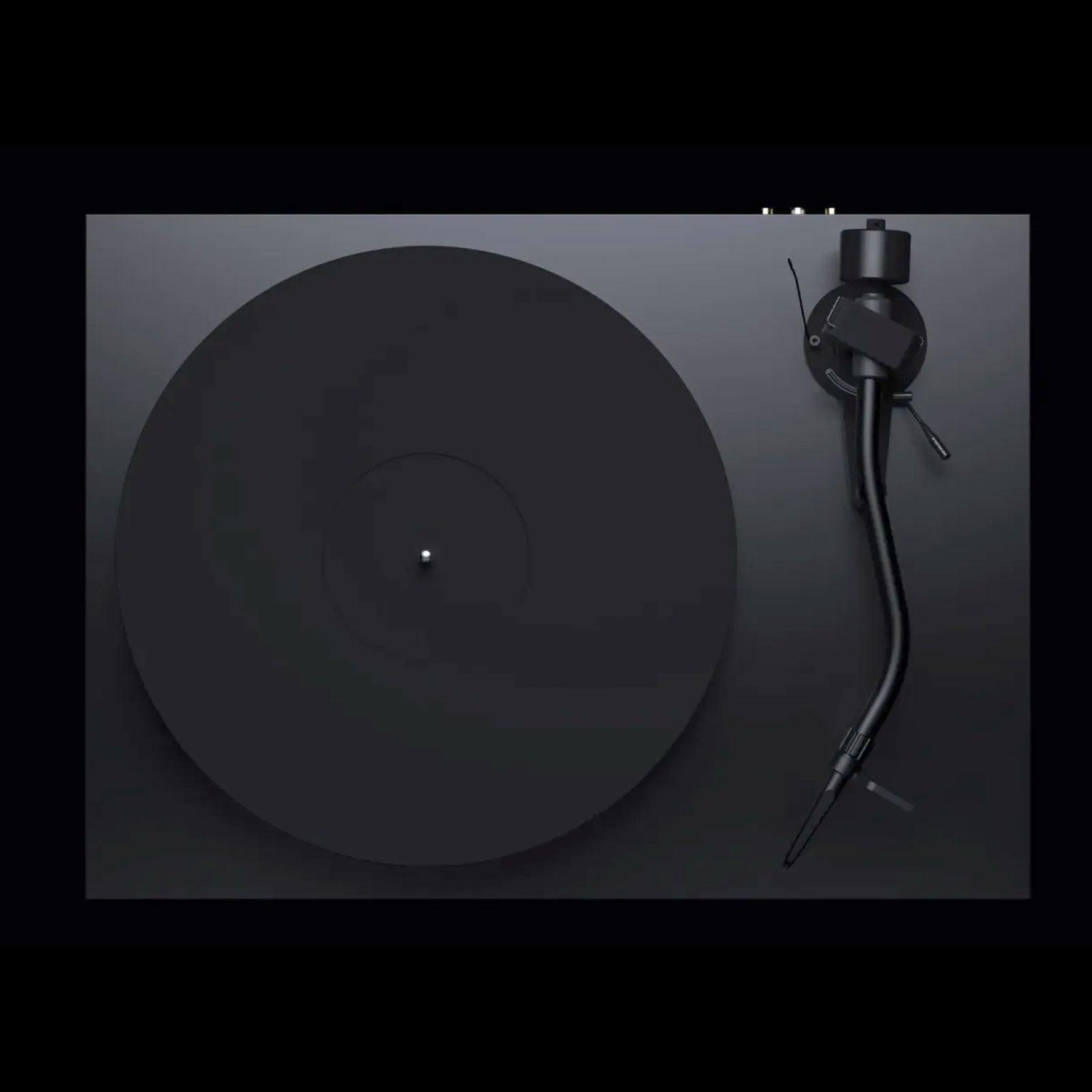
Explore this need in the finder →The Debut PRO S Balanced pairs a removable-headshell S-shaped arm with an RCA phono output and a mini-XLR connection. The important package detail is that the U.S.-facing Satin Black listing supplies a Pick it S2 C moving-magnet cartridge, not the Pick it PRO Balanced cartridge. Pro-Ject's product information says that true-balanced operation requires an MC or Pick it PRO Balanced cartridge, the correct balanced interconnect, and a compatible phono stage. The mini-XLR socket alone therefore does not turn the supplied package into a complete balanced chain. This is a document-based assessment of the identified configuration, not a listening test or claim of ownership.
A removable S-arm with a deliberate setup routine
The official product information describes a 10-inch S-shaped aluminum tonearm with an SME headshell connector. That removable headshell makes cartridge changes more convenient than a fixed-head arrangement, and the longer arm gives a different setup platform from a conventional short straight arm. It does not make alignment automatic: the supplied setup guide walks the owner through installing and balancing the arm and lowering it with the lift. A careful setup remains part of the experience, and replacement cartridges still need to be compatible with the arm and correctly aligned.
The 7 kg deck combines a die-cast aluminum platter with a TPE damping ring and a felt mat. Its electronic selector handles 33⅓ and 45 RPM. To play a 78, the user fits the supplied round belt and selects the corresponding speed; this is not a one-touch change from ordinary LP playback. The belt, puck, adapter, dust cover, power supply and pre-adjusted S2 C cartridge are listed in the official package information. Before relying on a retail offer, verify that the exact version still includes those parts rather than assuming a seller title tells the whole story.
Plan around the cartridge and both output sockets
The standard RCA connection is a conventional moving-magnet phono-level route. It can feed a compatible receiver or integrated amplifier PHONO input, or a separate MM phono stage placed before powered speakers or an amplifier's LINE/AUX input. Passive speakers still need an amplifier. The mini-XLR output is also phono-level. Pro-Ject describes true-balanced operation only with an MC or Pick it PRO Balanced cartridge and a balanced cable and phono stage. Because the included S2 C is identified separately, a buyer should not assume balanced compatibility from the word “Balanced” in the model name.
That distinction also separates this package from the reviewed Debut PRO B, whose U.S.-listed package includes Pick it PRO Balanced. Both remain manual tables without a documented built-in phono stage, but the cartridge is a material system-matching difference. When comparing listings, check the complete cartridge name, not just the turntable family or the presence of a mini-XLR socket. The official Product Information and model-specific setup guide are more useful for this question than a generic family description.
Manual cueing and the trade in space
Electronic speed control is not automatic record handling. The material reviewed documents a cue lift and hands-on arm balancing, but not automatic arm start, return or platter stop at the end of a side. Expect to cue and return the arm yourself and to switch the deck off unless a later exact-version manual documents another routine. Someone seeking hands-off start and finish should treat that as a poor fit rather than interpreting the electronic speed control as full automation.
The official closed-body dimensions are 462 × 145 × 345 mm (width, height, depth), or about 18.19 × 5.71 × 13.58 inches. The manufacturer separately gives a 430 mm, about 16.93-inch, projection with the dust cover open. Body width and depth are only initial screens: a shelf also needs room for rear RCA leads, cover movement, the record and access to the arm lift. A 13.5-inch depth limit is just narrower than the listed body, while 14 inches clears the body number but still does not certify usable clearance.
Who benefits from the design—and who does not
This model makes sense on paper for a listener who values a removable S-shaped arm, wants a manual table and is comfortable providing a proper phono input. The three-speed option is useful if 78s are part of the collection and belt changes are acceptable. Those features are specific practical choices, not evidence of superior sound or a promise that setup will be effortless. A buyer wanting a simpler line-level connection should choose a documented built-in preamp model instead; one with a line-only speaker input cannot connect directly to this phono output.
For the confirmed U.S.-facing Satin Black configuration, the seller identifies the model, the S2 C cartridge and the retailer reference used for that item. The official product page and sheet establish the design, dimensions and accessory list. Neither source establishes the condition or current availability of a particular offer. Before buying, confirm the exact Debut PRO S Balanced designation, included S2 C, round 78-RPM belt, RCA/ground cable, cover, puck, adapter and power supply; also verify the return terms and whether any desired balanced parts are sold separately. Do not substitute a generic “balanced” description for confirmation of the cartridge and phono chain.
Bottom line
The Debut PRO S Balanced is a manual, three-speed platform with a useful removable S-arm and two phono-output formats. Its included Pick it S2 C makes the ordinary MM/RCA path straightforward, while true-balanced use requires additional compatibility decisions and parts. The 78-RPM belt change, no documented platter auto-stop, lack of an internal phono stage, and roughly 18.2-by-13.6-inch body narrow its appeal. Choose it for the arm and hands-on setup—not because a balanced connector or speed switch is mistaken for a complete plug-and-play system.
Key specifications
Key details at a glance
| Drive | Belt drive |
|---|---|
| Documented record speeds | 33 1/3 RPM / 45 RPM / 78 RPM with the separate supplied round belt installed |
| 78-RPM play option | Yes |
| Included cartridge | Pro-ject pick it s2 c, pre-adjusted moving-magnet cartridge |
| Built-in phono preamp | No |
| Manual tonearm cueing | Yes |
| Platter | Die-cast aluminum with tpe damping ring and felt mat |
| Platter mat | Felt |
| Body width | 18.19 in |
| Body depth | 13.58 in |
| Body height | 5.71 in |
Use the exact model’s instructions for operating limits, supplied equipment and version differences.
Sources for this review
Sources for this assessment
- Pro-Ject Debut PRO S Balanced official model page
- Pro-Ject Debut PRO S Balanced official Product Information, 2024-12
- Pro-Ject Debut PRO S Balanced official setup guide
- Turntable Lab U.S.-facing Debut PRO S B Balanced Satin Black item record (rendered observation)
- Turntable Lab Debut PRO S Balanced Satin Black item-page image

Check your phono route before choosing
Check each model's documented input route, arm operation, and body limits. Use the finder to compare supported phono-system arrangements without assuming adjacent models share features.