
Your needs, this model
Does it fit your priorities?
Can I connect the Debut Reference 10 to a receiver PHONO input?
Yes, provided the receiver has a compatible moving-magnet PHONO input. The deck supplies an RCA phono-level output and cable; it has no documented built-in stage. Connect its RCA output to PHONO, and use the external MM-stage route instead if the receiver has only LINE/AUX.
Explore this need in the finder →Can the Debut Reference 10 feed powered speakers directly?
Not directly into an ordinary line-level speaker input as documented. Put a compatible MM phono stage between the turntable's RCA phono-level output and the speakers' LINE input. The balanced mini-XLR output is an alternative only with a compatible balanced phono stage and matching cable.
Explore this need in the finder →Does the Debut Reference 10 handle cueing or stopping automatically?
The setup guide describes manual arm balancing and lowering with the cue lift. Automatic start, arm return, and record-end platter stop are not documented. Its push-button speed control is separate: changing records still involves manual arm handling, and 78 RPM requires the round belt.
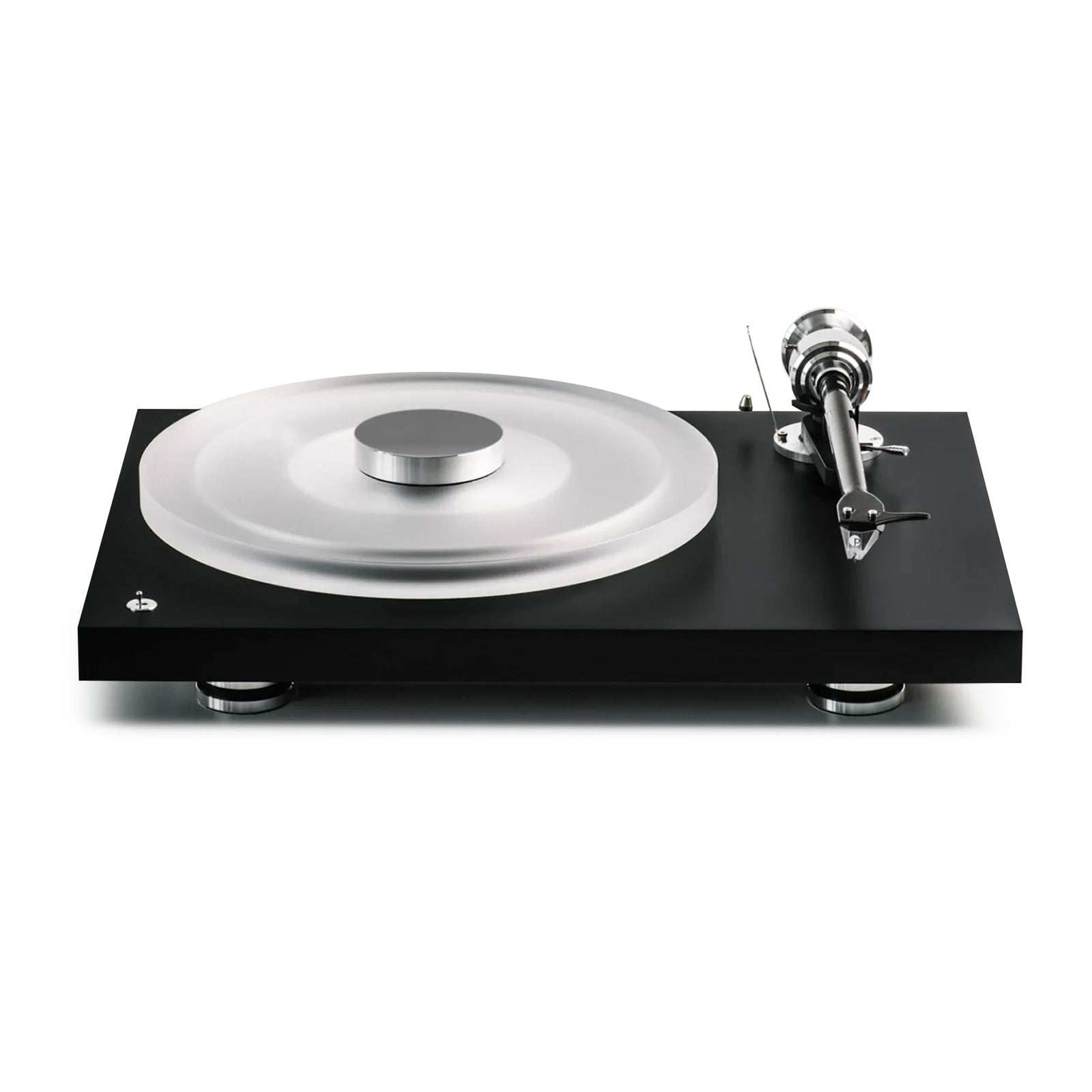
Explore this need in the finder →The Debut Reference 10 is a premium-looking manual belt-drive design, but its appeal is more specific than its name suggests. Its documented package pairs a long, adjustable carbon-aluminium tonearm with an acrylic platter, a pre-adjusted Pick it PRO Balanced moving-magnet cartridge, and both RCA and balanced mini-XLR phono outputs. It can play 33⅓ and 45 RPM records with electronic selection; 78 RPM requires swapping to the supplied round belt. The manufacturer model page and its linked Product Information support these features. This is a document-led assessment of the listed U.S. package and its setup demands, not a hands-on listening test.
Why it is distinct from a basic Debut
Several physical changes separate this deck from simpler manual tables. The official product sheet identifies an acrylic main platter over an aluminium sub-platter, a one-piece 10-inch hybrid carbon-aluminium arm, and height-adjustable damped feet. The tonearm has VTA and azimuth adjustment, so setup can account for cartridge height and alignment rather than treating the factory arrangement as the only geometry. Those are practical advantages for a careful system builder who expects to revisit cartridge alignment or experiment with compatible mats and cartridges. They are not evidence that every replacement cartridge or record mat will work without a new setup.
The longer arm and broad platter assembly also have a footprint consequence: Pro-Ject lists 462 × 145 × 345 mm, width × height × depth. That converts to about 18.19 × 5.71 × 13.58 inches. Use the width and depth only as a first body-fit screen; neither accounts for the rear cable bend, opening cover, record handling or access to the cue lift. The three adjustable feet are useful for leveling, but they do not remove the need for a solid, level support surface.
Manual handling and three record speeds
The model-specific setup guide walks through manual arm balancing and lowering the stylus with the cue lift. The speed selector changes 33 and 45 electronically, but 78-RPM playback is a separate task: fit the round belt to the appropriate pulley and select the 78 position. The cartridge setup is also a real owner responsibility. The supplied gauge and alignment protractor help with the initial adjustment; they do not make this an automatic table.
Automatic start, arm return and end-of-record platter stop are not documented in the model material reviewed here. A listener who wants the deck to begin and end playback without touching the arm should not treat the 33/45 switch or anti-skating mechanism as automation. Plan to raise and return the arm yourself and to stop the platter manually unless the exact instructions for a later revision state otherwise.
Plan the phono stage before choosing the speakers
The U.S. listing identifies a Pick it PRO Balanced cartridge, and the official documentation describes phono-level RCA and balanced mini-XLR outputs. The package includes an RCA phono-optimized cable; the balanced connection is an option for a compatible balanced phono preamp and matching cable, not a line-level output that can be plugged into any powered speaker. No internal phono stage is specified. For a conventional RCA system, use a compatible moving-magnet receiver PHONO input or place an external MM stage between the turntable and the amplifier or powered speakers. Passive speakers still need an amplifier.
This connection plan differentiates the Reference 10 from Pro-Ject's T1 EVO Phono, which adds a switchable built-in stage, and from the T1 EVO Standard, which has no balanced mini-XLR output. Compared with the T2 Super Phono, the Reference 10 trades the T2's documented internal stage and automatic functions for a manual, more adjustable arm and a balanced-output option. Those contrasts are system-fit points, not a sound-quality ranking.
Who should consider it—and what to check
The Reference 10 makes sense on paper for someone who wants to set up a cartridge deliberately, values upgrade-related arm adjustments, has room for a broad body, and already knows how to provide the required phono gain. The balanced output may be useful in a compatible balanced phono chain; it is not a shortcut around matching the cartridge, phono input and cable. The included round belt opens the 78-RPM format, but changing belts is less convenient than a single electronically selected speed.
It is a weaker fit if the room has a narrow shelf, the system has only line-level inputs and no external phono stage, or hands-off record-end behavior is essential. The U.S. Audio Advisor listing names the black model and Pick it Pro B package, but a seller page is not proof that a particular offer is complete or currently available. Before buying, check the exact Debut Reference 10 name, the included Pick it PRO Balanced/Pick it Pro B cartridge, black finish, cover, puck, power supply, belts and setup accessories; verify the seller's condition and return terms separately. The retailer item code is not a manufacturer SKU. Confirm the exact package documentation and leave clearance beyond the published body dimensions.
Bottom line
The Debut Reference 10 combines a substantial, adjustable manual platform with an included balanced-capable moving-magnet cartridge and two phono-output routes. Its strengths matter most when those adjustments and a compatible MM or balanced phono chain will actually be used. The same evidence makes its limits plain: manual cueing, no documented platter auto-stop, no built-in phono stage, a relatively wide body and a belt change for 78 RPM. It is a focused system-building choice, not a plug-and-play automatic deck.
Key specifications
Key details at a glance
| Drive | Belt drive |
|---|---|
| Documented record speeds | 33 1/3 RPM / 45 RPM / 78 RPM (round belt required) |
| 78-RPM play option | Yes |
| Included cartridge | Pick it pro balanced moving-magnet cartridge (u.s. retailer page labels it pick it pro b) |
| Built-in phono preamp | No |
| Manual tonearm cueing | Yes |
| Platter | Acrylic |
| Body width | 18.19 in |
| Body depth | 13.58 in |
| Body height | 5.71 in |
Use the exact model’s instructions for operating limits, supplied equipment and version differences.
Sources for this review
Sources for this assessment
- Pro-Ject official global Turntables category (2026-11-01 capture)
- Pro-Ject official dealer and distributor directory (2026-11-01 capture)
- Pro-Ject official Debut Reference 10 model page
- Pro-Ject Debut Reference 10 official Product Information document
- Pro-Ject Debut Reference 10 official Setup Guide
- Turntable Lab U.S. Debut Reference 10 item page (authorized Reference Partner)
- Audio Advisor U.S. Debut Reference 10 item page
- Turntable Lab exact-model Debut Reference 10 image

Check your phono route before choosing
Check each model's documented input route, arm operation, and body limits. Use the finder to compare supported phono-system arrangements without assuming adjacent models share features.