
Your needs, this model
Does it fit your priorities?
Can E1.2 Phono connect to a powered speaker's LINE input?
Yes when the deck's switch is set to LINE so its internal MM stage is in the path. Check that the receiving device has a line input; passive speakers still need a separate power amplifier.
Explore this need in the finder →Can I use the receiver PHONO input instead of the built-in stage?
Yes, set the E1.2 Phono switch to PHONO to bypass the internal stage, then use a compatible MM PHONO input. Avoid sending LINE output into another PHONO stage.
Explore this need in the finder →Is this E1.2 Phono automatic?
No automatic start/return is documented. The manual describes user cueing and the speed/off switch; an end-of-side auto-stop is not established.
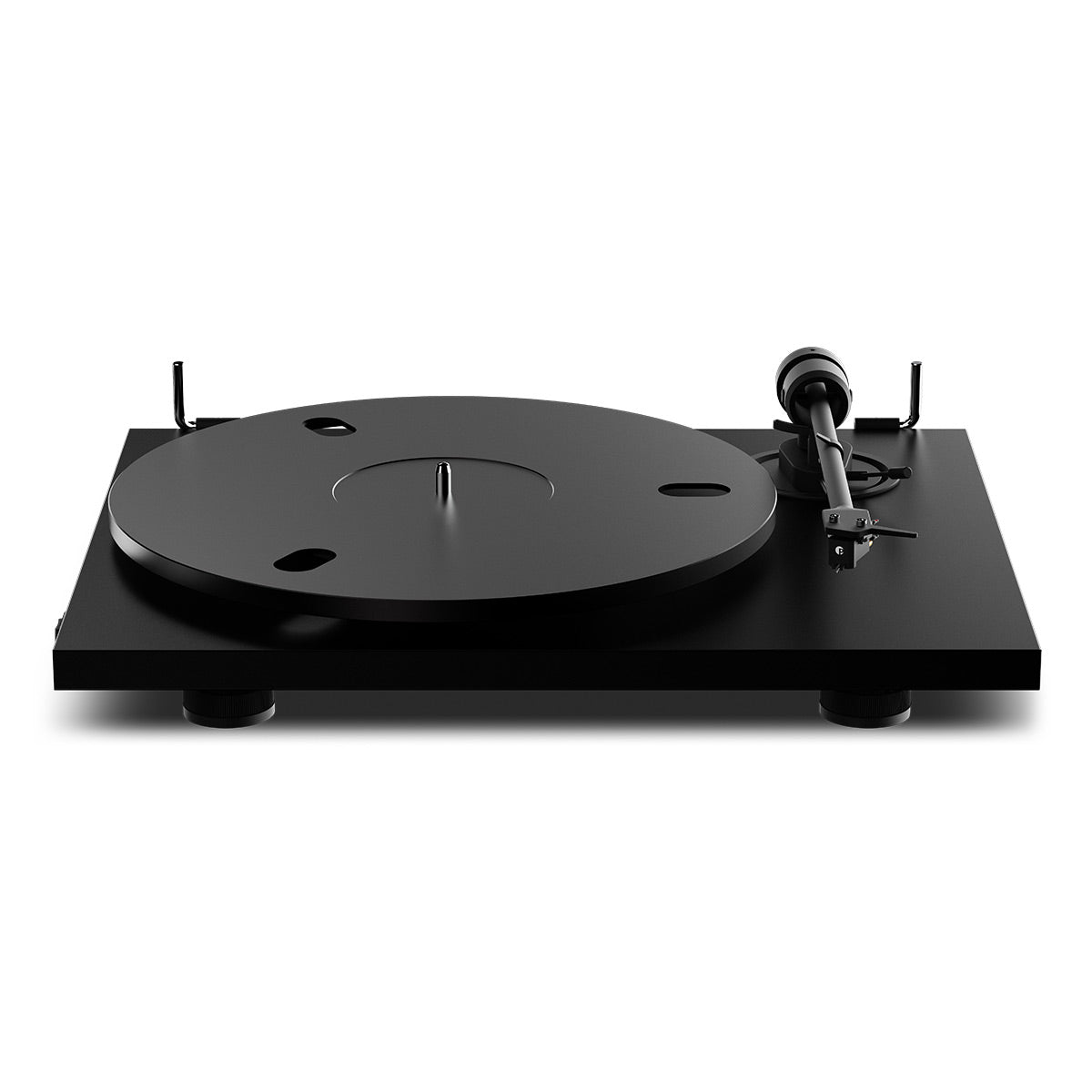
Explore this need in the finder →The E1.2 Phono is the middle signal-path option in Pro-Ject's E1.2 lineup: it keeps the manual belt-drive deck and Pick it MM E cartridge, then adds a switchable moving-magnet phono stage. U.S. item pages inspected for this assessment identify black and satin-walnut finishes. This is a document-led compatibility review; I have not used, listened to, or measured a sample.
One switch, two different connection routes
Set the selector to LINE when sending the deck to an ordinary line input on powered speakers, an integrated amplifier or a receiver. In that position the built-in MM stage handles phono equalization. The line output is not a speaker-power output: if your speakers are passive, connect it to an amplifier's LINE/AUX input and let that amp drive the speakers.
Set the selector to PHONO to bypass the internal stage. That route can feed a compatible receiver PHONO input, or a separate phono stage followed by a line input. The two-stage arrangement is intentional only when the E1.2 is in PHONO mode; leaving it on LINE into a receiver PHONO input stacks stages and is the wrong connection. Check whether the receiver's PHONO input supports MM, not just a different cartridge type. The manual's grounding note and the amplifier's instructions still matter.
That switch is the practical difference from E1.2 Standard, which offers no built-in phono stage. E1.2 BT adds a Bluetooth transmitter as well as the stage. The Phono version does not gain wireless playback just because its output board is built in, and neither sibling is a power amplifier.
The .2 package has its own cartridge and platter
For the examined current U.S. black listing, the supplied cartridge is Pro-Ject's Pick it MM E, a moving-magnet design with a conical stylus. Pro-Ject's data sheet describes a 730 g die-cast aluminum platter and 33/45 electronic speed selection. Those are the most useful clues when separating this E1.2 package from a plain E1 listing: the earlier U.S. E1 Phono record uses the AT3600L package and an ABS main platter. Verify the exact suffix and cartridge in any seller title; family resemblance does not prove that an old or open-box listing contains the current item.
One source discrepancy deserves a careful note. The E1.2 user guide's general illustration calls the pre-mounted cartridge “Ortofon,” while its cartridge-specific stylus passage says Pick it MM E. The model product-information sheet and both U.S. E1.2 Phono item records also name the Pick it MM E. I use that repeated, version-specific evidence for this configuration, not the generic diagram caption. The manual gives 20 mN (2.0 g) for this cartridge, whereas the general product sheet says 17.5 mN pre-adjusted for the tonearm. The documents do not explain the difference; leave a factory setup alone until the exact delivered instructions resolve it.
It is still a hands-on deck
The setup guide lays out belt and platter assembly, cover fitting and the output selector. You still place and lift the arm yourself. The speed/off switch stops the motor, but neither product sheet nor manual establishes a record-end auto-stop or automatic arm return. Treat stop behavior as unconfirmed rather than promising that a side ends unattended. The turntable supports 33 and 45 rpm; the inspected documentation does not list 78 rpm.
The setup guide notes an RCA-to-3.5 mm adapter for the Phono version. That adapter can help with some line-input devices, but it does not turn passive speakers into powered ones or make a speaker's 3.5 mm jack a PHONO input. Check the input type and which selector position is required before buying extra cables.
Plan the furniture around the cover
The product information gives a 420 × 112 × 330 mm body footprint (about 16.54 × 4.41 × 12.99 inches). The manual's open-cover dimension is substantially larger. Leave space behind the RCA lead, at the side for controls and above the lid; the published body depth is not required front-to-back working clearance. The item pages' dimensions are consistent with the current manufacturer sheet, but close shelving should still be measured with the dust cover in the position you will use.
Black and walnut are the observed U.S. finishes
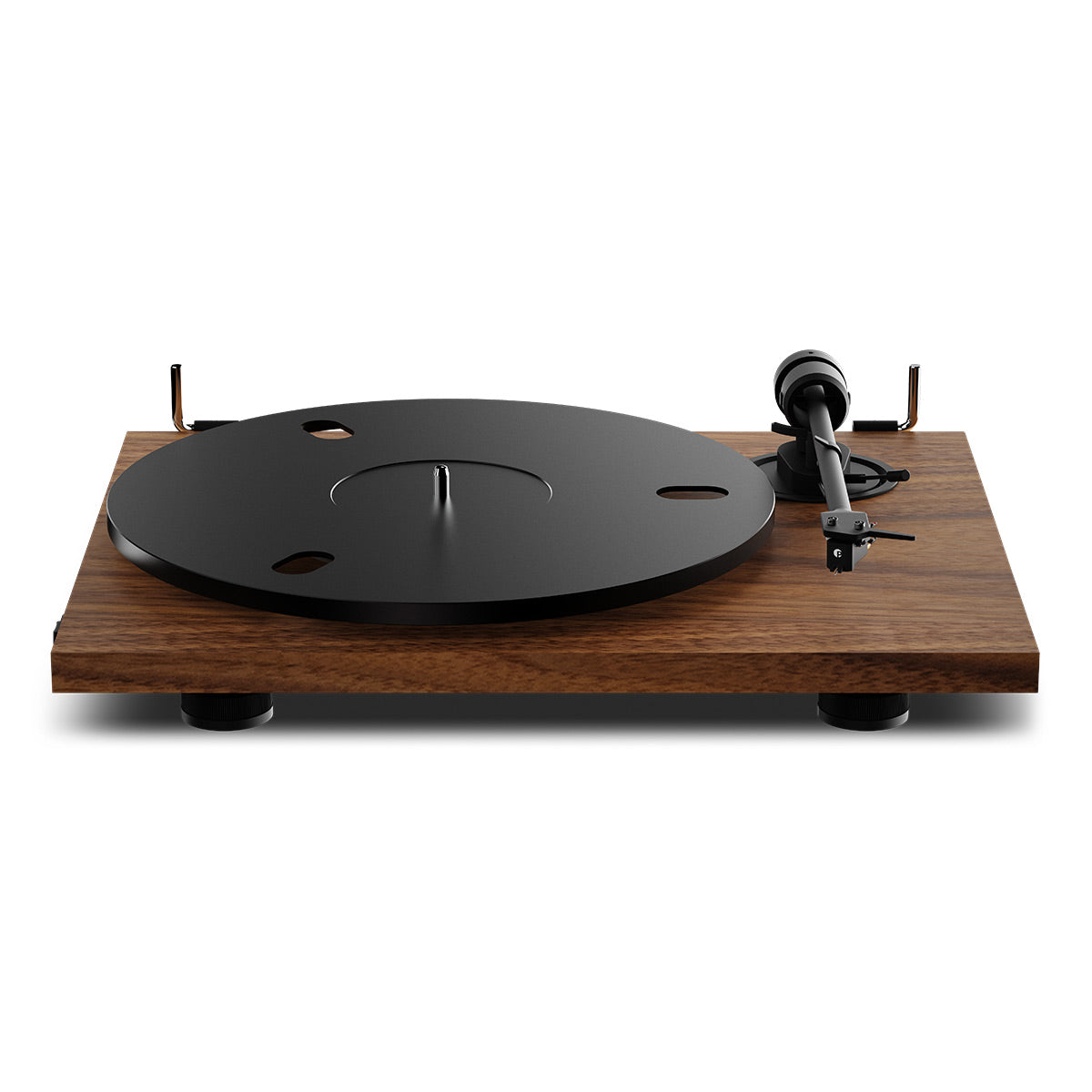
The dealer's black and walnut listings each name E1.2 Phono and Pick it MM E. Its separate item identifier and displayed barcode are retailer data, not a verified manufacturer model number. The images below are exact finish references from those item pages; they show the chassis and do not prove which electronics or cartridge are in a box. Current inventory can change, so the source observation is not a stock guarantee.
Who gets a useful option from the switch?
Choose this version if you want one turntable that can feed either a standard line input or a suitable MM PHONO input, provided you will set the selector correctly for each route. If you already own a compatible PHONO input and want to avoid a built-in stage, Standard is the simpler package. If wireless output to Bluetooth equipment is part of the job, look to E1.2 BT rather than assuming this model sends audio over Bluetooth. Whichever finish you choose, confirm “E1.2 Phono” and the Pick it MM E in the exact seller record, then plan for manual cueing and the larger open-cover envelope.
Key specifications
Key details at a glance
| Drive | Belt drive |
|---|---|
| Documented record speeds | 33 1/3 RPM / 45 RPM |
| 78-RPM play option | No |
| Included cartridge | Pro-ject pick it mm e |
| Built-in phono preamp | Yes |
| Manual tonearm cueing | Yes |
| Platter | 730 g die-cast aluminum with felt mat |
| Platter mat | Felt |
| Body width | 16.54 in |
| Body depth | 12.99 in |
| Body height | 4.41 in |
Use the exact model’s instructions for operating limits, supplied equipment and version differences.
Sources for this review
Sources for this assessment
Check your phono route before choosing
Check each model's documented input route, arm operation, and body limits. Use the finder to compare supported phono-system arrangements without assuming adjacent models share features.