
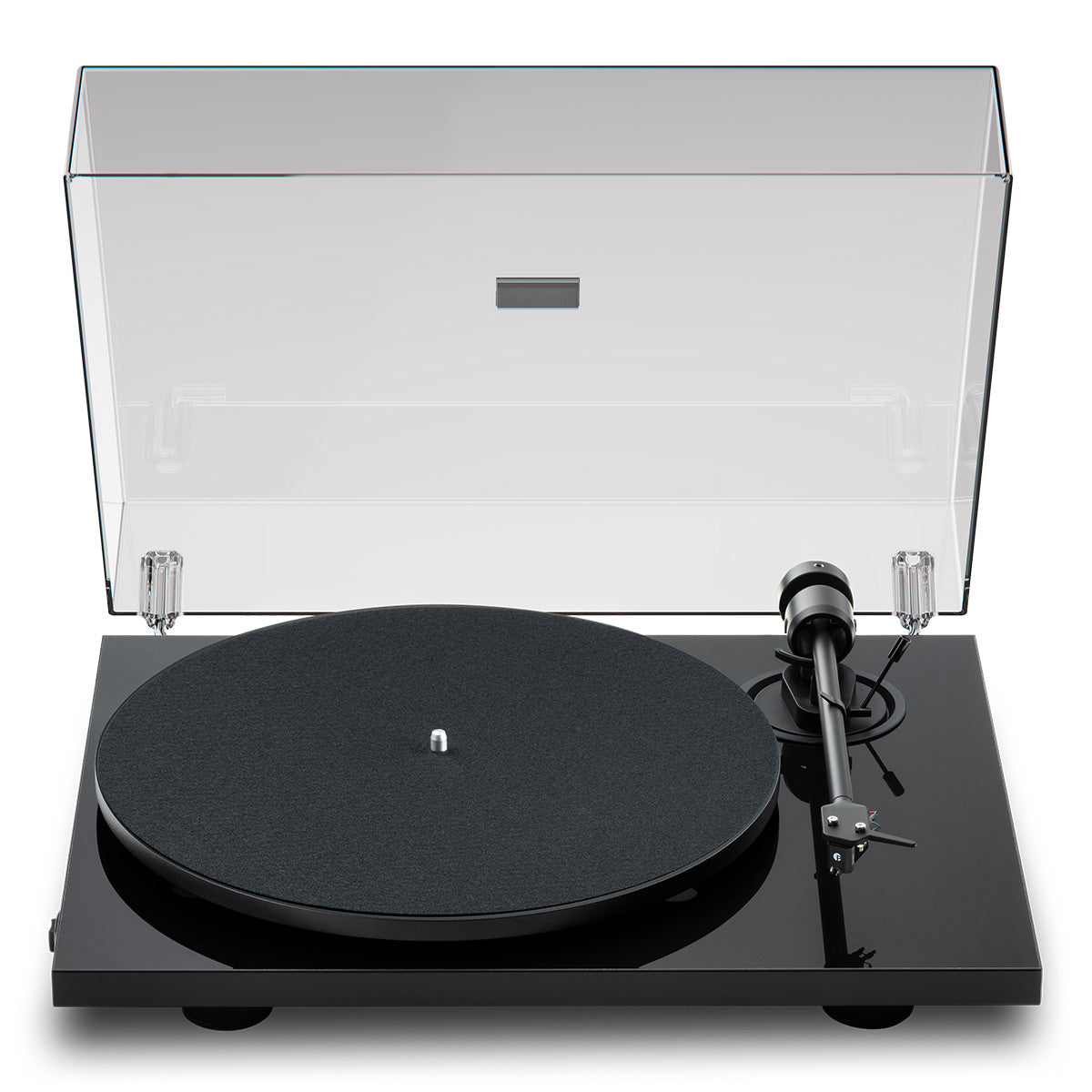
Your needs, this model
Does it fit your priorities?
Can the E1.2 Standard connect directly to ordinary powered-speaker LINE input?
Not by itself: the Standard has no built-in phono stage. Use a compatible MM PHONO input in the speakers, or put a separate MM phono stage between the turntable and the speakers' LINE input.
Explore this need in the finder →Can I use an amplifier's PHONO input with this package?
Yes, if the receiver/integrated amplifier input is compatible with the supplied moving-magnet Pick it MM E. The turntable's captive lead is phono level; use the amplifier's matching PHONO input, not AUX/LINE.
Explore this need in the finder →Does the E1.2 Standard cue or stop itself?
The guide describes manual tonearm handling and a motor stop switch. It does not document automatic start, arm return or an end-of-record auto-stop; that last behavior remains unknown.
Explore this need in the finder →The Pro-Ject E1.2 Standard is the no-built-in-stage version of the new E1.2 family. The U.S. black listing I reviewed identifies a Pick it MM E moving-magnet cartridge; separate white and walnut pages retain that same cartridge package. I assessed documents and item records, not a loaner or production sample, so this is a fit analysis rather than a listening or reliability test.
The important choice is the phono path
This model sends a low-level cartridge signal from its captive RCA lead. That works with a compatible MM PHONO input on a receiver or integrated amplifier. If the destination is a normal AUX/CD/LINE input, add one MM phono stage in between. Powered speakers with only a line input need that separate stage too. Passive speakers still need a power amplifier; a phono preamp is not a speaker amp. Do not buy the Standard expecting the turntable to perform the equalization itself—the Phono and BT siblings add the switchable stage, while this one does not.
The connection guide asks users to ground the lead at the amplifier when a ground post is available. Follow the receiver manual and preserve left/right channel orientation. One complete compatible signal path matters more than the number of sockets: do not put a phono-level deck into AUX without a stage, and do not feed a line-level output into another PHONO input.
What changed from the earlier E1 matters more than the shared name
The current E1.2 product sheet calls out a 730 g die-cast aluminum platter and a Pick it MM E cartridge. This is not the older E1 Standard U.S. package already assessed elsewhere in the library, whose seller record names an Audio-Technica AT3600L and whose manufacturer information describes an ABS-polymer main platter. Keep the suffix “.2” and exact cartridge visible when comparing a listing or replacement stylus. The E1.2 manual illustration has a generic premounted-Ortofon label, but the same manual's cartridge-specific replacement line names the Pick it MM E; the product sheet and U.S. item page also name Pick it MM E. The specific, repeated item evidence is the better package match, while the diagram inconsistency is worth preserving for anyone checking the box contents.
Pro-Ject describes the included Pick it as a moving-magnet cartridge with a conical diamond stylus. That makes a compatible MM input the relevant receiver route; it does not make every PHONO input suitable. A receiver with an MC-only input is not the documented match.
Manual operation is still part of the routine
The deck is sold as a manual turntable. Setup includes putting the belt on the pulley/sub-platter, fitting the platter and felt mat, removing the transport tie and connecting the supplied power unit. The speed selector chooses 33 or 45 rpm and its off position stops the motor. The user guide describes lowering and raising the arm with the cue lever. Those controls are not evidence of an automatic start, arm return or record-end stop; no inspected source establishes an automatic stop for this model. If you want the arm to handle a side unattended, do not infer that from the switch.
The manual provides a stylus pressure gauge for cartridge replacement and gives 20 mN (2.0 g) as the Pick it MM E's recommended force. The general product-information sheet separately prints 17.5 mN as a pre-adjusted arm setting. These are not reconciled in the documents. For a factory-fitted cartridge, do not change a working setup solely from a broad table; check the exact delivered model instructions or ask the dealer before adjusting the counterweight.
Use the body figure as a first screen, not an installation promise
Pro-Ject lists the body as 420 × 112 × 330 mm, or about 16.54 inches wide and 12.99 inches deep. Its manual gives a much larger envelope with the cover open. The current U.S. Standard page prints smaller width/depth figures than the manufacturer sheet, so the two sources disagree. The matching screen uses the manufacturer's current specification, but a tight shelf should be measured against the exact deck and lid position. Leave additional room for rear cables, reaching the cue lever and opening or removing the cover.
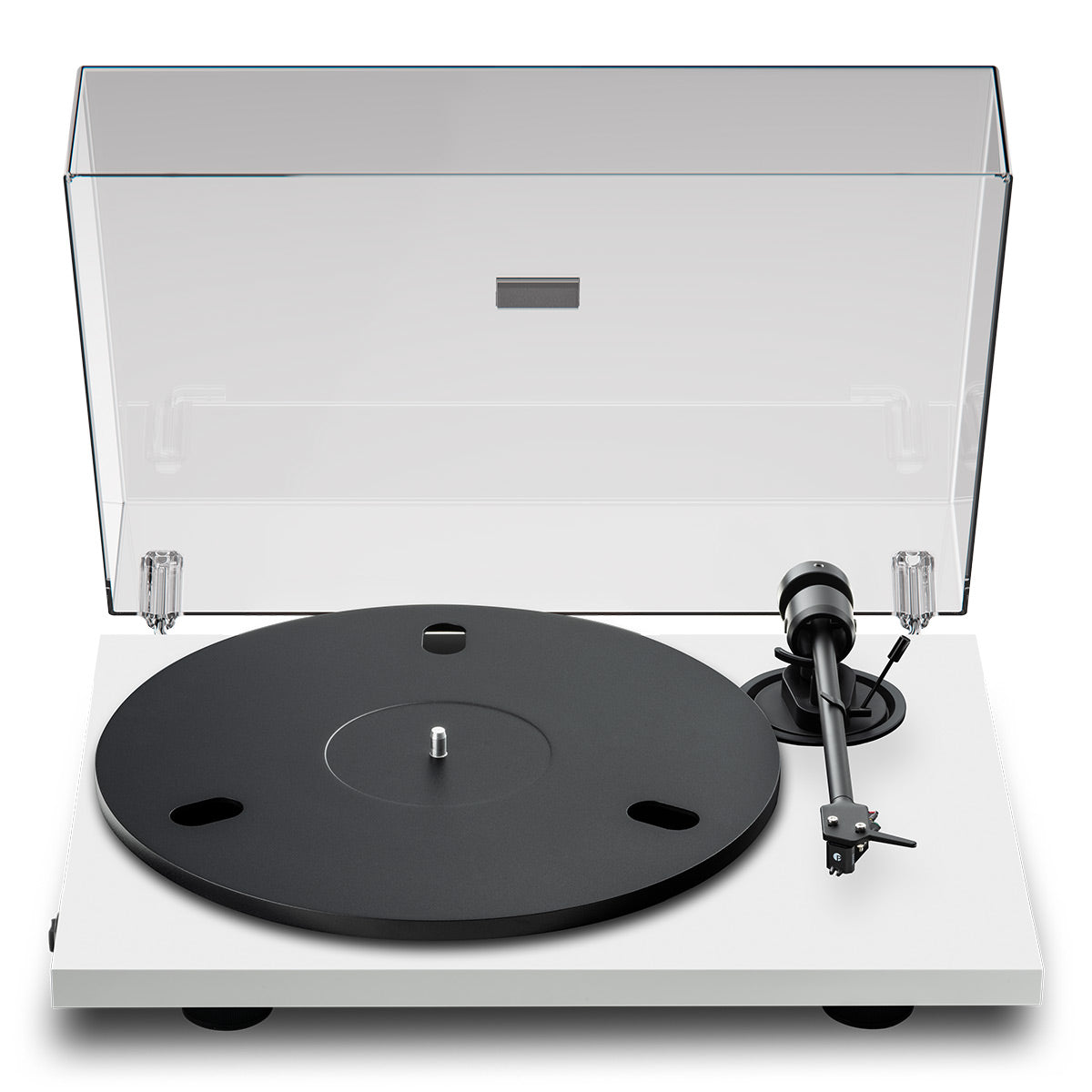
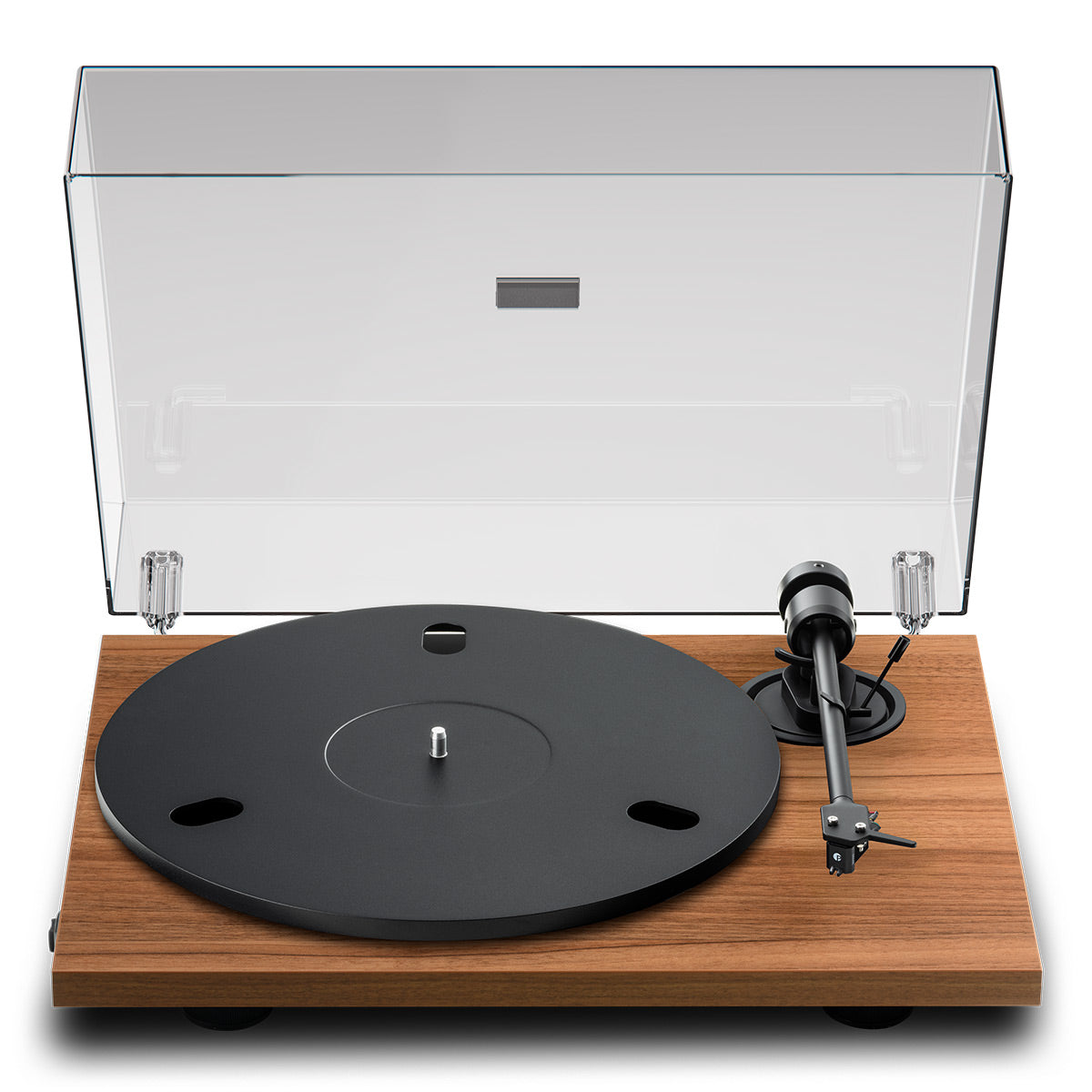
Black, white and walnut are separate item records
The U.S. dealer's exact Standard listings show black, white and walnut versions. Their item identifiers are retailer-reported and are not a confirmed Pro-Ject model code. The photos below identify chassis finish only; the visible image cannot establish the hidden output wiring, cartridge in a seller's box, condition or inventory state. Match the exact “E1.2” Standard item and Pick it MM E description rather than using appearance as proof.
Who should keep it on the list
This package makes sense when a compatible receiver PHONO input is already part of the system, or when an external stage is intentionally planned. It is a poor shortcut for someone whose only available input is a powered speaker's LINE jack and who does not want another component. Choose E1.2 Phono instead if a switchable built-in stage is important; choose BT only if a Bluetooth transmitter is useful and the receiving device is compatible. All three remain manually cued. Finally, compare the current deck's suffix, item title, seller identifier and supplied stylus before checkout; no listing image or generic family manual can certify a particular carton.
Key specifications
Key details at a glance
| Drive | Belt drive |
|---|---|
| Documented record speeds | 33 1/3 RPM / 45 RPM |
| 78-RPM play option | No |
| Included cartridge | Pro-ject pick it mm e |
| Built-in phono preamp | No |
| Manual tonearm cueing | Yes |
| Platter | 730 g die-cast aluminum with felt mat |
| Platter mat | Felt |
| Body width | 16.54 in |
| Body depth | 12.99 in |
| Body height | 4.41 in |
Use the exact model’s instructions for operating limits, supplied equipment and version differences.
Sources for this review
Sources for this assessment
- Pro-Ject E1.2 official product page
- Pro-Ject E1.2 official product-information sheet
- Pro-Ject E1.2 user guide, revision 2025-08-27
- Pro-Ject E1.2 setup guide
- Sky by Gramophone U.S. E1.2 black item page and variant record
- Sky by Gramophone U.S. E1.2 white item record
- Sky by Gramophone U.S. E1.2 walnut item record
Check your phono route before choosing
Check each model's documented input route, arm operation, and body limits. Use the finder to compare supported phono-system arrangements without assuming adjacent models share features.