
Your needs, this model
Does it fit your priorities?
Can the E1 Standard connect straight to powered speakers?
Only if those speakers include a compatible MM phono input. The Standard has no internal phono stage, so ordinary line-input powered speakers need a separate MM stage between the deck and speakers.
Explore this need in the finder →Will the E1 Standard work with my receiver's PHONO input?
It can use a compatible MM PHONO input because the included AT3600L is moving magnet and the Standard sends phono-level signal. Connect the ground lead if the receiver instructions call for it; do not connect the PHONO output to AUX/LINE without an external stage.
Explore this need in the finder →Is the E1 Standard automatic or does it stop when a side ends?
The manual documents user-controlled tonearm cueing and 33/45 speed selection, not automatic arm handling. It does not specify an end-of-record platter stop, so stop behavior is unknown rather than a confirmed feature.
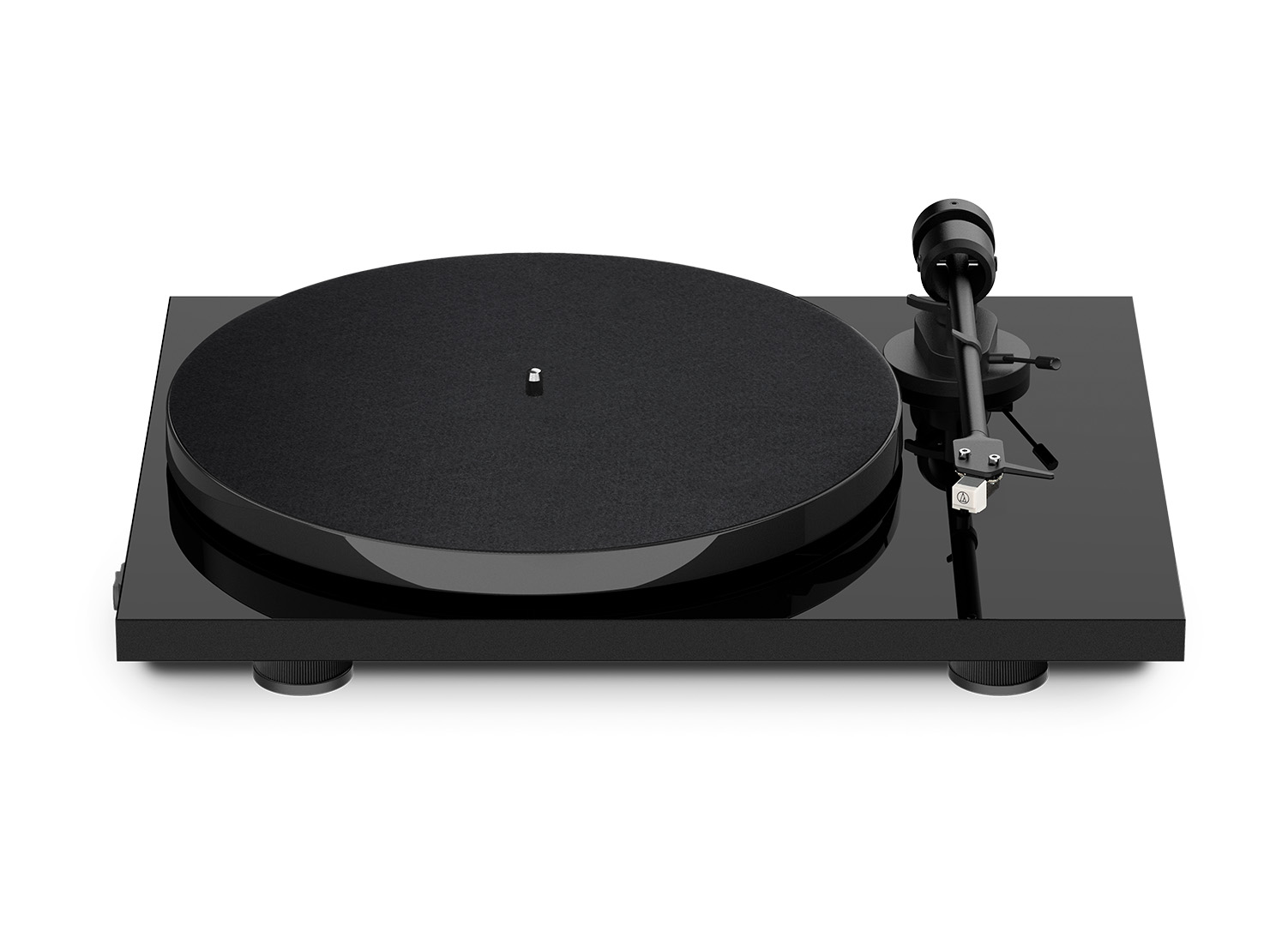
Explore this need in the finder →The Pro-Ject E1 Standard is the stripped-back member of the current E1 trio: belt drive, electronic 33/45 selection, a moving-magnet cartridge and no built-in phono stage. The exact U.S. listing assessed here is the Gloss Black AT3600L package. Its purchase decision is less about a mysterious “audiophile” adjective than about whether your system already has the right phono input—or whether you are willing to add a separate stage. This is a source-based fit assessment, not a listening test, ownership report, measurement session or claim of hands-on setup.
Choose it when your system already supplies the phono stage
The current U.S. listing identifies an Audio-Technica AT3600L moving-magnet cartridge. The manufacturer’s shared E1 user guide describes the Standard model’s captive tonearm lead as a phono-level output and says it needs a suitably matched PHONO input or a separate phono amplifier. That means a receiver’s MM PHONO input can complete the route to its power amplifier and passive speakers; powered speakers work only if they have a compatible phono input of their own. If the powered speakers have ordinary RCA line inputs—or an amplifier offers only AUX/LINE—put a separate MM phono stage between the E1 and that line input. A cable adapter cannot replace the gain and equalization a phono stage supplies.
There is no preamp switch to set on Standard because the reviewed model has no internal stage. That removes one routing choice, but it also removes the convenience offered by E1 Phono and E1 BT. Check whether the receiver PHONO input is intended for MM cartridges, connect the ground lead in the manner shown by both component manuals, and keep left/right channels matched. Do not mistake the turntable’s captive RCA plugs for a line-level output. The E1 Standard also does not include speakers or an amplifier, and a passive pair cannot be driven directly from the deck.
“Plug and play” still includes a small setup sequence
Pro-Ject’s setup guide walks through fitting the belt and platter, and the shared manual describes use of the cue lever and a user-controlled speed switch. The speed control changes platter rotation between 33⅓ and 45 RPM; it does not start, lift or return the arm. Once the record is on the platter, the listener lowers the arm and handles the end of the side. Fully automatic operation is therefore not supported by the documentation. An end-of-record platter stop is not specified for this version in the sources reviewed here, so its stop behavior remains unknown rather than being described as either present or absent.
The manufacturer product sheet lists an 8.6-inch aluminum tonearm, ABS-polymer platter and felt mat. It also gives 0.7% / 0.6% speed variance and 0.25% / 0.23% wow-and-flutter at 33 / 45 RPM, plus a 65 dB signal-to-noise figure. These are published specification values, not independent measurements and not guarantees about a particular record, cartridge condition, support surface or room. The published materials support 33 and 45 RPM; they do not document 78 RPM playback.
Allow for the lid and the connections, not just the body
The current E1 product information gives 420 × 112 × 330 mm (W × H × D), or about 16.54 × 4.41 × 12.99 inches. With the dust cover open the manual’s product sheet lists a taller and deeper envelope, 420 × 370 × 393 mm. The 16.54-inch body width first fits a 17-inch maximum in this finder’s half-inch increments; the 12.99-inch body depth fits a 13-inch cap by the published rounded figure. Those numbers are not shelf-clearance promises. Leave room behind for the captive lead’s bend, beside the deck to lift a record safely, above for the lid hinge, and around other components for access. Measure the actual shelf and lid path before purchase.
Keep the three E1 packages separate
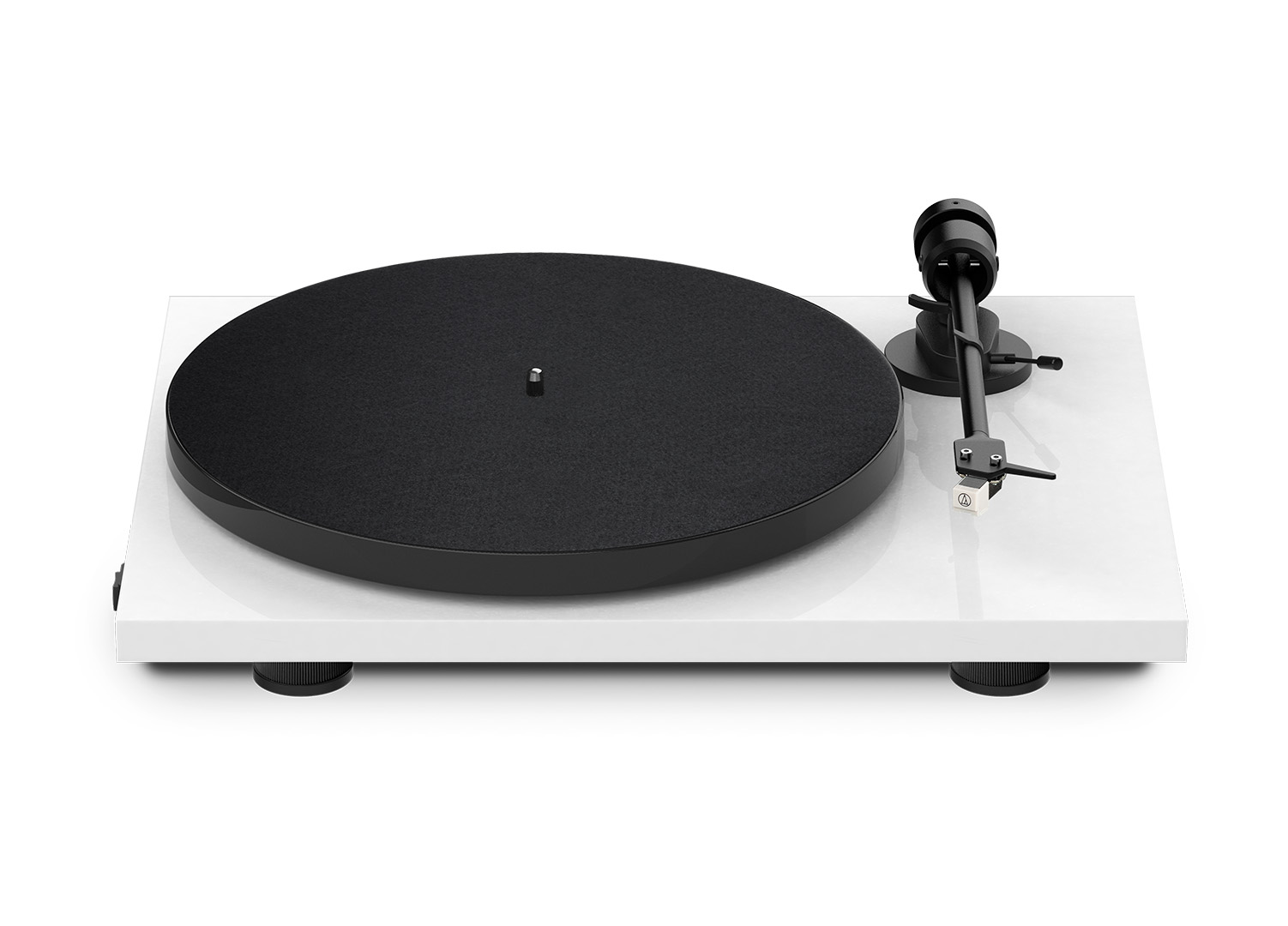
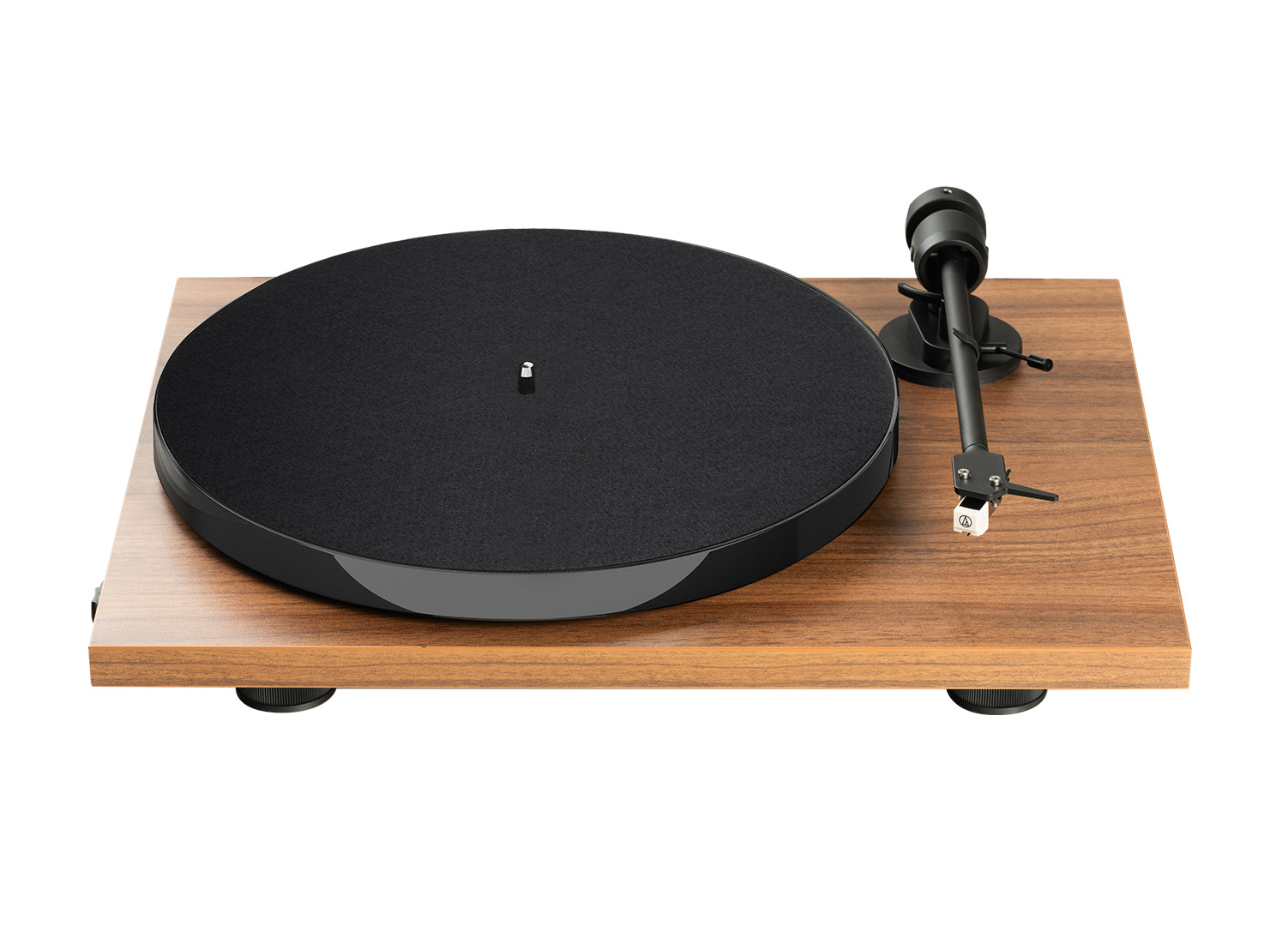
E1 Standard, E1 Phono and E1 BT share the basic deck platform, but they are not interchangeable package names. Phono adds a switchable MM stage; BT adds that stage and a Bluetooth transmitter. The three finish choices observed for Standard—Gloss Black, Satin White and Satin Walnut—are visual variants of this current U.S. Standard listing, not evidence that every E1 finish shares the same output electronics. The photographs below come from Pro-Ject’s E1 product pages and show the chassis finish only. They cannot identify the hidden stage or the cartridge supplied; the specific U.S. seller record establishes the AT3600L package separately.
What to verify before choosing
For the reviewed configuration, check the offer names E1 Standard and the AT3600L cartridge rather than E1 Phono or E1 BT. Confirm whether the RCA lead is captive, whether the box includes the belt, platter, mat, cover, adapter and correct power supply, and whether your phono stage is MM-compatible. An older revision of the shared manual contains an Ortofon OM 5E cartridge reference; a separate older U.S. E1 Phono/OM5e item was also observed. That is not merged into this current AT3600L review. Do not infer which cartridge is in an individual used or open-box offer from a generic chassis photo.
Sources checked: Pro-Ject global turntable directory; official E1 product information; official shared user guide; official setup guide; Audio Advisor U.S. Standard listing. U.S. retailer prose is used for package identity only, not adopted as product-review language.
Key specifications
Key details at a glance
| Drive | Belt drive |
|---|---|
| Documented record speeds | 33 1/3 RPM / 45 RPM |
| 78-RPM play option | No |
| Included cartridge | Audio-technica at3600l |
| Built-in phono preamp | No |
| Manual tonearm cueing | Yes |
| Platter | Abs polymer |
| Platter mat | Felt |
| Body width | 16.54 in |
| Body depth | 12.99 in |
| Body height | 4.41 in |
Use the exact model’s instructions for operating limits, supplied equipment and version differences.
Sources for this review
Sources for this assessment
Check your phono route before choosing
Check each model's documented input route, arm operation, and body limits. Use the finder to compare supported phono-system arrangements without assuming adjacent models share features.