
Your needs, this model
Does it fit your priorities?
Can the Essential II Demon connect straight to AUX or powered speakers?
Not on the documented route. The exact model guide describes PHONO-level RCA output; use a compatible MM PHONO input or add a suitable external phono stage before LINE/AUX or powered speakers.
Does the exact Demon edition play 78 rpm?
Its page and edition sheet specify 33 and 45 rpm only. No 78-rpm mode is documented for this edition, so do not assume it can play 78s.
Does it automatically lift or return the tonearm?
The model guide describes manual tonearm placement and lift. Automatic start/return and end-of-record stop are not established by the exact-model sources.
The Pro-Ject Essential II Demon is a Parov Stelar artwork edition of the Essential II platform. Its maker’s page identifies the exact turntable and lists a pre-mounted Ortofon OM5e, manual 33/45-rpm belt-drive operation and a PHONO-level connection path. The evidence supports a useful model reference, but not a U.S. retail package or a claim about how this edition sounds: no hands-on listening or testing is represented here.
What the exact edition includes on paper
The dedicated Essential II Demon product page calls it a limited collector’s edition and describes the “The Demon Diaries” artwork. Its published configuration is distinct from the later Parov Stelar PS01-Wave and PS00-Frida editions: this model is an Essential II with an 8.6-inch aluminum arm, an Ortofon OM5e, a 300 mm particle-board platter with felt mat, a pre-mounted gold-plated RCA lead and a dust cover. The maker lists a 420 × 112 × 330 mm body and 4.0 kg net weight. Those are manufacturer-listed figures, not measurements made for this review.
The page describes a belt drive, synchronous motor and integrated DC motor control. That motor-control wording should not be mistaken for a built-in phono preamp: the model-specific Essential II Demon user guide directs the owner to a suitable PHONO input and says that an external phono stage is needed if the amplifier lacks one. A normal AUX/LINE input or powered speaker therefore is not, by itself, the documented connection for this deck.
The setup is manual and cartridge-sensitive
The guide walks through fitting the belt, leveling the deck, balancing the arm and setting anti-skating. It describes hand-lowered tonearm operation and a factory-fitted, adjusted OM 5E cartridge. The exact product page and edition information sheet recommend 18 mN for the supplied cartridge, while the linked guide says 17.5 mN. Rather than silently choosing one rounded figure, check the cartridge actually fitted to the unit and follow the current cartridge maker’s instruction before changing an adjustment. That matters especially for a used example: a replacement stylus or cartridge may not be the factory OM 5E.
The published speeds are 33 and 45 rpm with manual speed change. The exact page does not document a 78-rpm route, automatic start, arm return or an end-of-record stop. I leave end-stop behavior unknown rather than infer it from the model family. The specified signal is phono level, so plan around a compatible moving-magnet PHONO input or a separate MM-capable phono stage, followed by an amplifier or powered speakers that accept line-level input.
What this assessment does not establish
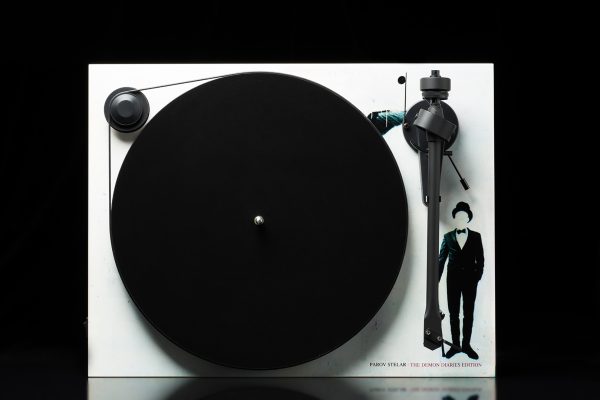
The manufacturer documentation establishes the model and its global design, not a current U.S. item number, exact adapter and plug, local offer or seller carton. The manual explicitly says to check the voltage printed on the power supply against the local mains supply; the correct supply for an individual used unit cannot be inferred from the artwork or model name. Confirm the adapter label, cartridge and stylus condition, belt, counterweight, RCA lead, dust cover and hinge condition in person before relying on a particular listing. The image here shows the exact edition’s plinth artwork and tonearm, not the carton or everything a seller will provide.
Pro-Ject’s published performance figures are specifications, not a listening test or an independent measurement. Claims about low vibration or sound quality are not validated here. The published dimensions use the maker’s stated body envelope; they do not tell you how much open-cover height, cable access or arm clearance a shelf requires.
Who should use this reference
This page is most useful to someone identifying the exact Essential II Demon edition, checking its documented analog chain, or assessing an existing unit whose seller calls it “Demon by Parov Stelar.” It is not a U.S. shortlist recommendation. If you are comparing the artist editions, read the separate assessments for the PS01-Wave and PS00-Frida: those pages identify different Debut Carbon Esprit-based editions with a carbon arm and 2M Red, not interchangeable names for the Essential II Demon.
Sources and method
This evidence-led assessment uses the exact model page, its linked product information and its directly linked user guide. It does not claim ownership, audition, setup, measurements or seller availability. Manufacturer specifications and package statements should be checked against the exact unit and its actual supply before use.
Key specifications
Key details at a glance
| Drive | Belt drive |
|---|---|
| Documented record speeds | 33 / 45 |
| Included cartridge | Ortofon om5e, factory fitted |
| Built-in phono preamp | No |
| Manual tonearm cueing | Yes |
| Platter | 300 mm particle board with felt mat |
| Body width | 16.54 in |
| Body depth | 12.99 in |
| Body height | 4.41 in |
Use the exact model’s instructions for operating limits, supplied equipment and version differences.
Sources for this review
Sources for this assessment

Check your phono route before choosing
Check each model's documented input route, arm operation, and body limits. Use the finder to compare supported phono-system arrangements without assuming adjacent models share features.