
Your needs, this model
Does it fit your priorities?
Can the E1 be connected to a receiver with a PHONO input?
Yes, through the separate Phono Out and a compatible MM PHONO input for the supplied Ortofon OM 5E. The receiver supplies the phono stage and amplification for that route; use a line output only with LINE/AUX, not PHONO.
Explore this need in the finder →Can it run a passive speaker pair without a separate amplifier?
Yes. The E1 combines a phono stage and a 2 x 50 W/4-ohm amplifier and lists speaker outputs; connect compatible passive speakers with speaker wire. Neither the exact U.S. standalone listing nor the official standard-box list establishes a supplied speaker pair.
Explore this need in the finder →Can I keep my powered speakers and add a phono stage instead?
The separate Phono Out supports a different analog route: use a compatible external MM stage matched to the OM 5E, then connect its line-level output to powered-speaker LINE. The speakers need their own volume control if using the E1's fixed line output instead.
Explore this need in the finder →Will the E1 lift the arm or stop the platter automatically at the end?
The setup guide shows the user moving the arm with a lift lever, and the model-specific material does not specify automatic arm return or an end-of-record platter stop. Do not select it to satisfy an essential full-automatic or auto-stop requirement without exact written confirmation.
Explore this need in the finder →Will the closed body fit 16.5 inches wide by 13.5 inches deep?
The manufacturer lists 415 x 118 x 334 mm (W x H x D), about 16.34 inches wide and 13.15 inches deep. Those values fit the stated body caps at the questionnaire's half-inch steps, but do not include cover swing, cables, arm access or operating room.
Explore this need in the finder →This is a source-led assessment of the Pro-Ject Juke Box E1, not a listening test or a claim about a particular unit. The U.S. seller page I reviewed identifies a standalone Black model with a pre-mounted Ortofon OM 5E cartridge. That exact package matters: the Juke Box E1 is an all-in-one system, not the standard E1 turntable or the separate E1 HiFi Set bundle.
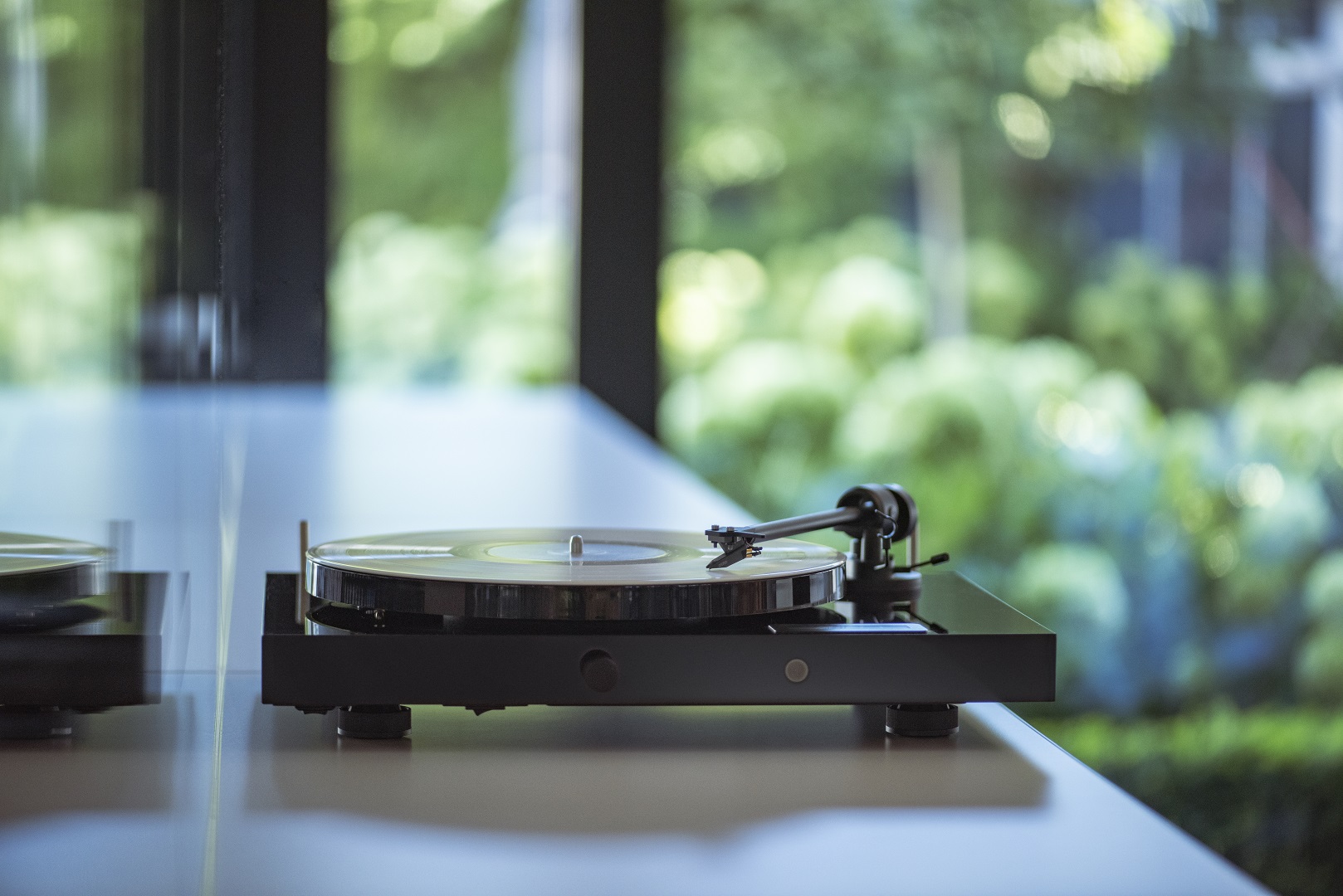
One chassis contains most of a small vinyl system
The Juke Box E1 combines a belt-drive turntable, phono stage, line preamplifier, Bluetooth receiver and power amplifier. Its speaker terminals and manufacturer-rated 2 × 50-watt output into 4 ohms let it drive a compatible pair of passive speakers directly. You do not need to add a separate phono box or amplifier for that simple route. You do still need speakers and speaker wire; the reviewed U.S. item is the standalone deck rather than the HiFi Set with speakers.
That arrangement is the E1's clearest advantage for someone assembling a first system: one turntable-sized component handles the cartridge signal and amplification. But the 4-ohm rating is a published specification, not an independent output test or a guarantee for every speaker. Check the speaker maker's load guidance before connecting a pair, and make sure the room and shelf can accommodate the body plus its operating space.
Three analog output types mean three different routes
The basic setup uses the E1's internal phono stage and amplifier: connect passive speakers to the speaker outputs and use the turntable normally. A second option is its fixed line output for the record-player signal. That can feed powered speakers with line inputs or another line-level component, but it is fixed rather than volume-controlled at the turntable; use the speakers' own level control or a compatible downstream control. Do not connect a line-level signal to a PHONO socket.
The rear panel also has a distinct Phono Out. With the supplied moving-magnet OM 5E, that provides a separate phono-level path to a compatible MM PHONO input on a receiver or integrated amplifier. Alternatively, use Phono Out into an external MM phono stage, then send that stage's line output to powered-speaker LINE or an amplifier's LINE/AUX input for passive speakers. These are alternatives, not a chain to stack: choose either the E1's internal stage through its line/speaker outputs or an external phono stage through Phono Out.
Bluetooth is an input for a phone or another source, alongside one analog line input. It lets the E1 play those sources through connected speakers. The current model page and setup guide do not document sending the turntable signal out to Bluetooth headphones or wireless speakers, so do not infer that direction from the Bluetooth label alone.
Setup is guided, but tonearm operation stays manual
Pro-Ject lists electronic selection of 33 1/3 and 45 RPM, with a belt drive and a 300 mm anti-resonant ABS polymer platter. Its setup guide has the owner fit the belt and platter, connect the speakers, select a source and move the arm up and down using the lift lever. The OM 5E is pre-mounted, with tracking force and anti-skating pre-adjusted for that cartridge, but this is not a fully automatic arm cycle. The inspected E1 material does not specify automatic arm return or an end-of-record platter stop. It also lists no 78 RPM arrangement. Treat those points as unknown rather than assuming that the display or electronic speed switch provides them.
Check the footprint and the box before choosing it
The manufacturer lists a body measuring 415 × 118 × 334 mm (W × H × D), about 16.34 × 4.65 × 13.15 inches, and a net weight of 5 kg. At the finder's half-inch width and depth steps, the body first passes a 16.5-inch width cap and a 13.5-inch depth cap. That is a closed-body screen, not a clearance promise. Allow additional room for the dust cover, rear connections, arm movement, access to records and safe placement.
The official standard box list includes the turntable with OM 5E, remote and batteries, felt mat, dust cover, 7-inch adapter, power supply and setup tools. Speakers are separate. The U.S. retailer page identifies a Black / OM5e item, but confirm the exact finish, cartridge and accessories in the offer you are considering, especially if condition or seller changes. The official image shown here is a model reference; it cannot verify an individual unit's condition or carton contents.
Bottom line: the Juke Box E1 makes sense when a built-in phono stage and amplifier simplify a passive-speaker system, while keeping a separate Phono Out for compatible external setups. It is less suitable if you require automatic arm handling or documented auto-stop, want the turntable itself to control a powered-speaker volume through the fixed output, or expect speakers to be included. The judgment above is based on product documentation and an exact U.S. listing, not personal use.
Key specifications
Key details at a glance
| Drive | Belt drive |
|---|---|
| Documented record speeds | 33 1/3 RPM / 45 RPM |
| Included cartridge | Ortofon om 5e moving-magnet cartridge, pre-mounted |
| Built-in phono preamp | Yes |
| Manual tonearm cueing | Yes |
| Platter | Anti-resonant abs polymer |
| Platter mat | Felt |
| Body width | 16.34 in |
| Body depth | 13.15 in |
| Body height | 4.65 in |
Use the exact model’s instructions for operating limits, supplied equipment and version differences.
Sources for this review
Sources for this assessment
Check your phono route before choosing
Check each model's documented input route, arm operation, and body limits. Use the finder to compare supported phono-system arrangements without assuming adjacent models share features.