
Your needs, this model
Does it fit your priorities?
Can the RPM 10 no-cartridge package use a receiver PHONO input?
Only after you choose and install a cartridge that the receiver's actual PHONO input supports. The deck has no built-in stage, and a PHONO label alone does not prove cartridge compatibility.
Explore this need in the finder →Can the no-cartridge RPM 10 feed powered speakers?
Yes, after you supply a compatible cartridge and add a phono stage matched to it before the speakers' LINE input; the bare package is not line level.
Explore this need in the finder →Can the no-cartridge RPM 10 be used with passive speakers?
Use a buyer-selected cartridge and compatible external phono stage before an amplifier LINE/AUX input; the amplifier must power the passive speakers.
Explore this need in the finder →Does the RPM 10 no-cartridge item satisfy a built-in-preamp-only requirement?
No. The exact item has no cartridge or built-in phono stage. It needs a compatible receiver PHONO input after a cartridge is installed or a separate stage before LINE.
Explore this need in the finder →Does electronic 33/45 switching make the RPM 10 fully automatic?
No. Manual tonearm handling is documented, while the speed button controls the motor and speed only. Full automatic start and end handling is not documented.
Explore this need in the finder →Does the RPM 10 meet a required automatic end-of-record stop?
No reviewed source verifies platter stop or arm return at record end; retain the feature as unknown and do not use it as a pass for a hard stop requirement.
Explore this need in the finder →This assessment covers the U.S.-facing Pro-Ject RPM 10 Carbon item sold without a cartridge. Audio Advisor’s item record explicitly names the no-cartridge package and supplies a package-specific image; Audio Advice separately labels a Sumiko Starling variant. Those are different buying decisions, not interchangeable names for a cartridge that may or may not be in the carton. This is a document-led review, not a report of ownership, listening, testing or measurement.
A heavy platform with the cartridge decision left to you
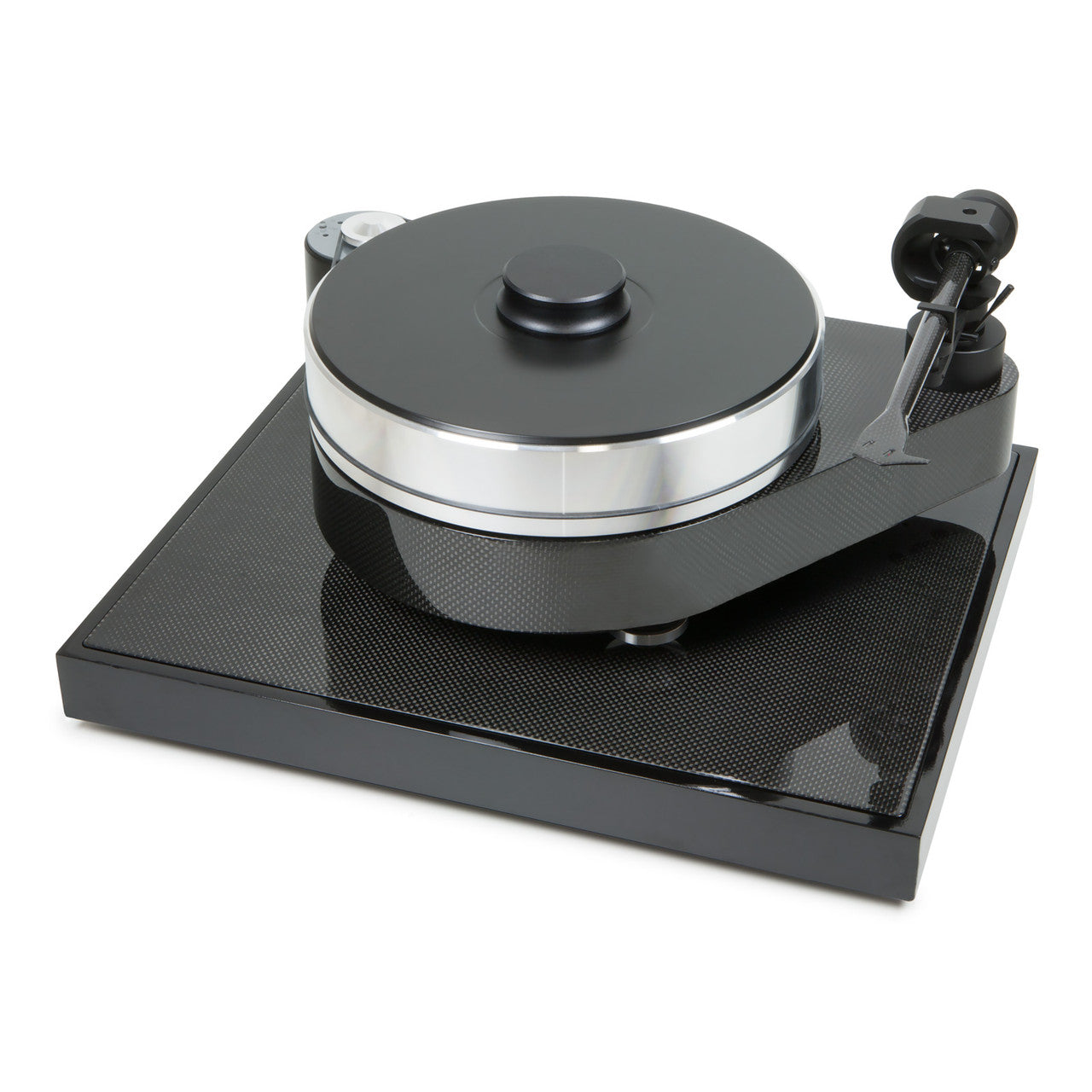
The no-cartridge RPM 10 Carbon is a belt-drive deck built around a mass-loaded plinth, an outboard motor, a damped aluminum platter, magnetic support feet and a pre-mounted 10-inch 10cc Evolution tonearm. Its useful distinction is not an unverified sonic promise: the reviewed package leaves the pickup choice and installation to the buyer. There is no cartridge, built-in phono stage or included dust cover listed for this exact U.S.-facing item. The bare headshell in its item image is consistent with that package identity.
Choose a cartridge before choosing the phono connection. Pro-Ject’s manual says a cartridge with standard half-inch mounting holes can be fitted and sets out alignment, downforce, anti-skating, vertical tracking angle and azimuth adjustments. The general mounting instructions are not evidence that a particular cartridge is supplied or already aligned. If cartridge setup is unfamiliar, the manual itself advises asking a dealer for help; a damaged cantilever or inaccurate installation is an avoidable cost on a configuration whose chief appeal is flexibility.
Build the phono chain around the cartridge you add
The turntable sends an un-equalized phono-level signal through its five-pin output. The product page and information sheet name a Connect it 5P-CC cable with RCA plugs, while the 2023 manual calls the supplied lead 5P-E; check the exact cable revision and connectors in the carton. Pro-Ject lists an XLR cable as optional, so balanced wiring is not part of the default RCA lead. With a buyer-selected cartridge installed, the manual allows a suitably matched receiver or integrated-amplifier PHONO input. A PHONO label alone is not enough: check that the input supports the cartridge’s generator type, gain and loading.
For powered speakers with LINE input, add a compatible external phono stage between the cartridge and speaker. For passive speakers, the chain is cartridge and turntable → compatible external stage → amplifier LINE/AUX → passive speakers. The amplifier still supplies speaker power. The exact product can support these different routes only after a cartridge is selected and the stage or receiver is matched to it; the bare package cannot play records by itself. It should not be placed directly into an ordinary LINE/AUX or powered-speaker line input.
Manual playback and the optional 78-RPM distinction
The instructions describe manual assembly, manual tonearm handling, a speed button that starts or stops the motor, and electronic switching between 33⅓ and 45 RPM. That button is not an automatic arm mechanism. Pro-Ject’s product sheet says 78 RPM is optional; the basic 33/45 setup should not be represented as ready for 78s. Verify the separate pulley/belt accessory and any 78-compatible cartridge or stylus before counting on that format.
The maker’s documents reviewed here do not establish an end-of-record platter stop or automatic arm return. That behavior remains unknown, not confirmed absent: manual operation is clear, but the record-end function is not. Someone who needs a verified auto-stop or fully automatic start, lift and return should not infer it from the electronic speed control.
Measure the base and reserve the motor’s space
Pro-Ject lists the turntable body at 480 × 210 × 330 mm, approximately 18.90 × 8.27 × 12.99 inches, and 22 kg. The included Ground it Carbon base is larger—500 × 65 × 400 mm, about 19.69 × 2.56 × 15.75 inches—and weighs 14.5 kg. Together the listed masses approach 36.5 kg before the motor, records or other equipment are considered. Measure and load-rate the furniture for the complete base-supported arrangement, not just the narrower plinth.
The outboard motor sits beside the deck, so the published body width and depth are only screening dimensions. Allow adjacent motor placement, cable reach, arm movement and service access. The no-cartridge U.S. item says the dust cover is not included, and the maker manual describes the cover as optional. If a cover matters, check availability and fit for the exact model rather than assuming it comes with the cartridge-free variant.
Keep disputed specifications out of the buying decision
There are source conflicts that should not be hidden by copying a single specification block. On the current Pro-Ject page, the feature list gives a 7.2 kg platter while its technical table gives 10.4 kg; the official information sheet also lists 10.4 kg. The current page labels ±0.11%/±0.10% as speed drift and ±0.01% as wow and flutter, while the older official information sheet assigns the ±0.11%/±0.10% pair to wow and flutter and ±0.01% to speed drift. This review does not select one disputed label or claim a measured result.
The physical dimensions are usable for an initial shelf check, but not a complete installation plan; the separate base and motor are decisive here. No current U.S. offer, stock state, price or customer experience is asserted. The item is a fit for a system builder who wants to choose a cartridge, has the skill or support to install it, can match a phono stage and has room and furniture for the full heavy assembly. It is a poor fit for plug-and-play use, MM-only assumptions when a different cartridge is chosen, automatic operation, or a shelf that only accommodates the smaller turntable body.
Documents checked
Model setup and connection details are in the Pro-Ject RPM 10 Carbon manual; construction, optional 78 RPM and the product-information table are in the official information sheet. The current manufacturer model page is retained as a separate source because some figures conflict with the sheet. The retailer item record was used to identify the exact no-cartridge U.S.-facing package, not to make a price or availability claim.
Key specifications
Key details at a glance
| Drive | Belt drive |
|---|---|
| Documented record speeds | 33 1/3 RPM / 45 RPM / 78 RPM (optional pulley/belt required; not treated as included) |
| 78-RPM play option | Yes |
| Included cartridge | None — exact u.s.-facing no-cartridge item. |
| Built-in phono preamp | No |
| Manual tonearm cueing | Yes |
| Platter | Aluminum with internal tpe damping and a vinyl surface |
| Body width | 18.9 in |
| Body depth | 12.99 in |
| Body height | 8.27 in |
Use the exact model’s instructions for operating limits, supplied equipment and version differences.
Sources for this review
Sources for this assessment
Check your phono route before choosing
Check each model's documented input route, arm operation, and body limits. Use the finder to compare supported phono-system arrangements without assuming adjacent models share features.