
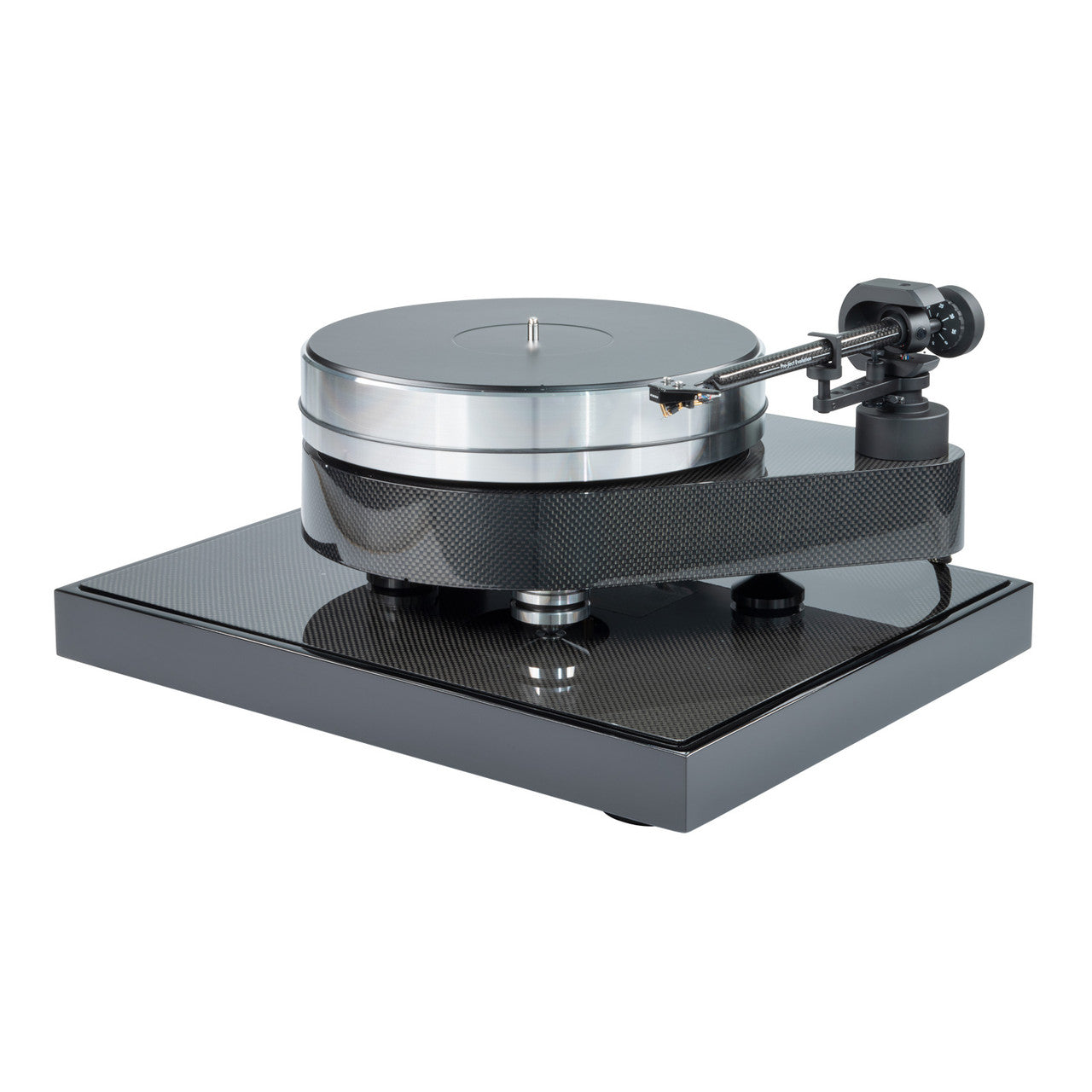
Your needs, this model
Does it fit your priorities?
Can the RPM 10 Sumiko Starling variant use a receiver PHONO input?
Only if that exact input supports low-output moving coil, the cartridge's 0.5 mV signal and Sumiko's greater-than-100-ohm load recommendation. An MM-only PHONO input is not enough.
Explore this need in the finder →Can the Starling package feed powered speakers?
Yes through an external MC-compatible phono stage with suitable gain and loading before powered-speaker LINE; the RPM 10 has no built-in stage.
Explore this need in the finder →Can the Starling package use passive speakers?
Use a compatible low-output-MC phono stage before amplifier LINE/AUX, then let the amplifier power the passive speakers.
Explore this need in the finder →Does the Starling package meet a built-in-preamp-only requirement?
No. This exact package has no internal phono stage; its included low-output MC cartridge needs compatible external or receiver MC amplification.
Explore this need in the finder →Is the RPM 10 with Starling fully automatic?
No. Electronic speed selection does not automate manual tonearm placement, and full automatic start/end handling is not documented.
Explore this need in the finder →Does the Starling variant meet a required record-end auto-stop?
No reviewed source confirms an end-of-record stop or arm return. Treat this function as unknown and do not count it as a match for a hard auto-stop requirement.
Explore this need in the finder →This review is for the U.S.-facing Pro-Ject RPM 10 Carbon variant identified by Audio Advice as the Sumiko Starling package. The same retailer’s item record has a distinct no-cartridge option, and Audio Advisor separately lists an exact no-cartridge U.S. item; this assessment does not transfer that bare package to the Starling variant. The package includes the Starling cartridge according to the retailer’s variant label, but the cited record does not establish setup or alignment quality. This is a document-based assessment, not an ownership, audition or measurement report.
The cartridge changes the system requirement
Both configurations share the RPM 10 Carbon chassis, 10-inch 10cc Evolution arm, separate motor and included Ground it Carbon base. The Starling package is functionally different because its included Sumiko Starling is a low-output moving-coil cartridge. Sumiko specifies 0.5 mV output, 28-ohm internal impedance and a recommended load above 100 ohms. An MM-only PHONO input or ordinary MM stage should not be treated as compatible merely because the deck has RCA connectors.
Before purchase, confirm that the exact receiver or external stage has genuine MC support with suitable gain and loading for the Starling. If the receiver’s PHONO input is MC-compatible for this cartridge, it can be the phono stage. With powered speakers, use a compatible external MC phono preamp before LINE. For passive speakers, the chain is turntable → compatible MC phono stage → amplifier LINE/AUX → passive speakers. The RPM 10 has no documented built-in phono stage, and the 0.5 mV pickup signal is not line-level. Pro-Ject’s current page and information sheet call the supplied lead 5P-CC with RCA plugs, while the 2023 manual calls it 5P-E; check the exact cable version. XLR is an optional cable, not the default connection.
Plan on deliberate cartridge setup
Sumiko gives the Starling an optimum tracking force of 2.0 grams, with a stated range of 1.8–2.2 grams, a 9.5-gram cartridge mass and a standard half-inch mount. Pro-Ject’s information sheet lists supplied counterweights including a 9–11-gram range, so the listed cartridge mass falls within a specifically documented weight band. That compatibility is a hardware fit, not proof that the cartridge in an individual box has been aligned or adjusted. Use the exact cartridge and tonearm instructions for installation and calibration.
Both manuals treat cartridge setup as delicate work. Pro-Ject provides instructions for alignment, downforce, anti-skating, VTA and azimuth; Sumiko warns that its nude cartridge construction needs careful handling. Those steps are a real ownership cost even when a cartridge is part of the package. Verify whether the seller ships it installed or separately packed, who will align it, and which phono input settings are required. Do not assume the retail word “package” means setup has already been completed.
Manual 33/45 operation, with 78 RPM optional
The maker’s manual describes manual tonearm cueing and a motor button for start, stop and electronic 33⅓/45 RPM selection. Automatic speed switching is convenient compared with moving a belt for those two speeds, but it does not automate arm placement or record-end handling. The documents do not verify an automatic platter stop or arm return; treat end-of-record behavior as unknown rather than promising either feature.
The manufacturer information sheet lists 78 RPM as optional. That does not mean a 78-ready pulley, belt, cartridge or stylus is included in the Starling package. Verify the separate speed accessory and a stylus suited to the record before using 78-RPM discs. With this low-output cartridge, setup decisions extend beyond the deck: correct tracking and MC loading are integral parts of the planned system.
Allow for the full assembly, not only the plinth
The official sheet gives body dimensions of 480 × 210 × 330 mm—about 18.90 inches wide, 8.27 inches high and 12.99 inches deep—and lists the turntable at 22 kg. The Ground it Carbon support is included but measures about 19.69 × 2.56 × 15.75 inches and weighs 14.5 kg. That larger base footprint and the roughly 36.5 kg combined listed mass matter more than the body-only figures when selecting a shelf or rack.
The motor is a separate unit, so reserve a clear adjacent spot and cable reach in addition to arm and record access. The maker’s manual calls the dust cover optional; the exact Starling variant record does not establish that a cover is included. Confirm the exact carton contents if dust protection is required. A tight body-size match is not an operating-clearance guarantee, and a shelf that is wide enough for the turntable body may still be too small for the base and motor.
Engineering claims are not listening evidence
Pro-Ject describes a mass-loaded MDF/carbon-fiber/steel-pellet plinth, magnetic feet, an outboard motor, a damped aluminum platter and an inverted bearing. Those are design choices, not proof of a particular sound. The official sources also disagree internally: the current page’s feature bullet lists a 7.2 kg platter, but its technical table and official product-information sheet list 10.4 kg. The current page assigns ±0.11% and ±0.10% to speed drift and ±0.01% to wow and flutter; the information sheet reverses those labels. No disputed number is promoted as an established performance result.
This configuration is best considered by someone who specifically wants the supplied low-output Starling and already has—or will add—a compatible MC stage, plus adequate room and support for the entire assembly. It is not the right shortcut for a receiver with only an MM input, for someone requiring a built-in stage or automatic arm behavior, or for a shelf constrained to the 18.90-by-12.99-inch body dimensions. If those system checks are not settled, the no-cartridge variant is not automatically a safer alternative: it leaves the buyer responsible for choosing, mounting and matching a different cartridge.
Documents checked
Pro-Ject’s RPM 10 Carbon manual, official information sheet and current model page establish the shared chassis and operating guidance; the Sumiko Starling manual supplies cartridge-specific electrical and setup limits. The retailer’s variant record establishes the U.S.-facing Starling package label and was not used for a price, stock or user-experience claim.
Key specifications
Key details at a glance
| Drive | Belt drive |
|---|---|
| Documented record speeds | 33 1/3 RPM / 45 RPM / 78 RPM (optional pulley/belt required; not treated as included) |
| 78-RPM play option | Yes |
| Included cartridge | Sumiko starling low-output moving-coil cartridge (retailer variant label) |
| Built-in phono preamp | No |
| Manual tonearm cueing | Yes |
| Platter | Aluminum with internal tpe damping and a vinyl surface |
| Body width | 18.9 in |
| Body depth | 12.99 in |
| Body height | 8.27 in |
| Published phono output | 0.5 mV |
Use the exact model’s instructions for operating limits, supplied equipment and version differences.
Sources for this review
Sources for this assessment
Check your phono route before choosing
Check each model's documented input route, arm operation, and body limits. Use the finder to compare supported phono-system arrangements without assuming adjacent models share features.