
Your needs, this model
Does it fit your priorities?
Can the Blue Point No. 2 use an MM-compatible receiver PHONO input?
The No. 2 is moving coil, but its legacy Sumiko manual lists 2.5 mV output and a standard 47 kΩ load. A compatible 47 kΩ/MM input is the supported route; check the exact input specification and cartridge condition.
Explore this need in the finder →Can it connect directly to line-only powered speakers?
No. The RPM 3 has phono-level output and no documented internal stage; add a suitable MM-compatible phono stage before powered-speaker LINE, or use a compatible receiver PHONO input.
Explore this need in the finder →Does the RPM 3 stop or return its arm automatically at the end of a record?
The model sources establish manual belt speed selection and user-operated cueing but do not confirm an end-of-record stop or automatic return. Do not treat unknown behavior as a verified feature.
Explore this need in the finder →Will it fit a 17.5-inch-wide shelf body limit?
Not on the conservative seller-listed body-width screen: 17.6 inches misses 17.5 and first fits the questionnaire step at 18 inches. Allow additional working clearance.
Explore this need in the finder →Does 33/45 belt switching make the deck fully automatic?
No. The user moves the belt between pulley steps and handles the tonearm; speed change does not automate start, lift or return.
Explore this need in the finder →This assessment covers the U.S.-facing Pro-Ject RPM 3 Carbon listings that identify a Sumiko Blue Point No. 2 cartridge: the Acoustic Sounds item codes T RPM3CW (White) and T RPM3CR (Red). It is a source-based fit review, not a listening test, bench measurement or ownership report. Keep it separate from the White/Moonstone RPM 3 Carbon assessment: the supplied cartridge is a different package, even though the deck's basic drive and connection layout are shared.
The Blue Point No. 2 changes the phono match
Acoustic Sounds identifies the fitted cartridge as the Sumiko Blue Point No. 2. Sumiko's legacy manual labels the No. 2 moving coil and lists 2.5 mV output with a standard 47 kΩ load for its moving-magnet and moving-coil designs. On those specifications, a suitable 47 kΩ/MM-compatible PHONO input is the practical receiver route—commonly described as high-output MC, rather than a low-output-MC setup. Confirm the exact receiver input specification rather than relying on a jack labelled only “phono.”
The turntable itself has no documented phono preamp or switchable LINE output. Its RCA sockets carry phono-level signal, and the RPM 3 manual shows a ground terminal. A compatible receiver or integrated amplifier PHONO input can provide the required equalization; otherwise place a suitable phono stage between the turntable and a powered speaker's LINE input. With passive speakers, that stage still has to feed an amplifier or receiver. The turntable does not supply speaker amplification or speakers. The central difference from the Moonstone package is cartridge generator type and package identity—not a new built-in stage.
Manual setup and playback
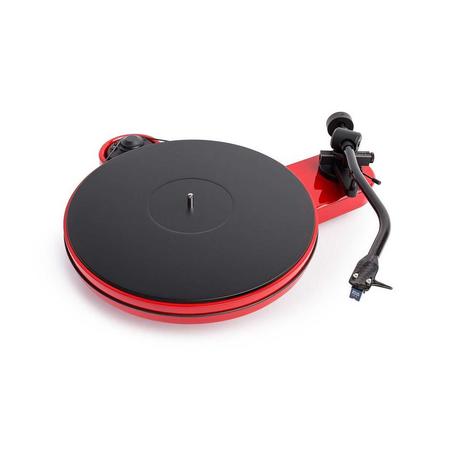
Pro-Ject documents the RPM 3 Carbon as a manual belt-drive design with 33⅓ and 45 RPM playback. Speed changes require moving the belt between pulley steps; this is not a one-button electronic speed selection. Expect to cue and lift the arm yourself. The material reviewed does not document fully automatic start-and-return or a platter stop at the end of a side, so do not choose it when those functions are essential. A 78 RPM mode is not listed.
The family uses a 10-inch S-shaped arm and a 300 mm MDF platter with a vinyl layer on its surface. The two U.S.-facing Blue Point listings describe the 10-inch Pro-Ject 10S arm, phono RCA jacks, and an outboard supply. The RPM 3 manual is written around an Ortofon 2M Silver configuration; do not transfer that cartridge's adjustment instructions to the supplied Blue Point No. 2. Check the Sumiko cartridge guidance and confirm the exact seller package has been set up for that cartridge. Published arm-mass figures also differ: the maker sheet and retailer listing do not agree, so this review does not use arm mass as a compatibility claim.
Space, cover and the width discrepancy
Acoustic Sounds lists the U.S. White and Red Blue Point packages at 447 × 118 × 373 mm, or about 17.6 × 4.65 × 14.7 inches (W × H × D). Pro-Ject's RPM 3 information sheet instead lists 422 × 118 × 373 mm, about 16.61 × 4.65 × 14.69 inches. Height and depth are close, but the width differs by 25 mm. For a conservative shelf screen, treat 17.6 inches as the relevant listed body width and ask the seller to confirm the exact unit if that margin matters. This is still only the plinth/body footprint: allow room for cables, arm movement, access and any cover in its raised position. It is not an installation-clearance guarantee.
The exact item pages say no dust cover is included, while the maker's product information describes a lid as optional. If a cover matters for dust control or pets, confirm a compatible cover and whether it is part of the offer; do not infer one from the product family name. The images in this assessment distinguish the recorded White and Red item finishes, but a photograph does not prove cartridge, included parts or current availability.
Who should consider this package?
It is a plausible fit for a listener who wants a manual RPM 3 Carbon with the observed high-output Blue Point No. 2 package, already has an MM-compatible receiver PHONO input or is prepared to add a suitable phono stage, and can accommodate the conservative 17.6-inch width screen. It is a poor match for a system that accepts only line-level input without an added stage, a buyer who needs automatic end handling, or a shelf that cannot tolerate the unresolved width difference. It is also not interchangeable with the White/Moonstone package merely because both sit in the RPM 3 Carbon family.
Before buying, check that the offer is specifically the RPM 3 Carbon / Blue Point No. 2 package and identify its exact White or Red finish; verify that the receiving PHONO stage supports the high-output cartridge route; ask about the 422-versus-447 mm width for the item being sold; confirm the dust-cover arrangement and required accessories; and use Blue Point No. 2 setup guidance rather than the RPM 3 manual's Ortofon settings. No price, stock promise, customer experience or sound-quality result is inferred here.
Key specifications
Key details at a glance
| Drive | Belt drive |
|---|---|
| Documented record speeds | 33 1/3 RPM / 45 RPM |
| 78-RPM play option | No |
| Included cartridge | Sumiko blue point no. 2 moving-coil cartridge, identified on each exact u.s.-facing seller item page. |
| Built-in phono preamp | No |
| Manual tonearm cueing | Yes |
| Platter | Mdf |
| Platter mat | Integrated vinyl layer (manufacturer description) |
| Body width | 17.6 in |
| Body depth | 14.7 in |
| Body height | 4.65 in |
Use the exact model’s instructions for operating limits, supplied equipment and version differences.
Sources for this review
Sources for this assessment
- Pro-Ject RPM 3 Carbon official model page
- Pro-Ject RPM 3 Carbon product information sheet
- Pro-Ject RPM 3 Carbon / Ortofon 2M Silver user manual
- Acoustic Sounds U.S.-facing RPM 3 Carbon / Sumiko Blue Point No. 2 White item
- Acoustic Sounds U.S.-facing RPM 3 Carbon / Sumiko Blue Point No. 2 Red item
- Sumiko Oyster Series cartridge legacy manual (Blue Point No. 2 specification table)
Check your phono route before choosing
Check each model's documented input route, arm operation, and body limits. Use the finder to compare supported phono-system arrangements without assuming adjacent models share features.