
Your needs, this model
Does it fit your priorities?
Can the RPM 9 Carbon no-cartridge item connect to a receiver PHONO input?
Yes, after you supply and install a cartridge whose generator type and loading match that receiver input. The RPM 9 itself has no documented built-in phono stage; confirm that the exact receiver's PHONO input supports the cartridge you choose.
Explore this need in the finder →Can the RPM 9 Carbon feed powered speakers with only LINE inputs?
Only with an added external phono stage before the speaker LINE input, after you select and fit a cartridge matched to that stage. The no-cartridge item has no built-in preamp and cannot be treated as a ready-to-play line-level source.
Explore this need in the finder →Does the RPM 9 Carbon automatically stop or return the arm at record end?
The inspected manual documents a manual arm routine, but no source establishes a platter stop or automatic arm return at record end. Treat stop behavior as unknown and do not select this deck if a verified end stop or full-automatic handling is essential without obtaining confirmation for the exact version.
Explore this need in the finder →This review concerns one U.S.-facing Pro-Ject RPM 9 Carbon item: Gloss Black and sold without a cartridge. Pro-Ject's global model page also describes other cartridge configurations, but those global options do not change the identity of the observed U.S. no-cartridge item. This is a document-led assessment, not an ownership account, listening test or measurement report.
A substantial manual deck, not a ready-to-play system
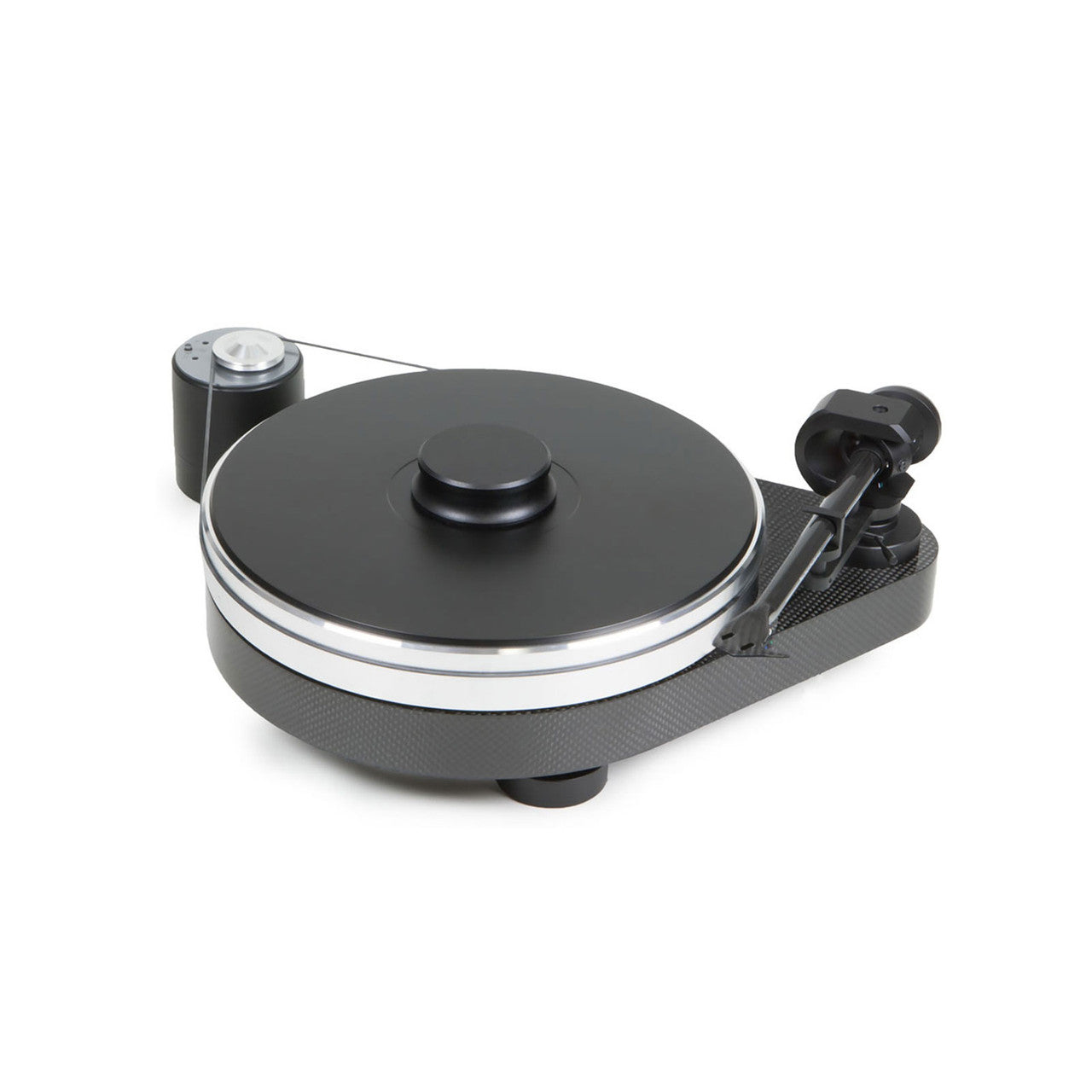
The RPM 9 Carbon combines a mass-loaded MDF plinth with a carbon-fiber surface, magnetic feet, a separate outboard motor and a damped aluminum platter. Pro-Ject documents a 7.2 kg platter and a 9-inch 9cc Evolution tonearm. Those are construction details, not proof of a sound advantage. The important package decision is simpler: the reviewed U.S. item has no cartridge. The open tonearm and platter shown in the exact item image should not be mistaken for an included cartridge or a complete playback chain.
Plan on selecting and fitting a cartridge before playback. The RPM 9 manual includes careful alignment, counterweight and anti-skating setup steps, and its general cartridge-mounting range does not select a cartridge for you. Check the future cartridge maker's mounting and tracking instructions; if you have not installed a cartridge before, ask an experienced dealer or technician about setup rather than guessing. The cartridge will determine the type of phono input or external phono stage you need, so choose the cartridge and downstream stage as a pair.
Three workable signal routes, each conditional on your cartridge
The manual directs the turntable's phono-level output to a compatible PHONO input or to a separate phono stage before an amplifier's line input. There is no documented internal phono preamp. With a cartridge installed, one route is a receiver or integrated amplifier whose PHONO input supports that cartridge's generator type and loading. For powered speakers with LINE inputs, add a matching external stage first. For passive speakers, use that stage and then an amplifier's LINE/AUX input. The turntable alone does not power speakers.
These are possible installation plans, not a claim that the bare no-cartridge item can play records as delivered. An MM cartridge generally needs a suitable MM input or stage; a low-output moving-coil cartridge needs compatible MC gain and loading. Do not assume an input marked PHONO supports every cartridge. The exact user's selected cartridge, receiver or separate stage must be checked together, and a line input should not receive an un-equalized cartridge signal.
Manual speed and arm handling
Pro-Ject documents electronic 33⅓/45 RPM selection and a manual tonearm routine. The speed control starts or stops the separate motor; it is not an automatic arm or record sensor. The reviewed manual does not establish an end-of-record platter stop or automatic arm return, so this assessment leaves auto-stop unknown instead of treating a motor button as proof either way. Listeners who want the deck to start, lift or return the arm automatically should not rely on the RPM 9 for that function without written confirmation for the exact version.
The documents identify two speeds, 33⅓ and 45 RPM; they do not document 78 RPM playback. A manual deck also asks the user to place and lift the arm and to handle setup carefully. Electronic speed selection makes belt changes unnecessary for the listed 33/45 speeds, but it does not make cueing automatic. These distinctions matter more to day-to-day fit than the elaborate chassis description.
Space, cover and specification checks
The manufacturer and U.S. item listing agree on a body width of about 17.3 inches and depth of about 12.8 inches; the official page and manual give 440 × 325 mm for those axes. This is a body-size screen, not an operating envelope. The motor is separate, so reserve adjacent placement and cable reach; also allow space for arm movement and service access. The turntable is listed at 16.5 kg, which should be considered against the supporting furniture rather than treated as a measure of stability.
Height is not settled across the current manufacturer page, manual/product sheet and retailer listing: they report 180 mm, 170 mm and 6.7 inches respectively. The maker page and the manual also disagree on wow-and-flutter by a factor of ten. Neither disputed figure is used for matching or presented here as a verified performance result. If a precise height or a particular published measurement matters, ask Pro-Ject to identify the exact production revision and confirm its specification. The U.S. no-cartridge listing explicitly says a dust cover is not included; the manual describes a cover as an optional separate accessory, so budget for and verify a separate cover if you need one.
Who should shortlist it
The RPM 9 Carbon makes the most sense for a system builder who wants a heavy, manually operated 33/45 deck, is comfortable choosing and mounting a cartridge, already has or will add a compatible phono stage, and has room for the plinth plus the separate motor. It is a poor fit for someone who needs an included cartridge, built-in preamp, automatic arm handling, verified end stop, 78 RPM, supplied dust cover, or a compact all-in-one turntable setup. Its chassis and arm may invite comparison with other RPM models, but the decision should be about package readiness and system requirements rather than untested sound language.
Before purchase, verify the exact Gloss Black no-cartridge item, choose a cartridge and matching phono stage, confirm who will perform alignment and setup, check the separate motor's shelf position, and measure for body width, depth, cables and arm access. Do not transfer a cartridge bundle, cover, performance figure or global option to this U.S.-facing no-cartridge package. No current price or stock assertion is made here.
Key specifications
Key details at a glance
| Drive | Belt drive |
|---|---|
| Documented record speeds | 33 1/3 RPM / 45 RPM |
| 78-RPM play option | No |
| Included cartridge | None — the exact u.s.-facing item is sold without a cartridge. |
| Built-in phono preamp | No |
| Manual tonearm cueing | Yes |
| Platter | Damped aluminum alloy with tpe damping and vinyl layer |
| Body width | 17.32 in |
| Body depth | 12.8 in |
Use the exact model’s instructions for operating limits, supplied equipment and version differences.
Sources for this review
Sources for this assessment
Check your phono route before choosing
Check each model's documented input route, arm operation, and body limits. Use the finder to compare supported phono-system arrangements without assuming adjacent models share features.