
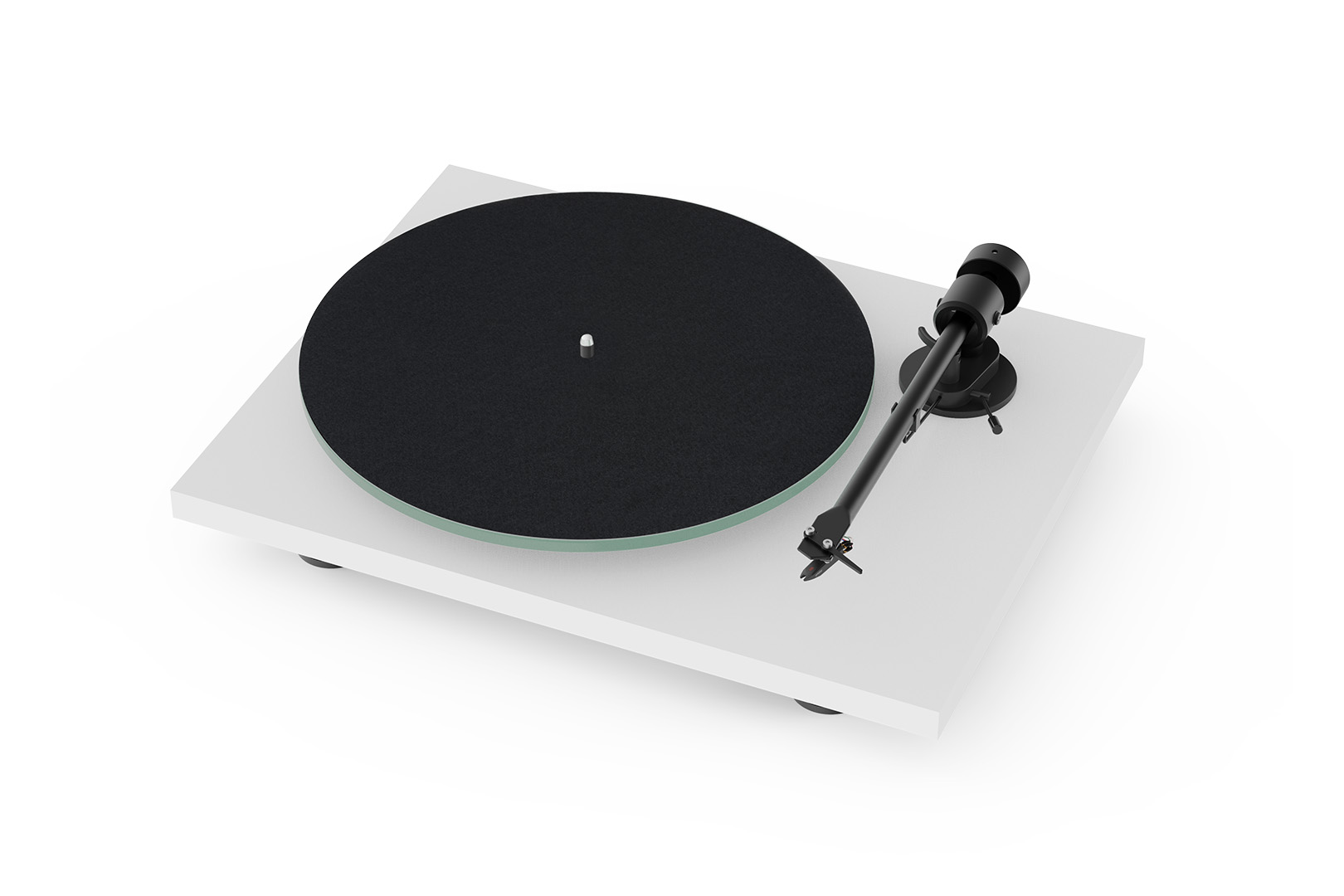
Your needs, this model
Does it fit your priorities?
Can the white T1 EVO Phono connect to powered speakers without a separate phono stage?
Yes, with the switch set to LINE: the built-in MM stage provides line output for powered speakers with a compatible line input. The speakers must supply their own amplification; passive speakers still need an amplifier.
Explore this need in the finder →Can I connect T1 EVO Phono to a receiver’s PHONO input instead of using its built-in stage?
Yes. Set the rear selector to PHONO so the built-in stage is bypassed, then connect the OM10 signal to a compatible MM PHONO input and ground as needed. Do not send LINE output into PHONO, which would duplicate the stage.
Explore this need in the finder →Is the T1 EVO Phono automatic at the end of a record?
No automatic arm return or platter stop is specified. It remains a manual two-speed deck; use the cue lever, lower and return the arm yourself, and stop playback manually. The 33/45 selector does not add 78-RPM support.
Explore this need in the finder →The T1 EVO Phono is the T1 EVO platform with a switchable MM phono preamplifier added. Its practical advantage is routing choice: set the output to LINE for powered speakers or an amplifier’s AUX/LINE input, or set it to PHONO and use a compatible external stage or receiver PHONO input. It still has no speaker amplifier, no speakers, and no automatic arm operation. The included cartridge documented for the U.S. retailer package is Ortofon OM 10. This assessment is built from the manufacturer’s model page, shared manual and U.S. item records—not personal ownership, listening, bench testing or measured performance. Retail pages are used to establish package identity, not to claim a live price or stock state.
The built-in stage is switchable, not a speaker system
On the Phono model, LINE output sends a phono-corrected signal to a standard line-level input. That is the simpler route for a powered speaker pair with RCA line input, provided those speakers include their own power amplification. In PHONO mode, the internal stage is bypassed so the cartridge signal can feed a compatible external MM stage or amplifier PHONO input. Selecting PHONO does not make the turntable’s output line level, and selecting LINE into a second phono input would duplicate equalization and gain. If your receiver’s PHONO input is the stage you want to use, make sure the deck’s switch is on PHONO. The T1 EVO Standard lacks this built-in choice; the BT version retains a line/phono route and adds Bluetooth transmission.
The included OM 10 is a moving-magnet cartridge with an elliptical stylus. The manual documents the selectable outputs and a ground wire, which may be attached to the amplifier’s ground terminal if needed. If hum appears, first follow the component manuals and confirm output switch, channel routing and grounding before assuming the cartridge or stage is defective. Passive speakers still need a power amplifier; the T1 EVO Phono supplies only the phono-level or line-level signal.
Manual speed selection is not automatic playback
The Phono version remains a fully manual belt-drive turntable. Its speed switch selects 33⅓ or 45 RPM electronically, but you start the record by lowering the arm and return it at the end yourself. The tonearm lift lever supports careful cueing; it does not perform an automatic start or end-of-record return. If you require hands-off arm handling or a platter that stops by itself, the T1 EVO Phono does not document those functions. The 33/45 selection also does not imply 78-RPM support.
Model pages describe a heavy 8 mm glass platter, felt mat, damped sub-platter, aluminum tonearm and pre-adjusted OM 10. The product sheet publishes 65 dB signal-to-noise, 0.7%/0.6% speed variance at 33/45 and 0.25%/0.23% wow/flutter. These figures are manufacturer specifications rather than independently measured results. The manual says a factory-fitted cartridge does not need its force adjusted unless it is replaced, but its OM 10 table and the product sheet’s pre-adjusted figure do not align exactly. Check the package-specific manual if replacing the cartridge or stylus instead of assuming the supplied setting is wrong.
Understand the size and cable differences before fitting a shelf
The T1 EVO Phono’s product page lists 415 × 100 × 335 mm; the shared manual’s technical table gives 420 × 112 × 330 mm. U.S. retailer dimensions also vary by page and section: one summary line gives 16 15/16 × 4 × 13 1/4 inches, while a different closed-cover details block gives 16.5625 × 4.3125 × 13.5625 inches. These are inconsistent published dimensions, not measurements reconciled by this review. The finder uses the largest reported width and depth across the reviewed T1 EVO U.S. records—about 16.94 by 13.56 inches—as a conservative body-only envelope. It is not a fit guarantee or operating clearance. Measure the complete shelf and allow for the lid hinge arc, hand access, cable bends and nearby components separately. Published net weight also differs between product page and manual; verify it for the specific package before planning a lift or placement.
The shared T1 EVO guide says the Phono model’s RCA cable is detachable; the Standard’s signal lead is captive. A removable lead can make the connection easier to replace or route, but check included cable length and connector clearance in the actual carton. Do not judge internal preamp capability from a photograph: the model’s switch and output are the meaningful distinction, and the exterior image does not reveal them.
Where it fits—and where the BT version differs
Keep the Phono on your shortlist if manual cueing is acceptable and the switchable built-in MM stage gives you a choice between direct line-level connection and a receiver or external stage. It is especially relevant when the system may change later: PHONO output can use a future separate stage, while LINE can feed an ordinary analog input today. The tradeoff is that the user must set the rear output selector correctly and the deck does not automate the start or finish of a side. The T1 EVO BT has the same documented analog stage functions plus a transmitter; Bluetooth remains a link to a compatible receiving device, not a substitute for an amplifier where passive speakers need power.
Before ordering, confirm the listing says T1 EVO Phono—not Standard or BT—and that the white package includes the OM 10, selectable phono/line output, detachable RCA lead, power supply, felt mat, dust cover and belt. Check whether your powered speakers have line input or your receiver has a suitable phono input, and identify which output switch position that path requires. The global model page lists three finishes, but this assessment is limited to the exact U.S.-listed Gloss White package and does not claim the entire U.S. Pro-Ject inventory is enumerated.
Other listed Phono finishes
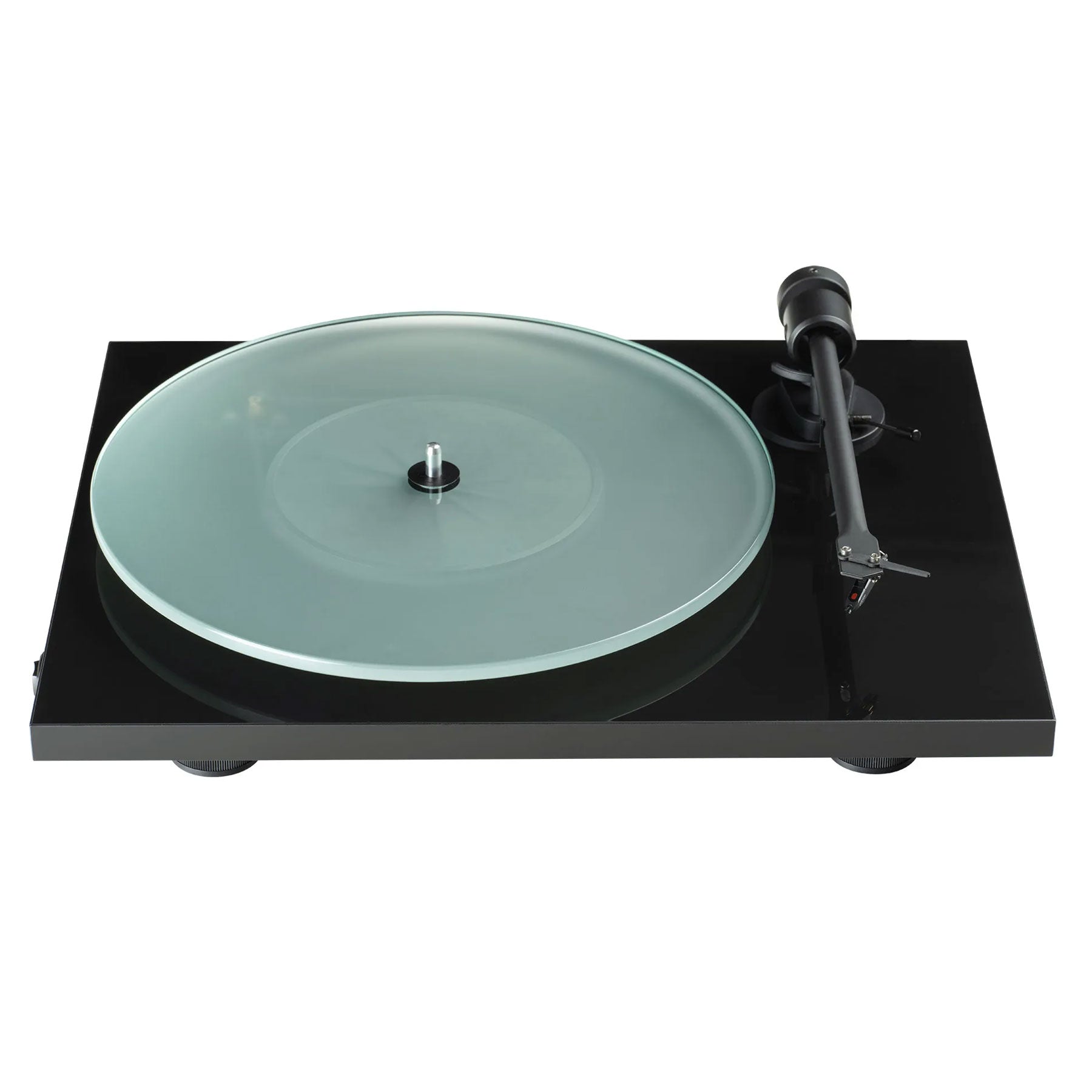
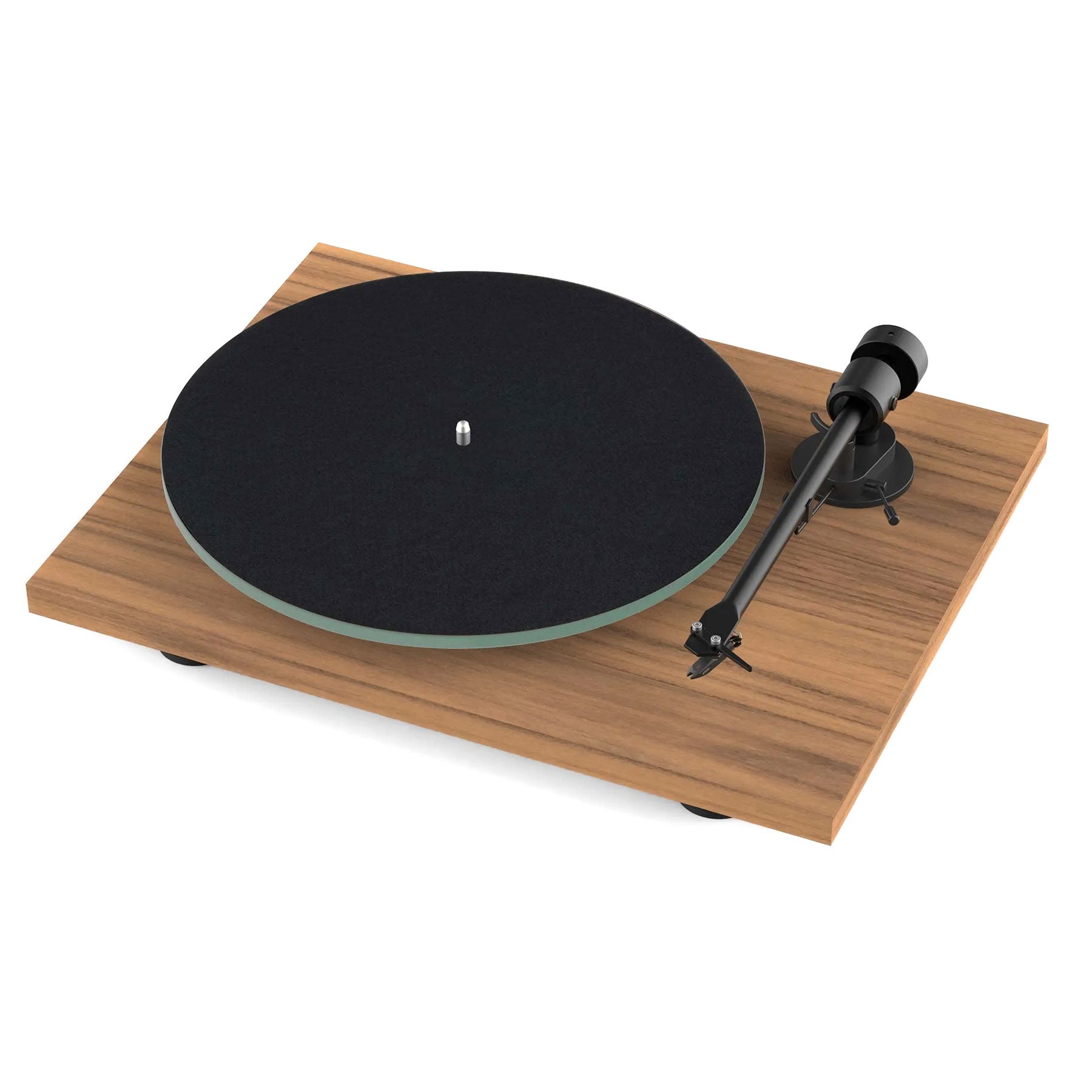
The U.S. Turntable Lab Phono item page also identifies Gloss Black and Walnut finish options. The photographs below are tied to those named variants on the Phono listing; they show exterior appearance only and cannot reveal whether the selector is set to PHONO or LINE. A retailer’s variant image is not proof of a current offer, so confirm the exact T1 EVO Phono name, finish label, OM 10 package and detachable lead in the offer being considered.
Key specifications
Key details at a glance
| Drive | Belt drive |
|---|---|
| Documented record speeds | 33 1/3 RPM / 45 RPM |
| 78-RPM play option | No |
| Included cartridge | Ortofon om10 moving-magnet cartridge, pre-adjusted by manufacturer. |
| Built-in phono preamp | Yes |
| Manual tonearm cueing | Yes |
| Platter | 8 mm blasted glass |
| Platter mat | Felt |
| Body width | 16.94 in |
| Body depth | 13.56 in |
| Body height | 4.41 in |
Use the exact model’s instructions for operating limits, supplied equipment and version differences.
Sources for this review
Sources for this assessment
- Pro-Ject official global turntable directory (2026-10-31 capture)
- Pro-Ject official T1 EVO product-information sheet
- Pro-Ject T1 EVO / T1 EVO Phono / T1 EVO BT user manual, revision 2025-01-28
- Pro-Ject T1 EVO setup guide
- Pro-Ject official T1 EVO Phono model page
- Turntable Lab U.S. T1 EVO Phono item page
- Crutchfield U.S. T1 EVO Phono Gloss White item page (direct archive 403 retained)
Check your phono route before choosing
Check each model's documented input route, arm operation, and body limits. Use the finder to compare supported phono-system arrangements without assuming adjacent models share features.