
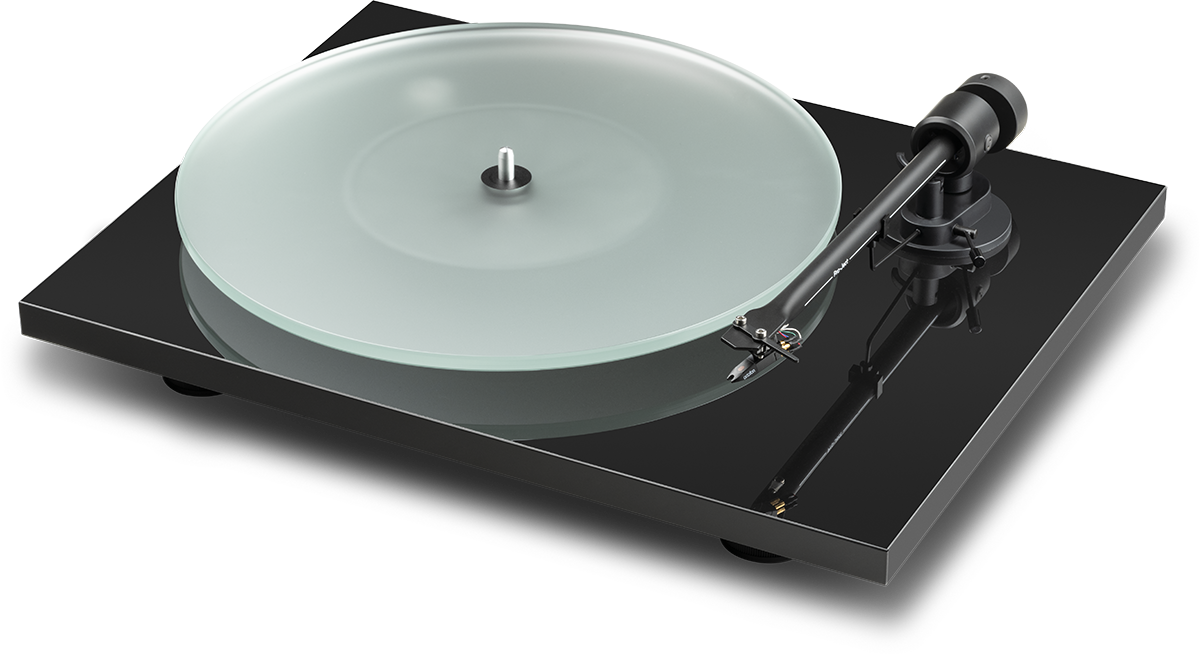
Your needs, this model
Does it fit your priorities?
Can I connect the black T1 EVO Standard directly to an AUX or line-only powered speaker?
Not as documented: Standard has no built-in phono stage, and its captive lead carries phono-level signal. Use a compatible MM PHONO input or put a separate MM phono stage before powered speakers or an amplifier line input. Passive speakers also need an amplifier.
Explore this need in the finder →Will T1 EVO Standard work with my receiver PHONO input?
Yes, if the input is a compatible MM PHONO input for the included Ortofon OM10. Connect the captive RCA lead and ground as the manuals direct. If the receiver has only AUX/LINE, add an external MM phono stage instead.
Explore this need in the finder →Does T1 EVO Standard cue or stop a record automatically?
No automatic tonearm routine or platter auto-stop is documented. Use the cue lever for manual lowering and raise/return the arm and stop playback yourself; 33/45 speed control is not automatic arm handling, and 78 RPM is not listed.
Explore this need in the finder →The T1 EVO Standard is the stripped-back member of Pro-Ject’s three-model T1 EVO line. It comes with an Ortofon OM 10 moving-magnet cartridge and the same glass-platter, belt-drive platform used by the Phono and BT versions, but it does not add either an internal phono stage or wireless transmitter. That makes the first decision about your existing system more important than its finish: a suitable receiver PHONO input or a separate phono stage is necessary. This is a source-based assessment of the documented package, not a listening test, hands-on setup report or independent measurement. A retailer listing confirms a U.S.-market OM10 package; it does not establish current offer availability or price.
Choose it only if you have a phono stage in the system
The Standard’s signal leaves the cartridge at phono level. Its model-specific manual says to connect the captive tonearm lead to a suitable PHONO input; an AUX, CD or other ordinary line input is not a substitute. If your amplifier lacks that input, a separate compatible phono stage belongs between the deck and powered speakers, or between the deck and an amplifier’s line input when using passive speakers. The T1 EVO Phono offers a switchable internal stage, and the T1 EVO BT adds wireless transmission plus its own selectable line/phono outputs. Those are real functional differences, not color choices. Do not buy the Standard expecting a line-level output merely because its cable has familiar RCA plugs.
Manual operation is part of its appeal—and its workload
There is a tonearm lift lever, but the manufacturer describes a manual player: you place the arm at the start of a side, lift and return it when playback ends, and stop the platter yourself. Its electronic speed button changes between 33⅓ and 45 RPM; it does not automate arm placement or add end-of-record lift. The platform is therefore a poor match if hands-off starts and stops are essential. If you want a deliberate, manual routine and do not mind returning to the deck at the side’s end, the model’s operating plan is straightforward. It does not list 78 RPM.
What is shared across the T1 EVO line
All three documented T1 EVO versions use a belt drive, electronically selected 33/45 RPM, an 8 mm blasted-glass platter with felt mat, a larger sub-platter, an 8.6-inch aluminum tonearm and an Ortofon OM 10 cartridge. The manufacturer states that the cartridge is pre-adjusted; the T1 EVO manual says tracking force need only be reset if the cartridge is replaced. The product sheet gives 65 dB signal-to-noise, speed variance of 0.7% at 33 and 0.6% at 45, and wow/flutter of 0.25% and 0.23% respectively. Those are published specifications, not measurements made for this review. They do not predict how the deck will behave on a particular shelf, with a particular cartridge sample or in a particular room.
One setup detail deserves care: the product information lists 17.5 mN as the factory pre-adjusted value, while the shared manual’s cartridge specification lists 15 mN as the OM 10’s recommended tracking force. The manual also explains a supplied gauge and says a factory-fitted cartridge is already set. Because those documents do not use the same number, do not change the supplied setting based on an assumption; check the current package manual and ask the dealer if the cartridge or stylus has been changed.
Size and package checks matter more than the hero image
Pro-Ject’s current product page lists a 415 × 100 × 335 mm body; the shared manual lists 420 × 112 × 330 mm. U.S. retailer dimensions also vary by page and section: one T1 EVO summary line gives 16 15/16 × 4 × 13 1/4 inches, while a separate closed-cover details block gives 16.5625 × 4.3125 × 13.5625 inches. The conflict is retained rather than presented as a single verified measurement. For finder screening this assessment uses the largest reported width and depth across the reviewed T1 EVO U.S. records—about 16.94 by 13.56 inches—as a conservative body-only envelope. It is not a measurement or operating clearance. Leave extra room for the hinged lid, rear cable bend, speed switch and access to the tonearm lift. The manufacturer page lists 3.8 kg net, whereas the manual’s technical table lists 5.0 kg; verify the exact delivered version if lifting weight is a practical constraint.
The Standard differs from its siblings in a small but useful physical detail too: the manual identifies its tonearm signal lead as captive, while the Phono and BT versions have detachable RCA cables. A fixed lead reduces one connection to choose, but it also means cable replacement or routing flexibility is different. Confirm that a used or open-box item includes the platter, drive belt, felt mat, dust cover, counterweight, power supply and the supplied 7-inch adapter, and inspect the stylus and packaging condition. The exact included items can depend on the offer.
Who should keep the Standard on the list
It makes sense to compare the T1 EVO Standard when you already own a suitable MM PHONO input or are intentionally adding a separate phono stage, prefer manual operation, and want the OM10 package rather than a turntable with built-in amplification. It is not the easiest route into a line-only powered-speaker setup unless you budget for the external stage. The Phono version is the more direct comparison if you want a selectable line output; the BT version is a distinct option if you also want a transmitter for compatible Bluetooth receivers. Neither wireless transmission nor a phono stage turns passive speakers into an amplified system.
Before purchase, verify the seller’s exact Standard package and finish, the cartridge and stylus supplied, whether the RCA lead is captive, the dimensions in the relevant manual, and whether your amplifier input is a genuine MM PHONO input. The manufacturer directory lists many additional global turntable models and does not establish a complete U.S. inventory. This review addresses the U.S.-listed black Standard/OM10 package only; it does not close Pro-Ject’s wider U.S. catalogue.
Other listed Standard finishes
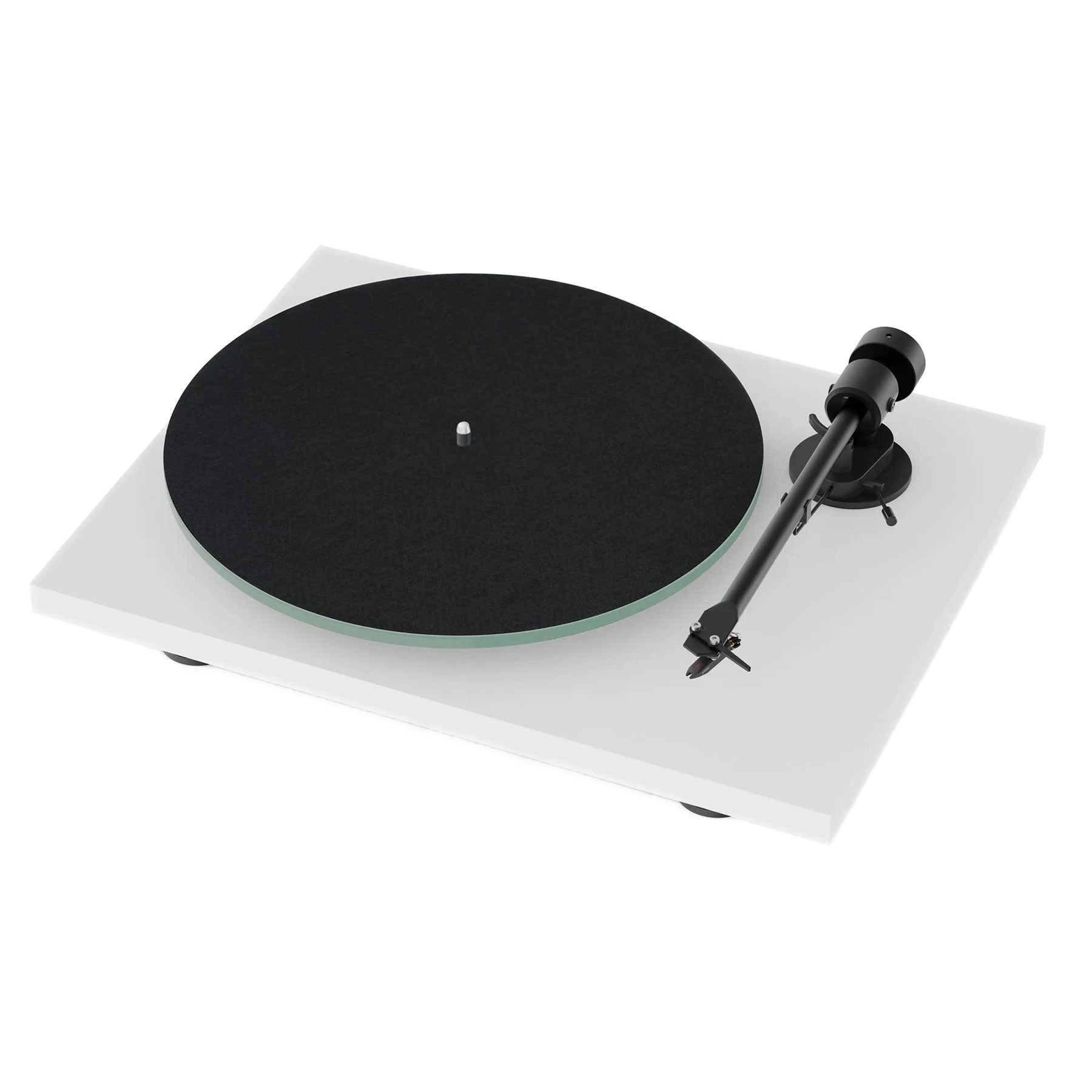
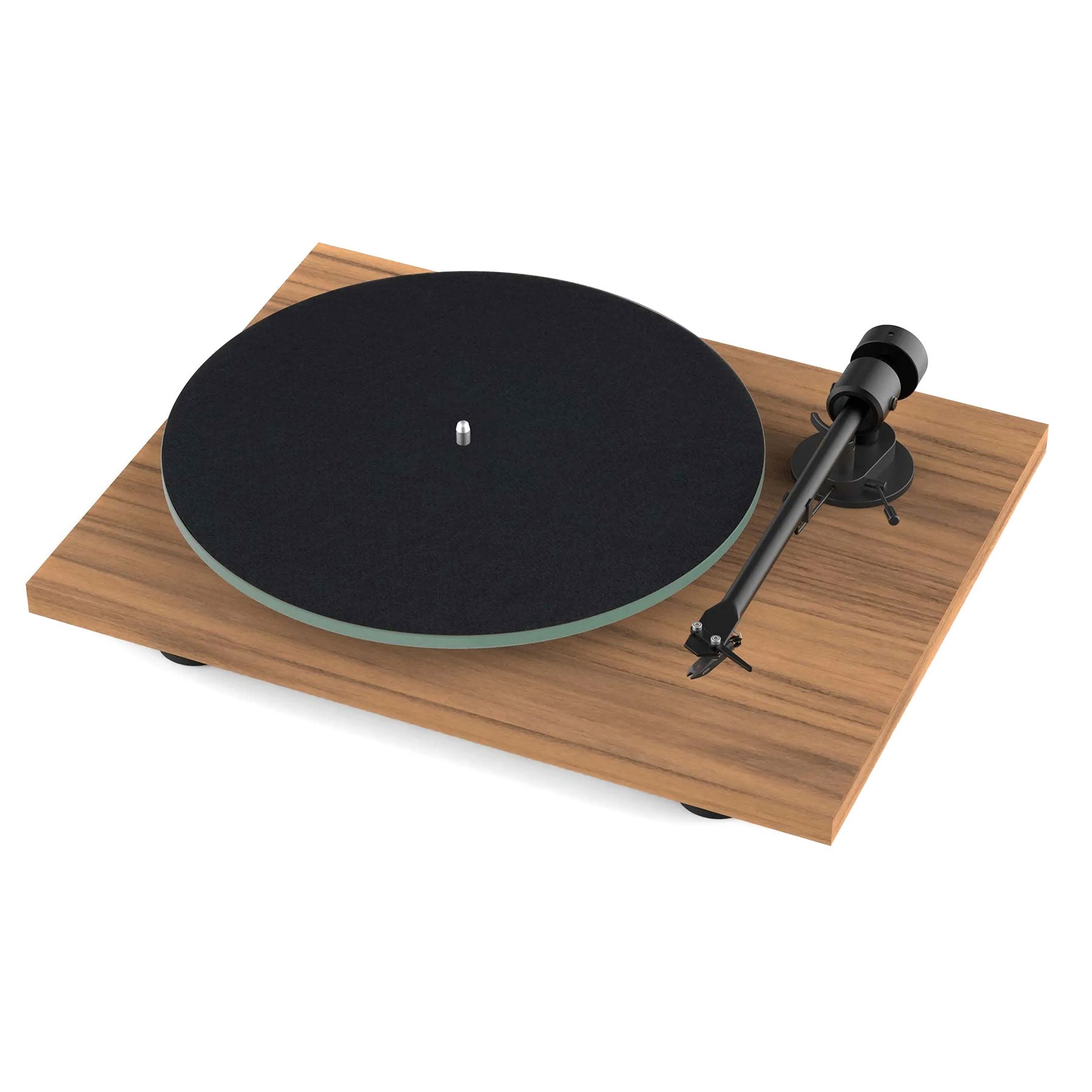
The U.S. Turntable Lab item page identifies Gloss White and Walnut as finish choices for its T1 EVO Standard / OM10 listing. These are the page’s variant-linked photographs, not evidence of a different cartridge or signal path; the colour image cannot establish current stock or an exact package in a later offer. Check the model name, finish label and supplied OM10 package against the seller’s current item details.
Key specifications
Key details at a glance
| Drive | Belt drive |
|---|---|
| Documented record speeds | 33 1/3 RPM / 45 RPM |
| 78-RPM play option | No |
| Included cartridge | Ortofon om10 moving-magnet cartridge, pre-adjusted by manufacturer. |
| Built-in phono preamp | No |
| Manual tonearm cueing | Yes |
| Platter | 8 mm blasted glass |
| Platter mat | Felt |
| Body width | 16.94 in |
| Body depth | 13.56 in |
| Body height | 4.41 in |
Use the exact model’s instructions for operating limits, supplied equipment and version differences.
Sources for this review
Sources for this assessment
- Pro-Ject official global turntable directory (2026-10-31 capture)
- Pro-Ject official T1 EVO product-information sheet
- Pro-Ject T1 EVO / T1 EVO Phono / T1 EVO BT user manual, revision 2025-01-28
- Pro-Ject T1 EVO setup guide
- Pro-Ject official T1 EVO Standard model page
- Turntable Lab U.S. T1 EVO Standard item page
- Crutchfield U.S. T1 EVO Standard Gloss White item page (direct archive 403 retained)
Check your phono route before choosing
Check each model's documented input route, arm operation, and body limits. Use the finder to compare supported phono-system arrangements without assuming adjacent models share features.