
Your needs, this model
Does it fit your priorities?
Can the earlier T1 Phono SB connect straight to line-input powered speakers?
Yes, with its selector at LINE: the built-in MM stage supplies line-level output. Powered speakers still need a line input and their own amplification; passive speakers need an amplifier.
Explore this need in the finder →Can I use a receiver PHONO input instead of the internal stage?
Yes. Set the SB to PHONO so its internal MM stage is bypassed, then use a compatible MM PHONO input and follow the ground instructions.
Explore this need in the finder →Does the speed button make the SB automatic?
No. It electronically changes 33/45 RPM, but tonearm cueing remains manual. The inspected model-specific sources do not document auto-stop or 78 RPM.
Explore this need in the finder →What body dimensions should I use for a close shelf?
Use the conservative body screen of 16.54 in width by 13.19 in depth; the product sheet and family manual disagree, and neither figure includes operating clearance.
Explore this need in the finder →The Pro-Ject T1 Phono SB is the older stage-equipped version of the original T1 family, not the later T1 EVO Phono. The specific U.S.-facing white and piano-black listings share the same documented functions and Ortofon OM5e cartridge; the finish is the meaningful observed package difference. In this version, an electronic 33/45 selector and a switchable MM phono stage remove two routine steps found on the base T1. The arm remains manually cued, and the sources inspected do not document automatic arm return, a platter stop at record end or 78-RPM playback. This is a source-led assessment, not a claim of ownership, listening or product testing. The model appears in Pro-Ject’s official archive, so this review treats it as an earlier configuration rather than an assurance of a current offer.
A useful output choice when the switch is set correctly
The rear PHONO/LINE selector determines which component supplies the phono stage. Set it to LINE when connecting the T1 Phono SB to powered speakers with an ordinary line input or to an amplifier’s AUX/LINE input. In LINE, the built-in MM stage processes the cartridge signal; powered speakers need their own amplification, while passive speakers still require a separate amplifier. Do not send that line-level output to a receiver’s PHONO input, which would add a second phono stage.
Set the selector to PHONO when you want a compatible MM receiver/integrated-amplifier PHONO input or a separate MM phono stage to do the work. That bypasses the turntable’s internal stage. The included Ortofon OM5e is specified in Pro-Ject’s manual and product sheet as a moving-magnet cartridge; confirm that any receiver PHONO input accepts MM. The source documents describe RCA phono/line outputs and an earth connection. Follow your amplifier manual for the ground wire, especially if hum occurs, and check that the output switch agrees with the input you chose.
That switchability is the practical distinction from the base T1 White Edition, which lacks an internal phono stage, and it is not the same as the later T1 EVO Phono package. A seller title, finish, or shared family name alone does not establish that the exact model has the same cartridge or electronics.
Electronic 33/45 speed selection, but manual record handling
Pro-Ject’s T1 Phono SB product sheet identifies a belt-drive system with electronic selection between 33 and 45 RPM. The user manual describes pressing the speed selector, and the setup guide distinguishes that electronic change from moving a belt by hand on the base T1. If you alternate between 33⅓ and 45 RPM records, this saves a setup adjustment. The manufacturer materials inspected list only those two nominal speeds and do not document 78-RPM playback for this model.
The platter motor’s on/off and speed controls do not automate the tonearm. The shared manual shows the user operating the arm lift and lowering the stylus; it does not establish automatic start, end-of-record lift or return. Pro-Ject’s materials also do not identify an automatic platter-stop feature for this model. Because the stop behavior is unverified, the finder does not treat the T1 Phono SB as meeting a required automatic-stop choice. Someone who is comfortable lowering and returning the arm manually can use the cue lever as documented; someone who needs hands-off tonearm motion should choose a model with that specific action explicitly described.
The OM5e and the rest of the package
The official T1 Phono SB sheet lists the Ortofon OM5e moving-magnet cartridge, 8.6-inch aluminum tonearm, felt mat, glass platter, dustcover, power supply and phono/line RCA cable. It gives 17.5 mN as the factory-pre-adjusted tracking force. The shared manual says setup is already done for a factory-fitted cartridge and gives cartridge-specific instructions if a replacement is fitted. Use the instructions for the exact cartridge rather than adjusting a factory setting from a mismatched specification block. These documents and manufacturer performance figures are not independent measurements of an individual deck.
Pro-Ject lists the T1 Phono SB finishes as High-Gloss Black, Satin White and Walnut. The two U.S.-facing item pages observed for this edition name Satin White and Piano Black, both with the OM5e package. Their retailer codes are seller-side identifiers, not manufacturer model numbers. The black and white photos below are separate finish images attached to their exact item pages; they confirm exterior appearance only, not internal switch position, cartridge wear, box contents or the condition of a unit offered elsewhere. No current offer is implied.
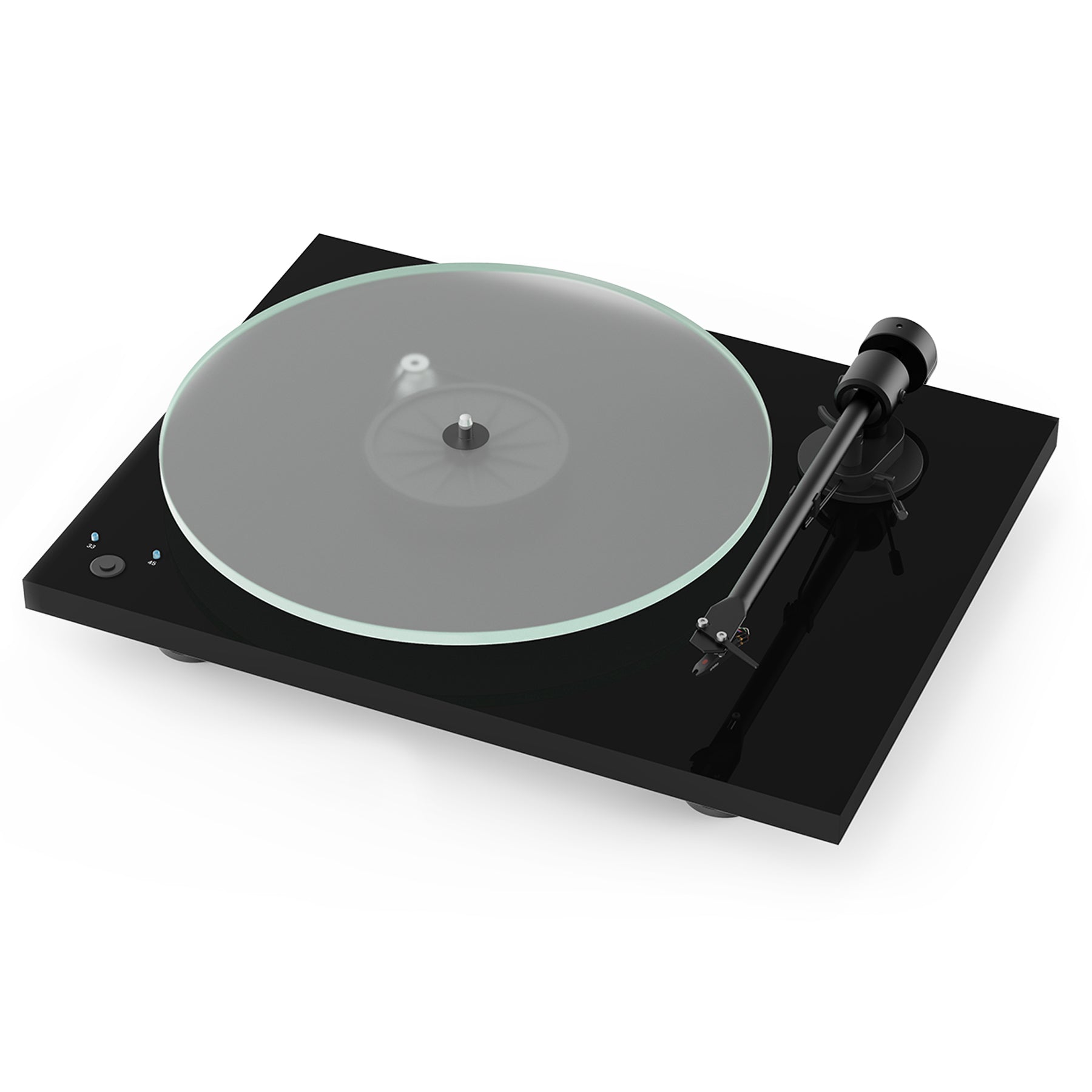
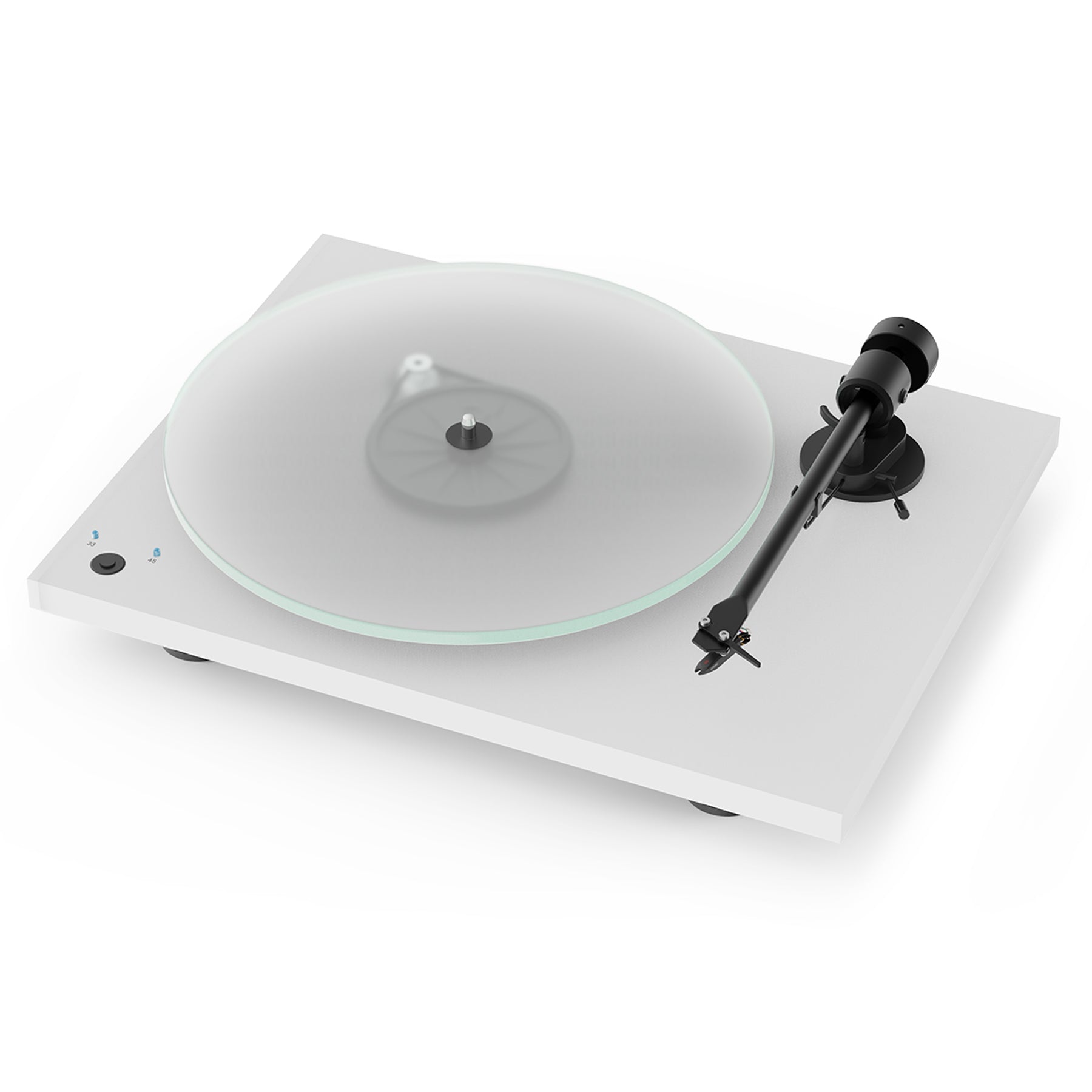
Resolve the dimensions before shelf placement
The product information sheet gives a 415 × 100 × 335 mm body (W × H × D), 3.8 kg net. The shared T1 family manual instead gives 420 × 112 × 330 mm and 5.0 kg. Those manufacturer-published size and weight figures conflict, so the finder conservatively screens the body at up to 16.54 inches wide and 13.19 inches deep and leaves net weight unresolved. This envelope is a cautious conversion from the largest width and depth values in the inspected records, not a measurement or claim that the deck occupies exactly that footprint.
At the questionnaire’s half-inch steps, the conservative width first passes a 17-inch cap, not 16.5 inches; the 13.19-inch depth first passes a 13.5-inch cap. Both are body-only tests. They exclude room to open the hinged cover, operate the cue lever, reach controls or bend signal and power cables. If a close fit or lifting mass matters, verify the exact model revision and its package-specific documentation before placing it.
Fit, limitations and buying checks
Keep the T1 Phono SB in view if you want a manually operated belt-drive model with a built-in MM stage that can be bypassed, convenient electronic 33/45 selection and an OM5e package. It is an earlier model in the current review scope: selecting the finder’s earlier-configurations option allows it to appear, but that is not a stock or condition claim. The exact item pages establish white and black U.S.-facing package identities; they do not establish current availability, a live offer or the contents of a specific box.
Before buying, confirm the exact listing says T1 Phono SB, verify the finish and OM5e cartridge, ask which power supply and signal lead are included, and check whether your system needs PHONO or LINE output. Confirm the input type and avoid connecting LINE to PHONO. Check for the dustcover, mat, belt and platter; for a used unit, request a condition-specific account of stylus, belt, arm and platter. No technical source can substitute for that inspection. If you need automatic cueing, verified record-end stop, 78 RPM, reconciled weight or a small footprint, this model’s evidence does not establish those needs.
Primary-source notes
Pro-Ject’s official T1 family manual and setup guide establish the SB’s output selector, switch operation and manual cue routine. Its model-specific information sheet documents the electronic 33/45 selector, OM5e, output, finishes and published dimensions. The official archive identifies T1 Phono SB in its archive context; it does not establish a present U.S. listing. The exact U.S.-facing retailer pages bridge the reviewed White and Piano Black package variants. See the Pro-Ject archive, T1 Phono SB product sheet, T1 family manual, setup guide, the Satin White item page and Piano Black item page.
Key specifications
Key details at a glance
| Drive | Belt drive |
|---|---|
| Documented record speeds | 33 1/3 RPM / 45 RPM |
| 78-RPM play option | No |
| Included cartridge | Ortofon om5e moving-magnet cartridge with elliptical stylus, pre-mounted in observed u.s. packages. |
| Built-in phono preamp | Yes |
| Manual tonearm cueing | Yes |
| Platter | 8 mm blasted glass |
| Platter mat | Felt |
| Body width | 16.54 in |
| Body depth | 13.19 in |
| Body height | 4.41 in |
| Published phono output | 200 mV |
Use the exact model’s instructions for operating limits, supplied equipment and version differences.
Sources for this review
Sources for this assessment
Check your phono route before choosing
Check each model's documented input route, arm operation, and body limits. Use the finder to compare supported phono-system arrangements without assuming adjacent models share features.