
Your needs, this model
Does it fit your priorities?
Can the T2 Super Phono connect directly to powered speakers?
Yes, when the built-in MM stage is enabled and the output switch is set to LINE; the speakers need an analog line input. With PHONO selected, use an appropriate receiver PHONO input or separate stage instead. Do not send the LINE output into a second phono stage.
Explore this need in the finder →Can I use my receiver's PHONO input with the T2 Super Phono?
Yes. Set its output switch to PHONO and connect the RCA/ground cable to a compatible receiver PHONO input. The internal stage is switchable; the receiver should not receive the turntable's already-equalized LINE output at its PHONO input.
Explore this need in the finder →Does the T2 Super Phono play 78 RPM records?
The current product page and matching manual document 33 and 45 RPM, not 78. Choose another documented 78-capable model if shellac playback is essential; do not infer 78 support from its electronic speed switch.
Explore this need in the finder →The Pro-Ject T2 Super Phono is best understood as a manual belt-drive turntable with a selectable phono stage, rather than as a deck that has one unavoidable connection method. That switch changes what can sit downstream: the built-in MM stage can produce a line-level signal, while PHONO mode leaves the signal for a compatible receiver input or a separate stage. The flexibility is useful, but only if the switch and the next input are treated as a pair. This is a source-based assessment of the published package, not a listening test or ownership report.
The phono switch is the main buying distinction
Pro-Ject's current T2 Super Phono product page and its matching manual document an internal, switchable moving-magnet stage. With LINE selected, the deck can feed powered speakers that have analog line inputs or an amplifier's LINE/AUX input. The system still needs the powered speakers or separate amplifier; the turntable is not a self-contained speaker system. With PHONO selected, use a suitably compatible receiver/integrated-amplifier PHONO input or place a separate MM stage before a line input. Sending the LINE output into another phono stage or a receiver's PHONO input would stack stages rather than follow the documented paths.
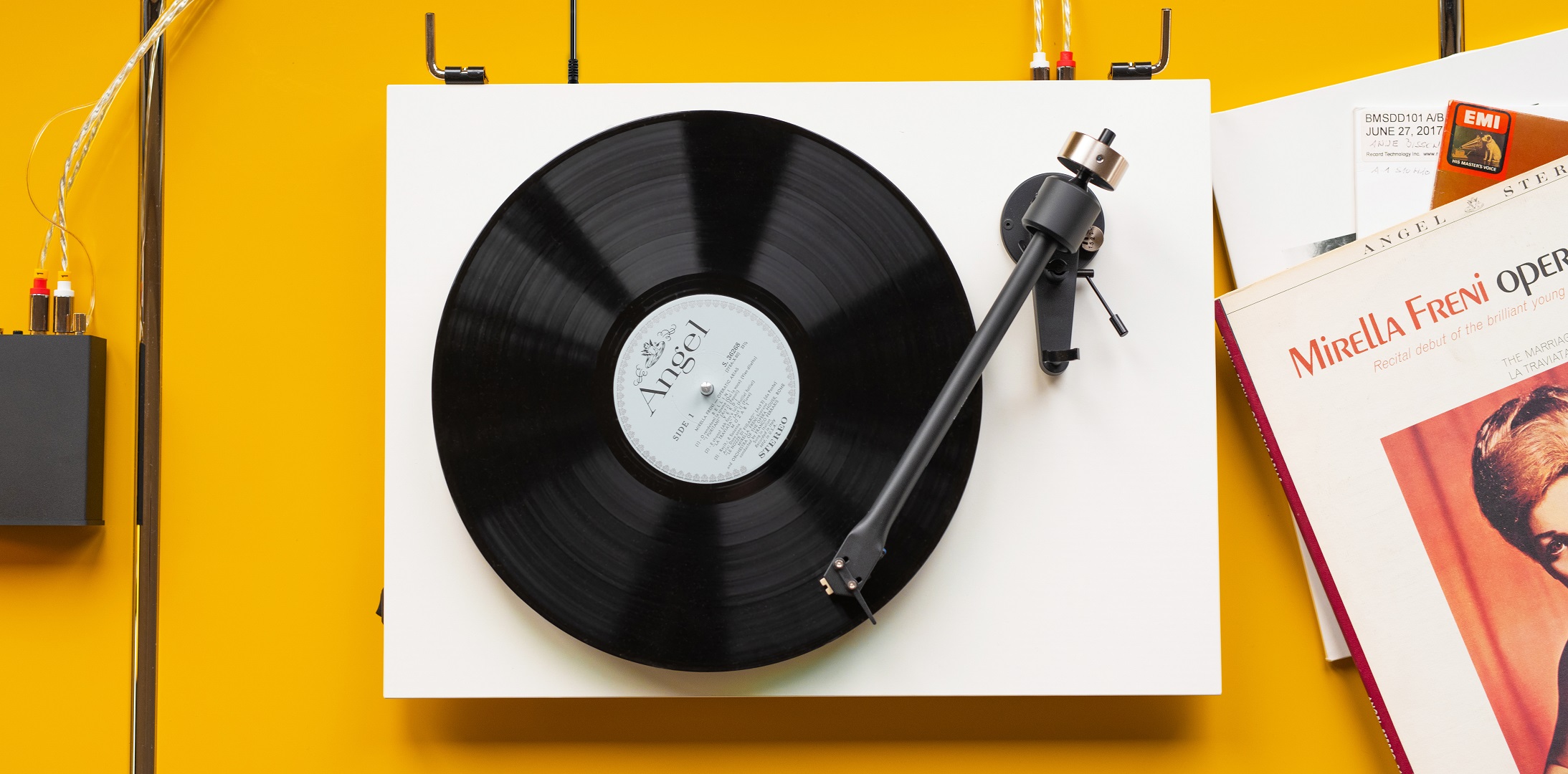
The U.S.-branded product information identifies a package with a factory-aligned Sumiko Rainier moving-magnet cartridge, electronic 33/45 RPM selection and three finish choices: gloss black, satin white and walnut. The U.S. retailer page records separate identifiers for its black and walnut variants, but those codes do not verify the contents of another seller's box. Check the exact product name, finish, condition and included cartridge in the offer. The manufacturer gallery image used at the top shows a white-appearing T2 in a listening scene; it does not reveal the hidden stage-switch position or prove a particular finish suffix.
Finish photos help identify an offer, not certify its contents
The black and walnut examples below are finish-only records within the same T2 Super Phono family, not separate feature packages. The U.S.-branded manufacturer sheet names both finishes; a U.S. retailer lists them under the same model with variant-specific identifiers. No source checked here describes an operating difference between these finishes. Use the names and images as a visual cross-check, then confirm the seller's exact item, cartridge, condition and accessories—especially for a used, open-box or substituted listing.
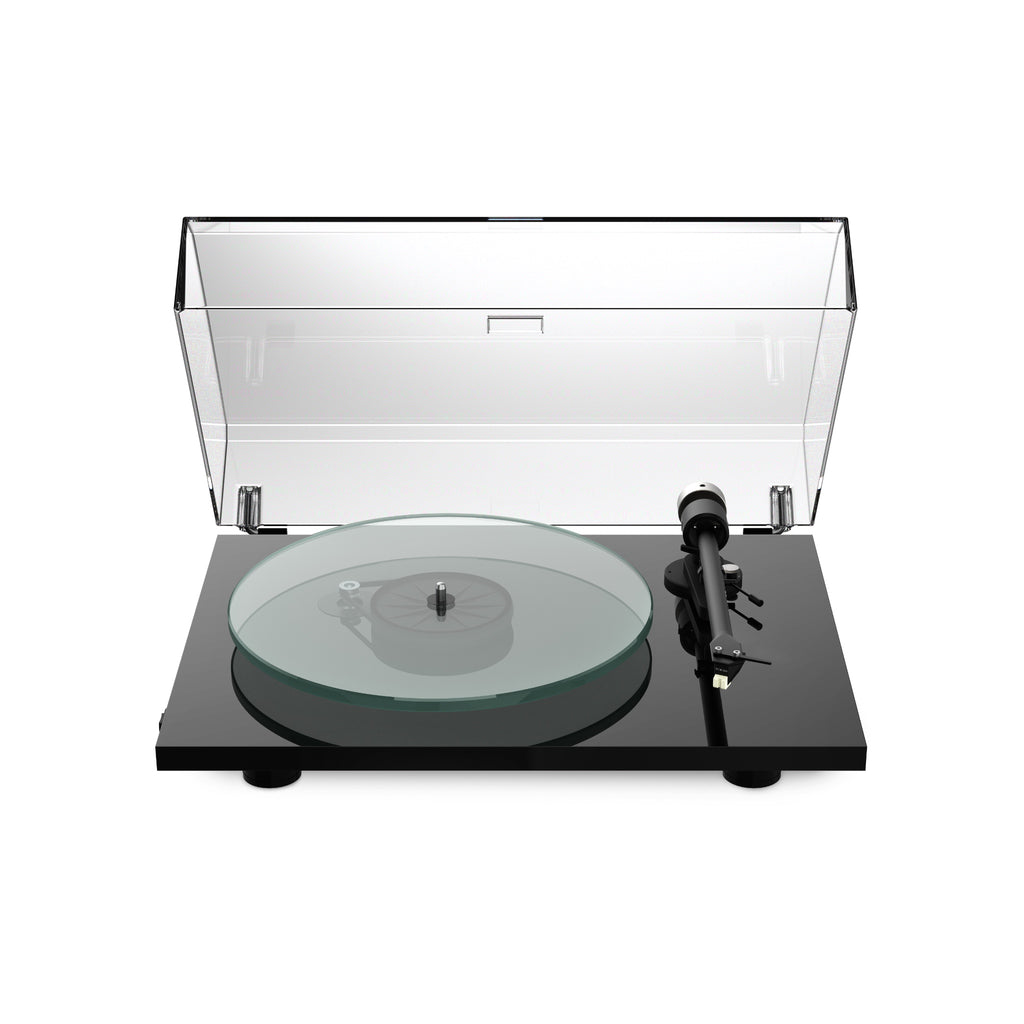
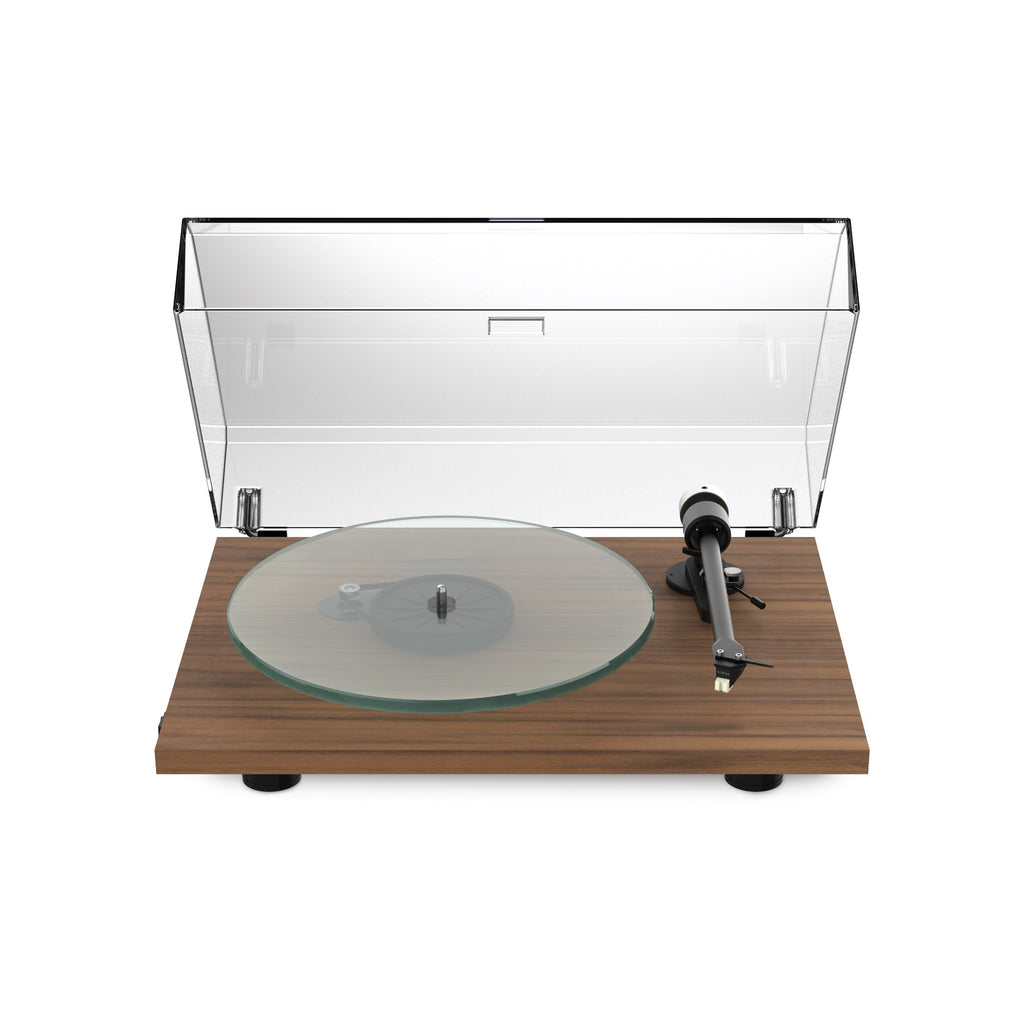
These photos identify the finish shown, not the output-switch position or the contents of any particular package; check the individual offer before ordering.
Manual operation and a two-speed scope
The electronic switch changes platter speed, not the arm. Setup remains a hands-on process: the manual describes fitting the platter and belt, connecting the power and signal leads, checking cartridge tracking force and operating the tonearm lift. The reviewed product page and manual document 33⅓ and 45 RPM, not 78 RPM. A listener with shellac records should not infer 78 capability from the presence of a speed control. Full automation is not documented, and the sources checked here do not specify a record-end platter auto-stop. Those are meaningful omissions for someone who wants the deck to start, lift or stop itself; the available evidence does not justify presenting it as an automatic convenience model.
There is one unusually important fit caveat. The current product page gives a cover-closed body size of 465 × 135 × 347 mm, while the manual gives 457 × 134 × 335 mm for the turntable body. A separate size line in the U.S.-branded sheet matches the manual's package dimensions rather than resolving the body discrepancy. For a conservative finder comparison, this review uses the larger current-page width and depth: about 18.31 × 13.66 inches. These are published body figures, not measurements taken here. A shelf also needs space for rear cable bends, access to the arm and dust-cover movement; the listed footprint alone does not guarantee a usable enclosure fit.
Where it makes sense—and where it does not
Compared with a manual deck that has no internal stage, the T2 Super Phono can simplify a line-input powered-speaker setup by keeping the phono stage in the turntable. Compared with a basic fixed-output all-in-one, it preserves a PHONO route if a receiver or preferred external stage is already part of the system. Its glass platter, belt drive, cartridge and stage switch make it a more configuration-sensitive choice than simply buying the least complicated automatic deck. If manual cueing is unwelcome, or if 78 RPM and a documented end-of-record stop are essential, look for a model that explicitly verifies those functions instead.
Before ordering, confirm the exact T2 Super Phono rather than a different T2 family member, the selected finish and seller's parts list. Verify that the speakers accept line level if using LINE, or that the receiver PHONO input matches an MM cartridge if using PHONO. Allow more room than the finder footprint where the lid, wiring or setup work needs it. The current U.S. Pro-Ject catalogue itself remains incompletely enumerated, so this individual model assessment is not a claim that every U.S. alternative has been compared. It does establish the central practical choice: one turntable can serve either a line-level route or a phono-level route, but the rear switch must agree with the downstream input.
Key specifications
Key details at a glance
| Drive | Belt drive |
|---|---|
| Documented record speeds | 33 1/3 RPM / 45 RPM |
| 78-RPM play option | No |
| Included cartridge | Factory-aligned sumiko rainier moving-magnet cartridge |
| Built-in phono preamp | Yes |
| Manual tonearm cueing | Yes |
| Platter | Tempered glass |
| Platter mat | Felt |
| Body width | 18.31 in |
| Body depth | 13.66 in |
| Body height | 5.31 in |
Use the exact model’s instructions for operating limits, supplied equipment and version differences.
Sources for this review
Sources for this assessment
- Pro-Ject USA T2 Super Phono Product Information PDF (browser-indexed official document)
- Pro-Ject T2 Super Phono current manufacturer product page
- Pro-Ject T2 Super Phono official user manual, revision 22.05.2024
- Crutchfield U.S. Pro-Ject turntable search (market-presence corroboration only)
- Bloom Audio T2 Super Phono finish-variant record (U.S. retailer)
Check your phono route before choosing
Check each model's documented input route, arm operation, and body limits. Use the finder to compare supported phono-system arrangements without assuming adjacent models share features.