
Your needs, this model
Does it fit your priorities?
Can I connect the T2 W directly to powered speakers?
Yes, if they have an analog line input: the internal MM stage is always on and the RCA output is LINE. Do not add another phono stage or connect that line signal to a receiver PHONO input.
Explore this need in the finder →Can I connect the T2 W's RCA cable to a receiver's PHONO input?
No, not according to the T2 W manual: the internal stage is always on and RCA is LINE output. Use AUX/LINE or powered-speaker LINE. If the system only provides PHONO, the receiver-PHONO finder path can show alternatives that document phono-level output.
Explore this need in the finder →Does the T2 W fit a shelf with an 18.5-inch body-width limit?
The official body width is 465 mm, about 18.31 inches, so it meets an 18.5-inch listed-body cap. Measure extra width and depth for plugs, cue access and lid movement; the finder screens body dimensions only.
Explore this need in the finder →The T2 W combines a traditional belt-driven deck with an always-on internal MM phono stage and a separate Wi-Fi streaming route. Its analog RCA sockets are line outputs, not phono outputs. That distinction makes the system decision unusually clear: powered speakers with a line input or an amplifier's AUX/LINE input are appropriate; a receiver PHONO input or a second external phono stage is not. Pro-Ject's manual says the internal preamp remains on and the RCA output is LINE. This review assesses those documented arrangements rather than making a listening, network-performance or ownership claim.
Two ways to route the signal, not one interchangeable output
For a conventional wired setup, the turntable's Sumiko Rainier moving-magnet cartridge feeds its built-in dual-stage phono circuit, which sends line-level analog audio over RCA. Connect that to powered speakers' LINE input or an amplifier/integrated receiver's AUX/LINE input. The amplifier then drives passive speakers. Do not use the receiver's PHONO socket: it adds another phono stage to a signal that is already equalized and amplified. The same logic rules out inserting an external phono stage into the analog RCA route.
Wi-Fi is a distinct network-audio function rather than a wireless version of the RCA cable. Pro-Ject describes UPnP streaming controlled through its app, with broad compressed-stream compatibility and lossless 24-bit/48-kHz playback only for selected compatible devices. “Wi-Fi” alone does not establish compatibility with every receiver, speaker or home network. Check the receiving device and network requirements for the particular setup. The manual describes the RCA output as remaining analog; it does not imply that the wired output is digitized or that Wi-Fi removes the need to plan a local analog connection.
Manual use and limited record-speed range
The T2 W is manually cued. Its tonearm lift helps lower the stylus, but the product documentation does not describe automatic start, automatic return or platter auto-stop at the end of a side. Its electronic selector changes between 33⅓ and 45 RPM, but the official materials do not list a 78-RPM mode. This suits someone comfortable starting and stopping playback by hand and listening to standard LPs and singles. It is not a fit for a requirement for fully automatic operation or for documented 78 playback.
The 10 mm glass platter, felt mat and 9-inch aluminum arm are among the manufacturer-listed components. A glass platter can make the table visually striking, but the material description is not a substitute for an operating or sound-quality guarantee. The buyer still needs a level support, correct stylus care, and reasonable protection from vibration. The supplied setup guide shows the user fitting the belt and platter and connecting the RCA cable to an amplifier LINE input, reinforcing that the product's integrated preamp is part of its normal wired path.
Body size and finish choices
Pro-Ject lists body dimensions of 465 × 135 × 347 mm (width, height, depth), about 18.31 × 5.31 × 13.66 inches. It is therefore wider than an 18-inch opening and fits the published-body figure under an 18.5-inch cap; its 13.66-inch body depth narrowly exceeds a 13.5-inch limit but fits under 14 inches. None of those comparisons reserves space for the rear cable, opening the dust cover, removing a record or moving the arm. Measure the real shelf and access path rather than treating a body-dimension pass as proof of installation clearance.
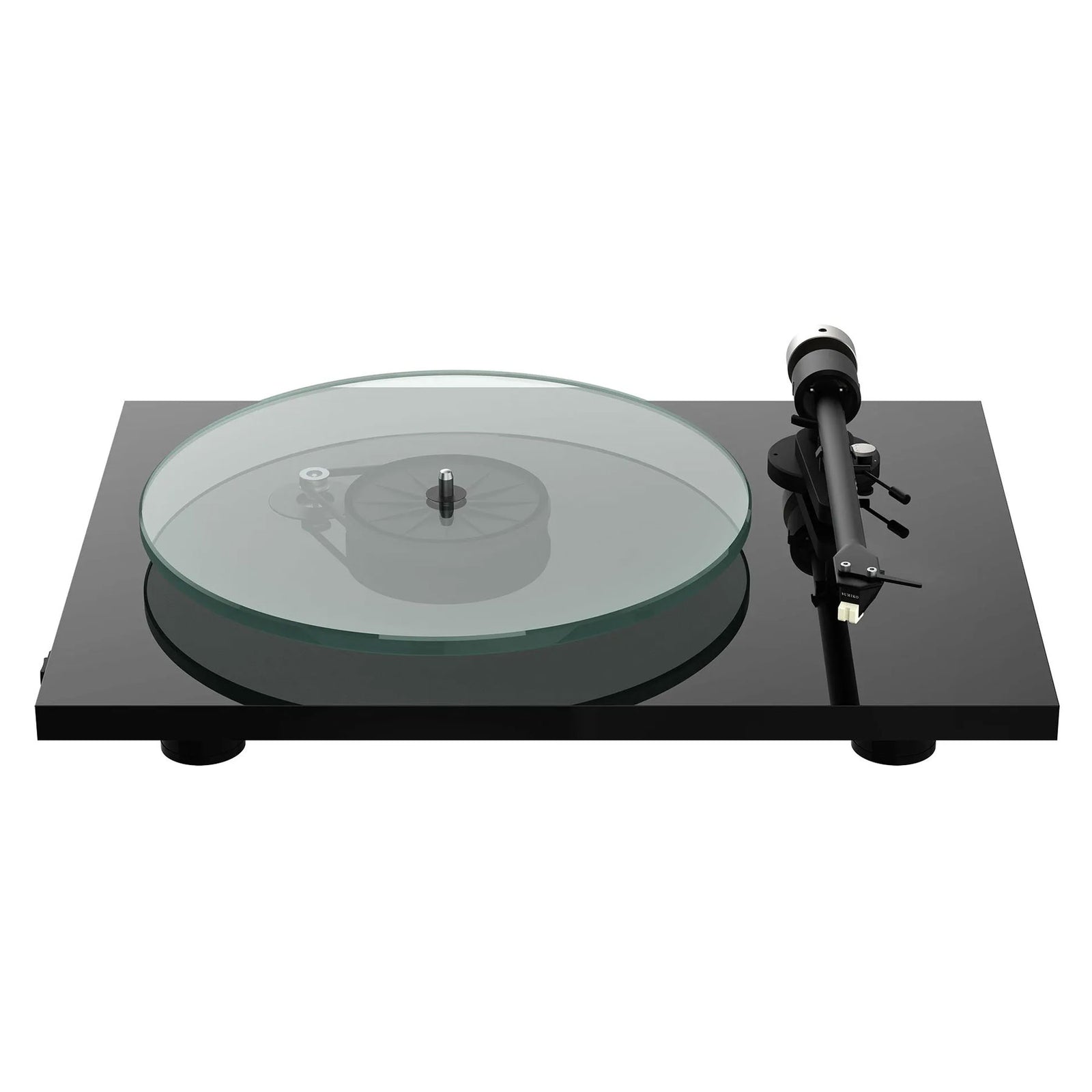
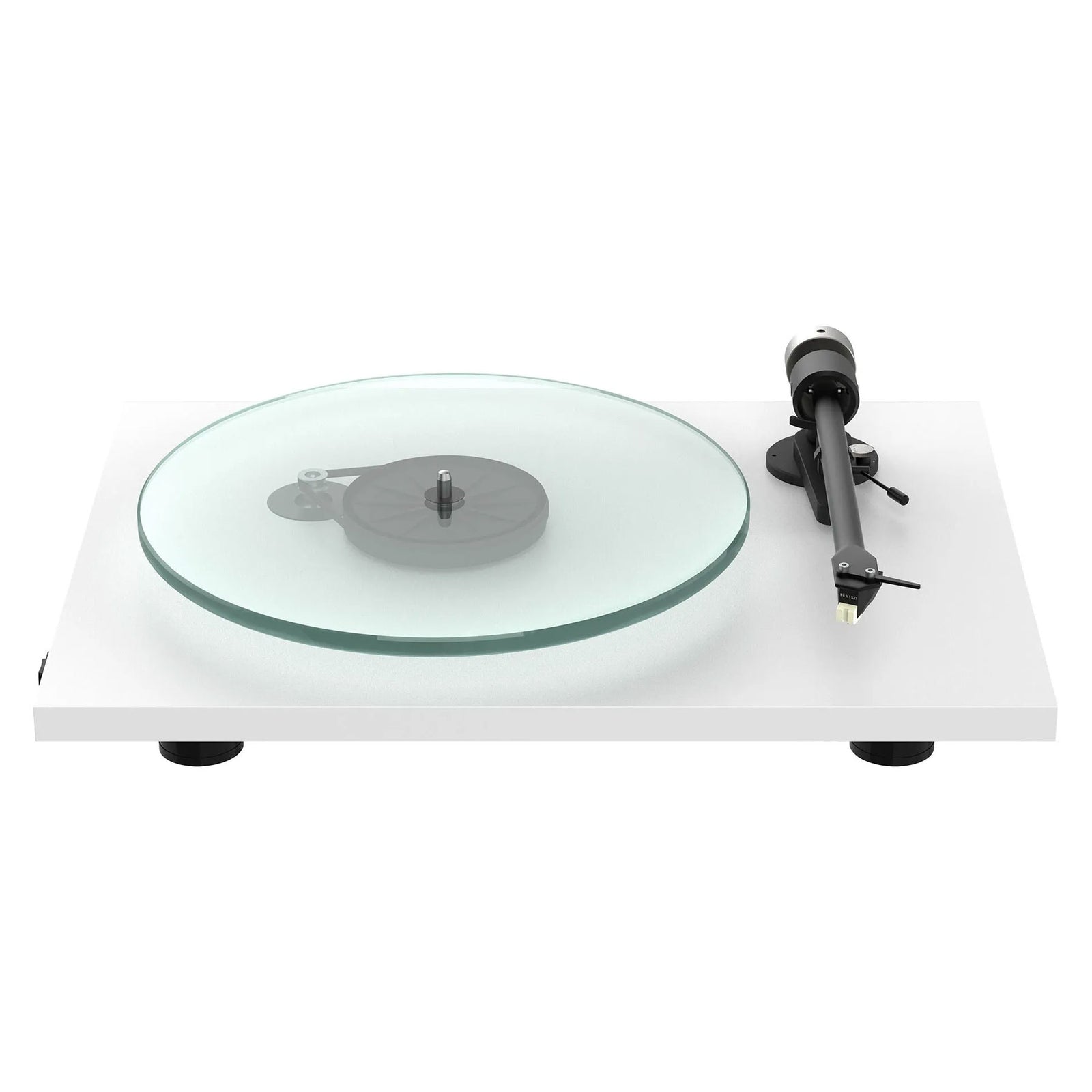
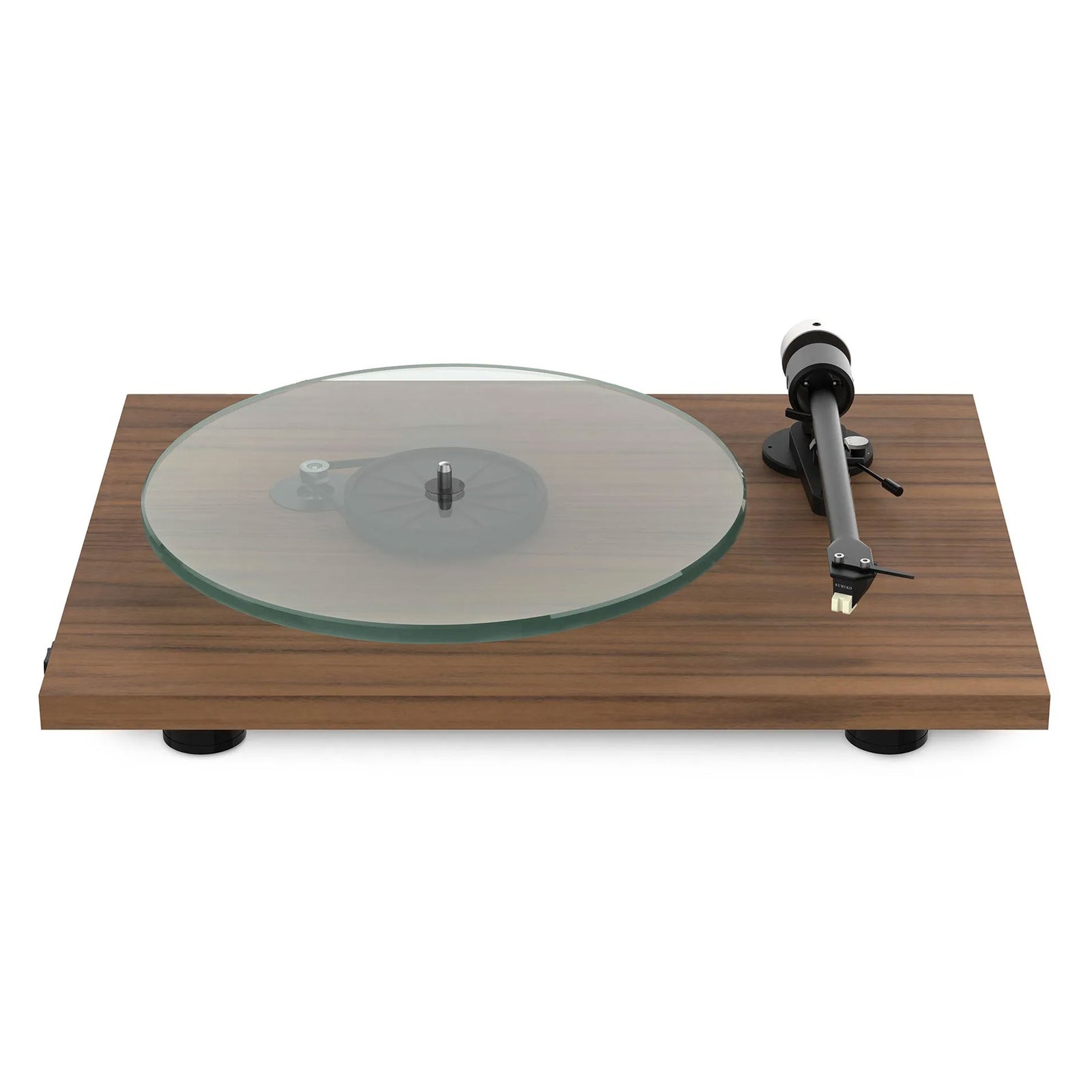
The current U.S.-facing item page presents Gloss Black, Satin White and Walnut finish choices. The three item-page-linked images below show those finishes as separate visual options; they do not establish a different cartridge, included accessory set or current seller offer for every finish. Confirm the exact chosen option and package on the order page.
Who the T2 W is for—and where it falls short
On paper, the T2 W is aimed at someone who wants a turntable with its own phono gain, a direct analog line connection and network streaming as an additional way to play into a compatible system. It can simplify the analog route because the buyer need not add a separate MM stage. The tradeoff is that the stage is not a selectable bypass in the manual: a PHONO-only receiver is a mismatch, and there is no documented 78-RPM or automatic end routine. Its network capabilities should also be chosen around a specific compatible receiving endpoint, not assumed from the presence of Wi-Fi.
Compared with the T2 Super Phono, the W adds network streaming and uses its own internal-stage arrangement. The T2 Super's phono stage can be switched; the T2 W manual instead labels its RCA output as LINE. This is a functional connection difference rather than a judgment about sonic quality. The T2 W is also wider and deeper than a compact automatic deck, and its manual arm needs the user to be present at the start and finish of each record.
Purchase checks and bottom line
Before choosing the T2 W, confirm that the destination has an analog LINE input or verify compatibility of the intended network receiver. Check the exact finish, Rainier MM cartridge, dust cover, glass platter, mat, power supply and RCA lead in the stated package. Verify return terms and condition on the actual offer; a retailer's specification page is not proof of live stock or package condition. Leave clearance beyond 18.31 by 13.66 inches and plan for manual cueing.
The T2 W's key strength is a clean, internally preamplified line-level analog output paired with an optional network route. Its key constraints are inseparable: the RCA signal is already line-level, network support varies by endpoint, the deck is manually operated, only 33/45 speeds are documented, and its footprint needs room. It is a considered fit for a LINE-ready or compatible network system, not for a PHONO-only receiver or a shopper seeking hands-off playback.
Key specifications
Key details at a glance
| Drive | Belt drive |
|---|---|
| Documented record speeds | 33 1/3 RPM / 45 RPM |
| 78-RPM play option | No |
| Included cartridge | Sumiko rainier moving-magnet cartridge |
| Built-in phono preamp | Yes |
| Manual tonearm cueing | Yes |
| Platter | 10 mm glass platter |
| Platter mat | Felt |
| Body width | 18.31 in |
| Body depth | 13.66 in |
| Body height | 5.31 in |
Use the exact model’s instructions for operating limits, supplied equipment and version differences.
Sources for this review
Sources for this assessment
- Pro-Ject T2 W official model page and technical information
- Pro-Ject T2 W official Product Information
- Pro-Ject T2 W official user manual, revision 2023-07-14
- Pro-Ject T2 W official setup guide
- Turntable Lab U.S.-facing T2 W item record (rendered observation)
- Turntable Lab T2 W Gloss Black item-page image

Check your phono route before choosing
Check each model's documented input route, arm operation, and body limits. Use the finder to compare supported phono-system arrangements without assuming adjacent models share features.