
Your needs, this model
Does it fit your priorities?
Can I connect the standard T2 directly to an AUX or LINE input?
No. The standard T2 sends phono-level signal. Use a compatible receiver PHONO input or place a compatible MM phono stage before a line input; the T2 itself does not provide line-level phono equalization.
Explore this need in the finder →Can the standard T2 work with powered speakers?
Yes, if the powered speakers accept line level and a separate compatible MM phono stage sits between them and the T2. Do not connect the deck's phono-level output straight to an ordinary speaker LINE input.
Explore this need in the finder →Does the standard T2 automatically lift the arm or stop at the end of a record?
The documented T2 routine is manually cued, with electronic speed selection but user-handled arm placement. The reviewed T2 documents do not establish an end-of-record stop or arm return, so do not buy it to meet a hard auto-stop requirement.
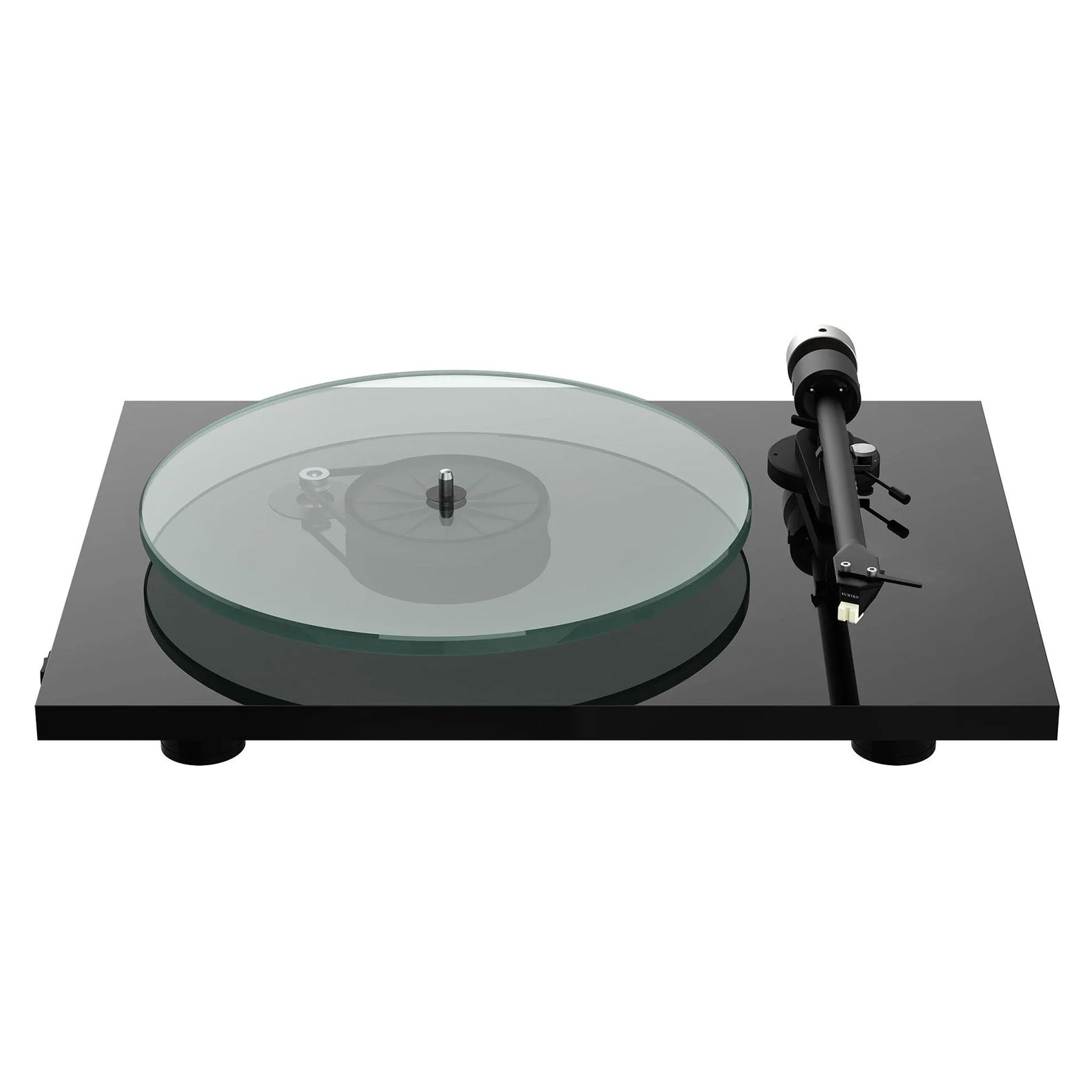
Explore this need in the finder →The standard Pro-Ject T2 is a manual belt-drive turntable for a system that already has a phono stage, either in a compatible receiver or as a separate component. The factory-aligned Sumiko Rainier moving-magnet cartridge and glass platter are part of the appeal; the missing built-in phono preamp is the first thing to plan around. This assessment follows the current Pro-Ject T2 product page, its matching manual and setup guide. It does not claim listening tests, ownership, measurements or a complete U.S. model inventory.
Choose the phono stage before choosing speakers
The T2's RCA connection carries the cartridge's phono-level signal. Pro-Ject's manual tells the owner to connect it to a suitable PHONO input; an ordinary AUX, LINE, CD or tape input does not provide the required cartridge matching and equalization. If the receiver or integrated amplifier has a compatible moving-magnet PHONO input, the basic chain is turntable → PHONO input → amplifier → passive speakers. With powered speakers that accept only LINE, put a compatible MM phono stage between the turntable and speakers. With passive speakers and a receiver lacking PHONO, the chain needs both a phono stage and a power amplifier or receiver. The RCA plug shape is not evidence that the signal is line level, and passive speakers cannot be driven by the turntable alone.
Keep the three T2 names distinct
“T2,” “T2 Super Phono” and “T2 W” are not interchangeable seller names. The standard T2 reviewed here has no built-in stage. The T2 Super Phono adds a switchable internal MM phono stage, while the T2 W has an always-on stage and adds network streaming. If the goal is to avoid another phono component, those may be the more relevant siblings; if a receiver PHONO input or external stage is already part of the system, the standard T2 avoids paying attention to an unused internal stage. Confirm the exact suffix and the stage arrangement in the offer rather than inferring it from the cabinet or a family photo.
Electronic speed switching is not automatic playback
The official specification and manual document belt drive and electronically selected 33⅓ and 45 RPM. The electronic button changes platter speed; it does not start the arm on a record. The manual identifies a tonearm lift lever and setup steps that leave cueing to the listener, so this is not a fully automatic choice. The reviewed T2 documents no 78-RPM mode. Its manuals do not specify a record-end auto-stop or arm return; those behaviors remain unverified here, not presumed absent from every possible revision. If hands-off start and end handling, a known platter stop or 78 playback is essential, seek that exact feature in the competing model's own manual.
Expect a real assembly and cartridge check
The setup guide shows the belt being fitted over the sub-platter, followed by platter and felt mat installation, removal of the transport protections, power connection and amplifier connection. The manual identifies the supplied Sumiko Rainier MM cartridge and describes checking tracking force and adjustable spring-based anti-skating. Its Rainier specification gives 20 mN (2.0 g) tracking force. It also briefly uses the sibling name “T2 Super Phono” in one tracking-force paragraph even though the document cover and specification section identify the T2; confirm the instructions for the exact cartridge package before changing a setting. The included power supply, dust cover, mat, adapter and RCA lead are listed by the manufacturer, but a used or open-box offer should be checked for each piece rather than assumed complete.
Use the body dimensions cautiously
The current T2 product page lists 465 × 135 × 347 mm (width × height × depth) with the cover closed, or about 18.31 inches wide and 13.66 inches deep. The matching manual gives a smaller 457 × 134 × 335 mm figure. The current page's wider and deeper values are used for the fit screen, but neither set measures the space needed to open the lid, reach the controls, route cables or isolate the deck from vibration. Measure the actual shelf and allow additional operating clearance before ordering. These are published dimensions, not measurements taken for this review.
Who this configuration suits
The standard T2 makes most sense when a compatible phono stage is already in the plan and the buyer is comfortable placing and lifting the arm, assembling the belt and platter, and checking the cartridge setup. The 10 mm, 1.7 kg glass platter, 9-inch aluminum arm and pre-adjusted Rainier are meaningful documented hardware details, but they do not replace a phono stage or speaker amplification. Its tradeoffs are the additional analog component for line-only systems, manual cueing, no documented 78-RPM support and an unconfirmed record-end stop. This is a fit analysis of published specifications, not a claim about sound quality from a listening session.
Verify the exact finish and offer
The U.S.-facing Turntable Lab T2 listing distinguishes Gloss Black, Satin White and Walnut with separate seller item identifiers and images. Its product data marked those variants unavailable when checked on November 1, 2026; that is a dated observation for one retailer, not a market-wide availability claim. Compare the exact finish, included Rainier cartridge, power supply, dust cover, return terms and package condition in the listing. A T2-family image or a mention of a built-in preamp may describe one of the different siblings rather than the standard T2 assessed here.
Key specifications
Key details at a glance
| Drive | Belt drive |
|---|---|
| Documented record speeds | 33 1/3 RPM / 45 RPM |
| 78-RPM play option | No |
| Included cartridge | Factory-pre-adjusted sumiko rainier moving-magnet cartridge |
| Built-in phono preamp | No |
| Manual tonearm cueing | Yes |
| Platter | Glass |
| Platter mat | Felt |
| Body width | 18.31 in |
| Body depth | 13.66 in |
| Body height | 5.31 in |
| Published phono output | 5 mV |
Use the exact model’s instructions for operating limits, supplied equipment and version differences.
Sources for this review
Sources for this assessment
- Pro-Ject T2 current manufacturer product page
- Pro-Ject T2 official Product Information PDF
- Pro-Ject T2 official User Guide, revision 22.05.2024
- Pro-Ject T2 official Setup Guide
- Turntable Lab U.S.-facing T2 item page and exact variant data
- Turntable Lab T2 exact item-level variant data (U.S.-facing retailer)
- Pro-Ject current global turntable directory (discovery source, not a U.S. inventory)
- Pro-Ject T2 Super Phono manufacturer page for model-family distinction
- Pro-Ject T2 W manufacturer page for model-family distinction
Check your phono route before choosing
Check each model's documented input route, arm operation, and body limits. Use the finder to compare supported phono-system arrangements without assuming adjacent models share features.