
Your needs, this model
Does it fit your priorities?
Does the exact Olive Xtension 10 package include a cartridge and phono preamp?
No cartridge or built-in phono stage is documented for the exact same-GTIN Olive package: the U.S.-facing matching item explicitly says No Cartridge, and its page states no built-in preamp. Choose and install a compatible pickup, then use a matching receiver PHONO input or separate MM/MC stage.
Explore this need in the finder →What phono route works for powered speakers with the Olive Xtension 10?
After supplying and fitting a cartridge, connect the turntable's PHONO output to an external MM/MC phono stage that supports that pickup, then feed the stage's LINE output to the powered speakers. The turntable itself has no built-in stage, and its manual describes manual arm cueing.
Explore this need in the finder →What body limits admit the Olive Xtension 10, and is that operating clearance?
The listed closed body is 18.9 inches wide and 15.75 inches deep, so it first fits the finder's half-inch caps at 19 inches by 16 inches. The maker lists a 480 x 495 x 535 mm cover-open envelope; add room for the arm, cover movement, cable routing and access. The cited weight figures conflict, so confirm the exact deck/carton and support before moving it.
Explore this need in the finder →This assessment covers the Olive Pro-Ject item sold in the U.S.-facing Acoustic Sounds listing as “Xtension 10 Turntable.” Its EAN, 9120035829436, matches a separate U.S.-facing Xtension 10 Evolution Olive Wood Gloss item that explicitly says “No Cartridge.” Pro-Ject’s model guide also distinguishes its no-cartridge and Cadenza Red configurations. On that cross-source identity bridge, this review treats the observed item as the no-cartridge package; it does not infer contents from the photograph. This is a document-led analysis, not a listening test, measurement, ownership report or claim about a particular unit.
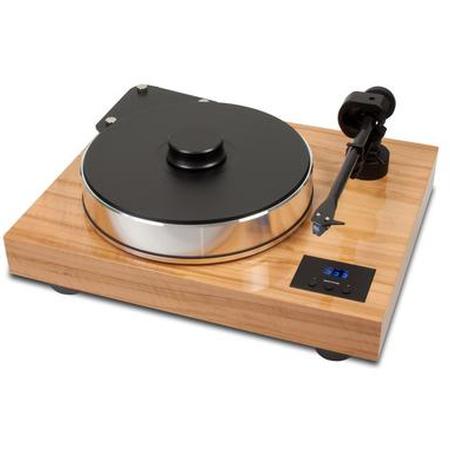
A large, manually configured platform
The Xtension 10 Evolution is a belt-drive turntable with a mass-loaded, magnetically decoupled chassis, a damped aluminium-alloy sandwich platter and magnetic support feet. It uses a 10-inch 10cc Evolution carbon-fibre tonearm, and the model is built around electronic 33/45 speed selection. Those construction details describe the design; they are not independent evidence of sound quality. The Olive listing is a finish-specific retail identity, not a distinct arm or phono-stage configuration.
The exact no-cartridge package leaves meaningful setup work to the buyer. Pro-Ject’s manual describes installing and aligning a cartridge, balancing the arm, setting downforce and anti-skating, adjusting azimuth and vertical tracking angle, and leveling the deck. It notes that an experienced dealer can help if cartridge adjustment is unfamiliar. An adjustable arm is only useful when the selected pickup, counterweight and setup are compatible; treat the manual as a setup procedure, not a claim that the seller has pre-adjusted this item.
Provide the cartridge and the phono stage
The matching-GTIN U.S. listing identifies a no-cartridge version and says there is no built-in phono preamp. The turntable’s five-pole DIN output carries a phono-level signal, and the current maker sheet names a 5P-to-RCA cable. That cable transports the signal; it does not add the equalization and gain required by a phono cartridge. Confirm the exact cable and contents of the seller’s carton before ordering.
After choosing and installing a compatible cartridge, a receiver or integrated amplifier with a PHONO input can provide the stage, but the input must support the pickup’s generator type, gain and loading. If you use powered speakers with a LINE input, route the turntable through a separate MM- or MC-compatible phono stage first. Passive speakers need that stage followed by an amplifier that can drive them. The exact package can support each route only after the cartridge and downstream equipment are matched; it is not a complete plug-in system by itself.
Electronic speed control is not automatic operation
Pro-Ject’s manual describes user-operated motor start/standby and manual tonearm lift. Pressing the speed control switches 33 and 45 RPM electronically, but that does not move the arm. The manual’s 78-RPM procedure is different: the user removes the pulley cover and moves the belt to the alternate pulley step before selecting the motor setting. Check the record format, appropriate stylus and setup before relying on 78-RPM playback; it is not the same effortless button change as 33/45.
Fully automatic start-and-return is not documented. The inspected model-specific documents also do not establish an automatic platter stop at the end of a side. Keep record-end behavior unknown rather than assuming either that it stops or that it definitely continues indefinitely. Buyers who require verified hands-off arm handling or a documented auto-stop should not treat electronic speed control as a substitute.
Separate the body-size screen from working space
The manufacturer manual lists 480 × 235 × 400 mm with the cover closed, roughly 18.9 inches wide, 9.25 inches high and 15.75 inches deep. In this finder’s half-inch steps, a strict 18.5-inch width cap or 15.5-inch depth cap is too small; the first listed-body limits that admit it are 19 inches wide and 16 inches deep. Those numbers describe the closed body only. The manual’s open-cover envelope is 480 × 495 × 535 mm, so a shelf that barely fits the closed deck may still block the lid, arm movement or access. Reserve extra room for cable bend, record handling and service access, and use a level, sturdy support surface.
Resolve the mass discrepancy before planning a lift
Weight claims do not agree. Acoustic Sounds lists 20 kg for this Olive item; the separate U.S. listing with the matching EAN says 48.5 lb; Pro-Ject’s 2024 guide, 2025 information sheet and current manual list 26 kg net. The 2018 manufacturer sheet itself adds an older split, with 18 kg in its specification table and 22 kg in its descriptive text. Platter figures differ too: the Acoustic Sounds table says 5.7 kg, the current maker page says 10.3 kg, the 2025 sheet says 10 kg and the older sheet says 10.5 kg. These are conflicting published values, not measurements of the same physical unit. For support and delivery planning, use the current 26 kg maker figure as a conservative screen, then ask the seller to confirm the exact unit and carton before arranging the move.
Bottom line: the Olive Xtension 10 Evolution is a very large, heavy, manual deck for a system builder willing to choose and install a cartridge, match the phono chain, and make room for a 78-RPM belt change if needed. It is a poor match for a buyer who wants a supplied cartridge, a built-in phono stage, compact placement or verified automatic arm/record-end behavior. Confirm the cartridge-free package, cable and accessories, exact mass, shelf capacity and lid-open clearance for the particular seller unit.
Documents checked
Model construction, speed controls and current dimensions are described on Pro-Ject’s Xtension 10 Evolution model page. The setup and signal path are in the Xtension 10 Evolution instructions for use; the model’s package branches and current listed body envelope appear in the 2024 Pro-Ject product guide and 2025 product-information sheet. The exact Olive retail identity and same-GTIN no-cartridge bridge were assessed separately; no price, availability, customer feedback or sound-testing claim is adopted.
Key specifications
Key details at a glance
| Drive | Belt drive |
|---|---|
| 78-RPM play option | Yes |
| Included cartridge | None — the exact olive item gtin matches a u.s.-facing no-cartridge listing. |
| Built-in phono preamp | No |
| Manual tonearm cueing | Yes |
| Platter | Tpe-damped aluminium alloy sandwich with a vinyl layer on top |
| Body width | 18.9 in |
| Body depth | 15.75 in |
| Body height | 9.25 in |
Use the exact model’s instructions for operating limits, supplied equipment and version differences.
Sources for this review
Sources for this assessment
- Pro-Ject Xtension 10 Evolution official model page
- Pro-Ject Xtension 10 Evolution Product Information sheet, May 2025
- Pro-Ject Xtension 10 Evolution Instructions for Use, revision 2025-09-08
- Pro-Ject 2024 Product Guide, Xtension 10 Evolution entry
- Pro-Ject Xtension 10 Evolution Product Information sheet, April 2018
- Acoustic Sounds U.S.-facing Xtension 10 Olive item page
- Audio Advisor U.S.-facing Xtension 10 Evolution Olive no-cartridge item
Check your phono route before choosing
Check each model's documented input route, arm operation, and body limits. Use the finder to compare supported phono-system arrangements without assuming adjacent models share features.