
Your needs, this model
Does it fit your priorities?
Can PS-LX3BT feed a receiver's PHONO input?
Yes: select PHONO so the built-in stage is bypassed, and verify the receiver input supports the installed MM cartridge. The body has an integrated lead, and the manual should determine the input and cable routing.
Explore this need in the finder →Can it connect to powered speakers with only LINE input?
Yes, select LINE to use the built-in MM stage, then connect its RCA lead to the speakers' analog line input. The speakers must provide their own amplification; the turntable has no built-in speakers.
Explore this need in the finder →Can I manually position the arm despite its automatic routine?
Yes. Sony documents UP/DOWN arm lifting and manual arm repositioning. The deck can still start automatically and return/stop at the end; only 33⅓ and 45 RPM are supported.
Explore this need in the finder →Will a 17-inch-wide shelf fit the stated body?
Sony publishes 17 inches wide and 14.5 inches deep. A 17-inch cap meets the listed width only; measure more space for the cover, rear cable bend and reaching the controls.
Explore this need in the finder →The Sony PS-LX3BT is a two-speed, belt-drive turntable for a system that values button-start playback and wireless output without giving up an analog connection. Sony lists this exact model in its current U.S. Store turntable category. The U.S. support specifications and manual identify automatic start, automatic arm return and platter stop, a built-in moving-magnet phono equalizer with PHONO/LINE switching, Bluetooth transmission and USB computer recording. This is a source-based fit assessment, not a listening test or a claim of ownership. The main package caveat is that Sony's U.S. documentation does not name the installed cartridge part number.
Automatic, but still manually cueable
The start button is intended to begin playback automatically, and Sony documents an automatic end routine that lifts and returns the arm before stopping the platter. The UP/DOWN control also raises the arm for manual positioning, so the automated mechanism does not prevent selecting a groove by hand. That control is not the same as a traditional damped cue lever: the owner's manual should be followed for lifting, positioning and lowering the arm. Choosing the automatic path does not mean every record is guaranteed to trigger perfectly; check the record's size and the manual's operating instructions.
This is a 33⅓/45-RPM deck, not a 78-RPM model. A 78 collection therefore needs another turntable with the appropriate speed and stylus rather than an adapter or a hidden menu setting. Sony identifies the cartridge as moving magnet and says to use the stylus specified for this model. Its support FAQ does not support replacing the installed cartridge with a different type. If a future cartridge upgrade is important, a model with an ordinary removable headshell is a more flexible starting point. The exact replacement-stylus part number should be confirmed through Sony before ordering; it is not supplied by inference here.
Choose one correct phono route
The rear Phono/Line switch changes how the analog signal should connect. Select PHONO when sending the turntable's cartridge-level signal to a compatible receiver PHONO input or an external MM phono stage. Select LINE when using the internal phono equalizer with line-input powered speakers or an amplifier AUX/LINE input. In the latter route, powered speakers supply their own amplification; passive speakers still need a separate amplifier. The deck itself has no built-in speakers. Avoid feeding LINE into another PHONO input, which would apply another phono stage. Confirm the input label and cartridge compatibility on the exact receiving equipment rather than relying on the fact that both ends use RCA plugs.
The PS-LX3BT has a fixed RCA cable that exits the back of the chassis, rather than a removable cable socket. That can simplify the parts count, but it means placement needs to account for the factory lead's reach, its bend behind the unit and the route to the receiver or speaker input. Sony's support specifications do not list an external earth terminal; follow the model-specific diagram rather than attaching a ground wire to an arbitrary screw.
Bluetooth and computer recording are separate features
The Bluetooth connection is a transmitter from the turntable to a compatible speaker or headphone. It is not a Bluetooth input for a phone, television or computer, and a receiving device needs its own amplification and volume control. Sony lists SBC, aptX and aptX Adaptive support for this model, but it does not support AAC or LDAC and does not provide AVRCP volume control. Pairing and codec support depend on the receiving product; check whether that exact speaker or headphone accepts a supported format and can adjust its own volume. Wireless output is an alternative playback route, not proof that every device will pair or sound the same.
USB Type B is a computer-recording connection, not a digital playback input. Sony says the cable and recording software are not included and that recording is not hi-res. Its current support article lists Windows 11 64-bit and macOS 13–15, while cautioning that compatibility is not guaranteed on every computer. If capturing records is a key use, verify the computer port, cable, operating system and chosen software before buying; do not mistake the Type-B port for a connection to a phone or USB speaker.
Body size, setup and what the image shows
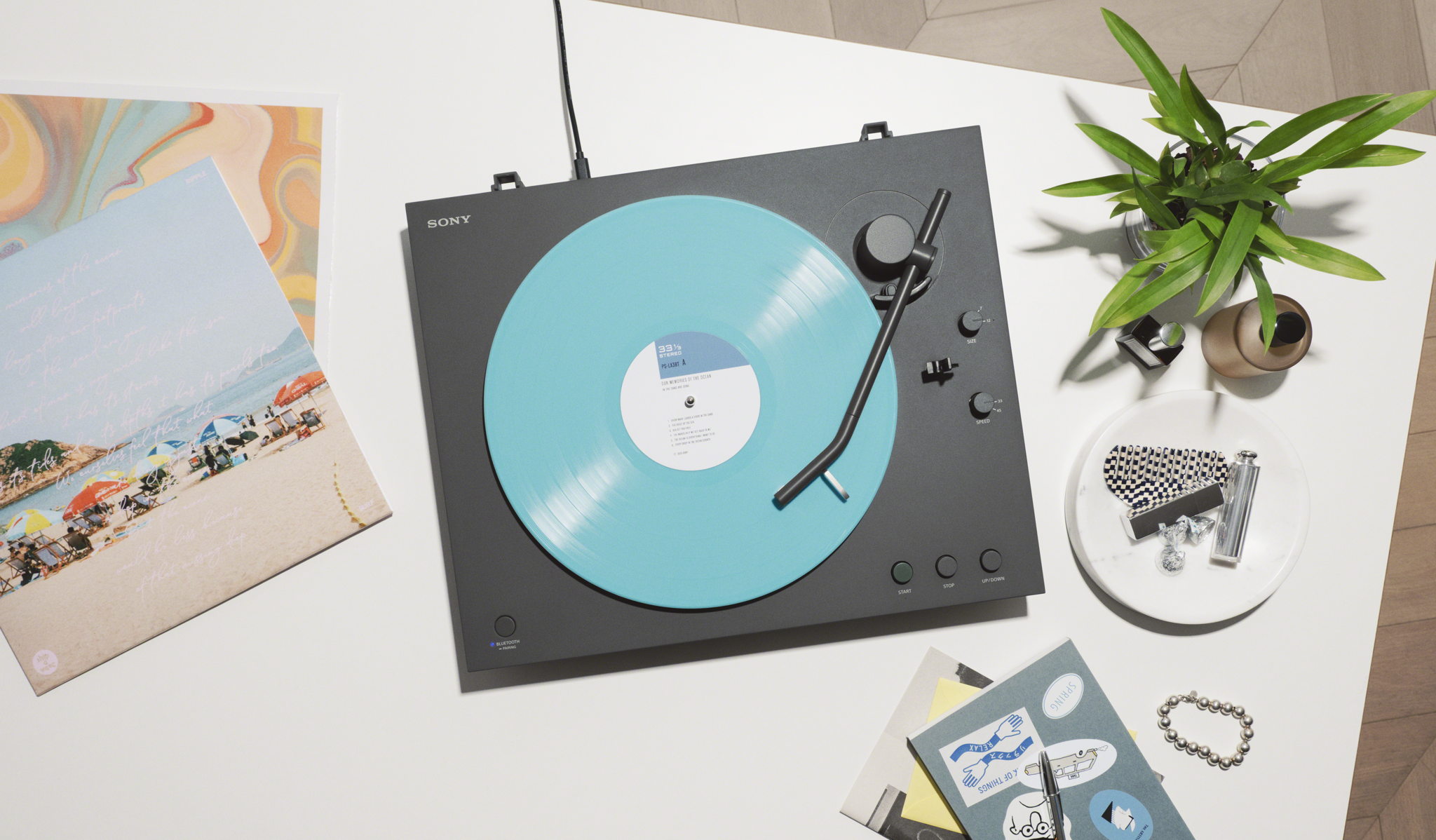
Sony publishes a body size of 17 inches wide, 4.63 inches high and 14.5 inches deep. A 17-inch shelf only meets the width figure on paper; it leaves no allowance for installation tolerance. Measure for dust-cover movement, reaching the controls, ventilation and the back-facing fixed lead. The image in this assessment is an official Sony Europe press image of the exact PS-LX3BT, but it is staged: the turquoise record, books and decorative objects are not claims about box contents. The shared U.S. manual describes a 296-mm aluminum die-cast platter, belt setup, external AC adaptor and no built-in speakers. Check the actual regional power supply and included accessories in the specific U.S. offer; a global press image cannot settle carton details.
How to compare it
The PS-LX5BT shares the basic automatic, two-speed and switchable-stage design. Its U.S. manual documents output jacks and a detachable cable instead of the LX3BT's integrated lead; Sony calls its cartridge a step-up MM type but gives no exact part number in the U.S. manual. That distinction is not an independent sound ranking. The older PS-LX310BT also has automatic operation, Bluetooth and a built-in stage, but its RCA lead is fixed and it adds a separate USB recording path.
PS-LX3BT suits a system needing full automatic start/end handling, a switchable PHONO/LINE connection and optional Bluetooth transmission. It is a poor match for 78-RPM playback, cartridge-body swaps, Bluetooth input, high-resolution USB capture or a tight shelf. Confirm model, stylus, adaptor, fixed-cable reach and receiver compatibility in the exact offer. Evidence: Sony's U.S. product page, specifications, manual and Bluetooth FAQ. No price, stock or sound-test claim is made.
Key specifications
Key details at a glance
| Drive | Belt drive |
|---|---|
| Documented record speeds | 33 1/3 RPM / 45 RPM |
| 78-RPM play option | No |
| Included cartridge | Factory-installed mm cartridge; sony's u.s. manual does not name its part number. |
| Built-in phono preamp | Yes |
| Manual tonearm cueing | Yes |
| End-of-record platter stop | Yes |
| USB audio capture to computer | Yes |
| Bluetooth audio transmission | Yes |
| Platter | 296 mm aluminum die-cast alloy |
| Body width | 17 in |
| Body depth | 14.5 in |
| Body height | 4.63 in |
Use the exact model’s instructions for operating limits, supplied equipment and version differences.
Sources for this review
Sources for this assessment

Check your phono route before choosing
Check each model's documented input route, arm operation, and body limits. Use the finder to compare supported phono-system arrangements without assuming adjacent models share features.