
Your needs, this model
Does it fit your priorities?
Can PS-LX5BT use my receiver's PHONO input?
Yes, switch to PHONO so the internal MM stage is bypassed, then connect the supplied detachable RCA cable to an input compatible with the installed cartridge. If the receiver offers only LINE/AUX, use LINE instead.
Explore this need in the finder →Can I run it to powered speakers through a separate stage?
Yes. Use PHONO output to a compatible external MM phono stage, then feed that stage's line output to powered speakers with an analog line input. Avoid stacking the turntable's LINE output into another phono stage.
Explore this need in the finder →What differs from the PS-LX3BT in wired use?
The PS-LX5BT uses output jacks and a detachable cable; the PS-LX3BT's RCA cable is fixed to its body. This changes cable replacement and placement, not a proven sound ranking. Confirm the exact supplied cable in the offer.
Explore this need in the finder →Does it stop and return automatically, and can I cue manually?
Sony documents one-button automatic playback, end-of-record arm return and stop; the UP/DOWN control also permits manual lifting and repositioning. It is a two-speed 33⅓/45 model, not a 78-RPM deck.
Explore this need in the finder →The Sony PS-LX5BT is a two-speed, belt-drive model built around automatic play, a switchable MM phono stage and Bluetooth transmission. Sony's current U.S. Store page lists it alongside the PS-LX3BT and PS-LX310BT. The model-specific U.S. manual and support specification are more useful for system planning than broad “premium” or sound-quality language: they establish a 17-by-14.5-inch body, PHONO/LINE switching, automatic start and end return, USB recording and a detachable analog-cable connection. This assessment is based on those documents, not hands-on testing or listening.
What the extra cable flexibility changes
The most clearly verified wired difference from the closely related PS-LX3BT is at the rear panel. The LX5BT has separate audio output jacks and a detachable RCA cable supplied in the U.S. manual; the LX3BT has its RCA cable permanently attached to the chassis. Detachability makes it easier to replace or route the cable without moving the whole deck, but it does not by itself prove an audible improvement. Check that the exact offer includes a suitable stereo RCA lead and that its length reaches the intended input. Sony's product page also describes the LX5BT's factory cartridge as a step-up moving-magnet type. The U.S. manual identifies the cartridge type as MM but does not supply an exact cartridge part number, so this assessment does not imply a particular model or universal cartridge-upgrade path.
Sony says to use the model-specific replacement stylus and does not support changing the cartridge to another type. A buyer who wants routine cartridge-body swaps should compare a deck with a standard removable headshell and established alignment adjustments. The LX5BT can still be a practical fit for someone who wants the manufacturer-specified stylus service route and a cable that can be changed independently. Verify the current replacement-stylus part number with Sony instead of assuming compatibility from appearance.
Full automatic playback with a manual option
Sony documents one-button automatic playback: the arm starts, returns at the end and the platter stops. The manual also describes pressing UP/DOWN to lift the arm and moving it to a desired groove. That combination makes the deck manually cueable as well as fully automatic; it does not have to be used only in one mode. There is no ordinary cueing lever documented, so handle the arm as the manual describes. The supported record speeds are 33⅓ and 45 RPM, not 78. Record size and end-groove behavior still matter; automatic classification describes the intended mechanism, not a guarantee for every disc or damaged record.
Four analog connection decisions
The built-in MM phono stage is switchable. If the receiver or integrated amplifier has a compatible PHONO input, set the turntable to PHONO so the built-in stage is bypassed. If using powered speakers with line inputs, select LINE to use the internal stage. A third route is PHONO into a compatible external MM stage, followed by line-level input on powered speakers. For passive speakers, an amplifier is needed after either the receiver's built-in PHONO route or an external stage and amplifier LINE input. Passive speakers cannot be powered by this deck alone. Don't send the LX5BT's LINE output through another PHONO stage, and verify the exact receiver cartridge support and input labels.
Bluetooth transmission is a separate fourth listening path, not a substitute for analog compatibility in those plans. Sony lists SBC, aptX and aptX Adaptive, but the turntable is a transmitter rather than a receiver: it does not accept audio from a phone, TV or computer. It lacks AAC, LDAC and AVRCP volume control, so the receiving speaker or headphone must support pairing and provide volume adjustment itself. If reliability or a particular codec is essential, confirm the compatibility of both endpoints rather than relying on a codec name alone.
USB capture is not USB playback
The USB Type-B connection supports recording records to a computer. Sony says the cable and recording application are not supplied, and the U.S. FAQ says the turntable does not support hi-res recording. Sony lists Windows 11 64-bit and macOS 13–15 in current support guidance, while warning that operation is not guaranteed on every system. Consider it an additional capture function, not a USB audio player input. A recording workflow also needs a computer port, cable, software and enough setup time to check levels and file handling.
Footprint and package checks
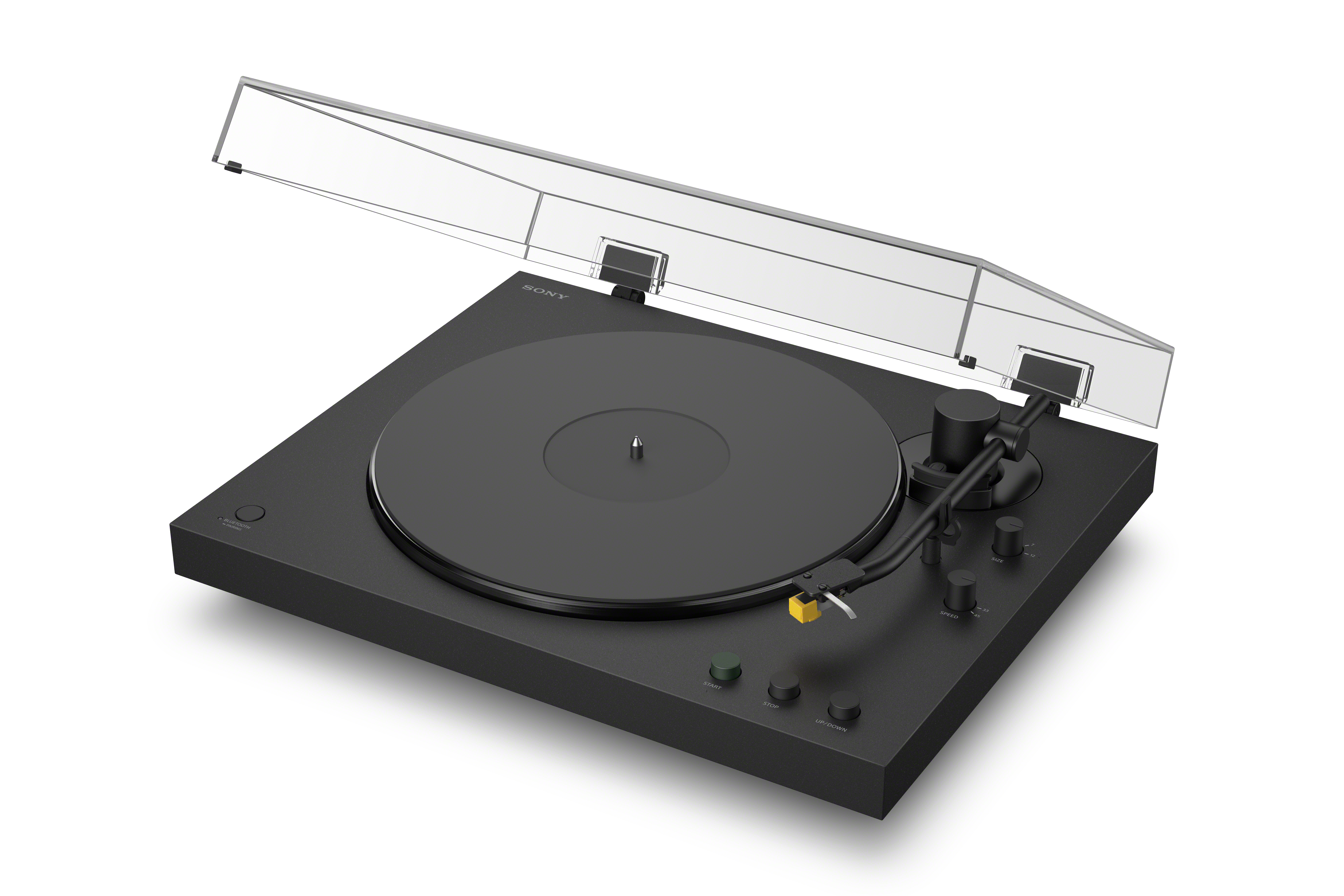
Published size is 430 × 117 × 366 mm, or 17 × 4.63 × 14.5 inches (width, height, depth). Those numbers describe the body, not the space needed to open the transparent cover, insert records, reach controls or leave room for detachable-cable plugs. Measure the usable surface and cable route before selecting a shelf. The shared manual lists a die-cast aluminum platter, external adaptor and dust cover, but the exact U.S. package should still be checked against the seller's box contents. The official Sony Europe image shown here is an exact-model reference with the cover open; its background and any staging do not establish the U.S. package or availability.
The PS-LX5BT's useful differentiators are the detachable cable connection and Sony-described step-up MM cartridge, not a proven sound ranking. The older PS-LX310BT is another fully automatic Sony option with Bluetooth and a switchable stage, but it has an integrated RCA lead and a computer-recording function. PS-LX3BT keeps the core automatic and wireless approach with a fixed lead. Buyers who prioritize serviceability beyond a dedicated stylus, 78-RPM support, manual adjustments or analog input to Bluetooth should compare other reviewed designs. Start with the actual phono input, speaker type, record speeds and space limit; then confirm the model code, cable, adaptor, stylus service details and receiving-device compatibility in the exact offer. Source checks are Sony's U.S. product page, U.S. support specifications, shared U.S. manual and Sony's shared Bluetooth FAQ. This is a source-based fit review; it does not report listening tests, current prices or seller stock.
Key specifications
Key details at a glance
| Drive | Belt drive |
|---|---|
| Documented record speeds | 33 1/3 RPM / 45 RPM |
| 78-RPM play option | No |
| Included cartridge | Factory-installed moving-magnet cartridge. sony's u.s. product faq calls it a step-up mm cartridge, but the manual/specification does not name its part number. |
| Built-in phono preamp | Yes |
| Manual tonearm cueing | Yes |
| End-of-record platter stop | Yes |
| USB audio capture to computer | Yes |
| Bluetooth audio transmission | Yes |
| Platter | 296 mm aluminum die-cast alloy |
| Body width | 17 in |
| Body depth | 14.5 in |
| Body height | 4.63 in |
Use the exact model’s instructions for operating limits, supplied equipment and version differences.
Sources for this review
Sources for this assessment
- Sony Electronics U.S. turntables category
- Sony PS-LX5BT U.S. product page
- Sony Support PS-LX5BT U.S. specifications
- Sony PS-LX5BT / PS-LX3BT U.S. operating instructions, YY2098C / YY2097C
- Sony U.S. FAQ for PS-LX3BT / PS-LX5BT Bluetooth turntables
- Sony Europe PS-LX3BT / PS-LX5BT announcement, 22 January 2026
- Sony Europe PS-LX5BT official press image

Check your phono route before choosing
Check each model's documented input route, arm operation, and body limits. Use the finder to compare supported phono-system arrangements without assuming adjacent models share features.