
Your needs, this model
Does it fit your priorities?
Can the Orbit Custom use a receiver's PHONO input?
Yes, when the exact configuration is selected without its optional built-in Pluto 2 stage and the receiver PHONO input is compatible with the installed moving-magnet cartridge. With Built-in selected and enabled, use a line input instead; the setup guide identifies the preamp bypass control. Verify the actual selected offer because the product page does not expose a per-combination SKU list.
Explore this need in the finder →Can I connect an Orbit Custom directly to line-input powered speakers?
Only with the Built-in Pluto 2 option selected and enabled, or with a compatible external phono stage between a None configuration and the speakers. A built-in-stage line signal should feed the powered speaker's LINE/AUX input, not a second phono stage. The speakers supply their own amplification; the turntable has no built-in speakers.
Explore this need in the finder →Does choosing electronic speed control make the Custom fully automatic?
No. The selector changes 33/45 platter speed by knob, while the Orbit arm still needs manual cueing. The manufacturer FAQ describes no automatic arm return or lift. A platter auto-stop at record end is not specified in the exact Custom page or linked setup guide, so do not treat electronic speed change as evidence of that feature.
Explore this need in the finder →The Orbit Custom is not one fixed package with a single published SKU. It is a current standalone U-Turn Orbit built through a series of choices: finish, platter, speed control, cartridge, cue lever, phono stage and feet. That flexibility is useful when you know which parts of your system need to change, but it makes the product name alone a poor way to identify a seller's exact configuration. U-Turn's public product record has one blank-SKU “Default Title” wrapper, not a list of individual barcodes for every build. This assessment therefore separates the functions without pretending to identify a universal box.
Seven choices, several real package differences
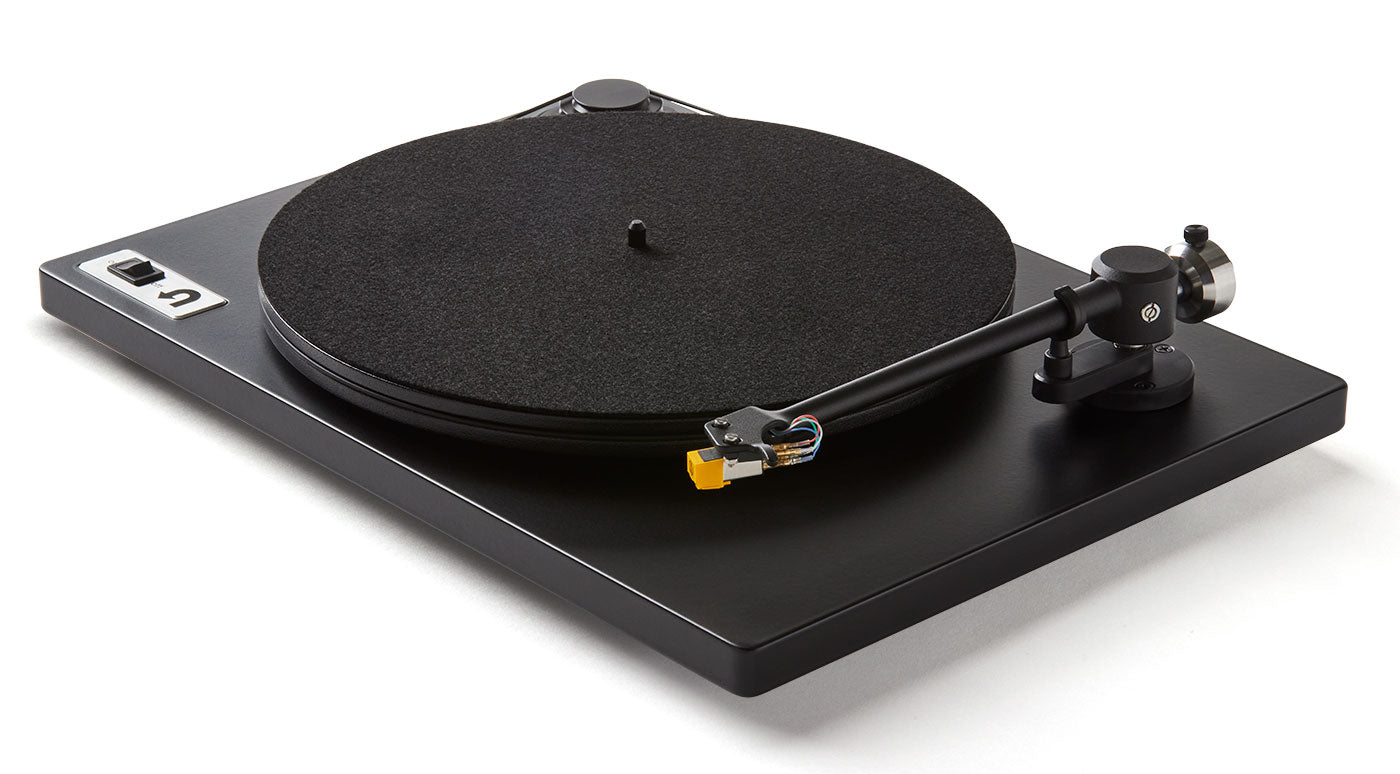
The current page describes the OA3 magnesium tonearm and offers five moving-magnet cartridge choices: Audio-Technica AT91B, Ortofon OM5E, Grado Green4, Ortofon 2M Red and 2M Blue. The maker characterizes the AT91B as a conical-stylus entry option and describes the OM5E and 2M Blue as elliptical forms; the remaining choices also differ in generator and stylus details. These are not interchangeable labels, so check which cartridge is installed and read its own setup information before considering a replacement. The official image used here shows a black example with the yellow AT-style cartridge, but that photograph cannot verify every configuration a particular seller may offer.
Platter and speed control are also separate choices. The base platter is grooved MDF; frosted acrylic is an alternative. U-Turn publishes different wow-and-flutter figures for those two versions and describes acrylic as the speed-stability upgrade. Those are conditional manufacturer specifications, not measurements made for this assessment. Speed can be changed by moving the belt between pulley positions or by using the electronic knob if that option is fitted. The second method removes a belt-change step; it does not start the record or move the tonearm for you.
The page also allows a no-cue-lever or optional cue-lever build, None or Built-in Pluto 2 preamp, and rubber or Iso-Level feet. Those parts affect setup or system connection, not whether the arm is automatic. Confirm the actual selections one by one. The product image shows the black MDF/manual example with rubber feet and no visible cue lever; it does not reveal the preamp setting. The maker's selector flow matters more than an image that can be shared across configurations.
Choose one phono route for the equipment you own
With None selected, the cartridge output needs a phono stage downstream. A compatible receiver or integrated amplifier's PHONO input can supply it; otherwise place an external phono stage before powered speakers or before an amplifier that drives passive speakers. Check the installed cartridge and the receiver's supported cartridge type. The listed options are moving-magnet cartridges, but connector shape alone does not prove that every input is suitable.
With the Built-in Pluto 2 option selected and enabled, use an analog line input on powered speakers or a LINE/AUX input on an amplifier. The setup guide describes a bypass switch and status light for equipped builds. Do not run an already-equalized line output through a second phono stage or receiver PHONO input. The turntable has RCA connections, but it does not include speakers or speaker amplification; passive speakers still need an amplifier. The built-in stage is a selectable configuration, not something to assume from “Orbit Custom” or from the black product photo.
Manual arm handling remains the defining routine
Orbit Custom supports 33⅓ and 45 RPM, not the 78-RPM mode a shellac-record collector may need. Its manual calls for belt movement when the manual speed option is chosen and offers electronic speed selection when equipped. U-Turn describes Orbit playback as fully manual, without automatic arm return or lift. A cue lever can raise and lower the stylus more gently, but it is a hand-operated aid. No record-end platter auto-stop routine is documented on the exact product page or linked setup guide, so a buyer who requires one should not treat this model as a verified match.
Plan for the listed body and for the complete setup
The published body measures 16.75 inches wide, 12.5 inches deep and 4.25 inches high. That is the deck's footprint, not a complete operating envelope: leave room for the cover to open or come off, the manual speed control if selected, rear RCA and power leads, and a comfortable reach to the arm. The product page lists an AC adapter, RCA cables, dust cover and felt mat. It does not turn the deck into an all-in-one system; budget and shelf-plan any separate stage, amplifier or speakers your configuration still needs.
U-Turn's current Orbit Basic is the closer fixed-package comparison for the AT91B/MDF combination; its own cue and preamp selections still need checking. The current Plus fixes an OM5E and acrylic platter but changes speed manually, while Special lists a 2M Red, acrylic platter, included cue lever and electronic speed selector. Theory uses a different OA3 Pro arm, electronic speed control and its own cartridge/preamp choices. Custom is most useful when choosing among those component types is the point. It is less straightforward when a buyer wants one exact model suffix to search for or a hands-off operation routine. Before ordering, identify the cartridge, platter, speed selector, cue lever, stage state, feet, finish, included parts and the seller's return terms. This research-based assessment does not claim listening tests, ownership or live stock.
Use the exact model’s instructions for operating limits, supplied equipment and version differences.Key specifications
Key details at a glance
Drive Belt drive Documented record speeds 33 1/3 RPM / 45 RPM 78-RPM play option No Included cartridge One cartridge selected from audio-technica at91b, ortofon om5e, grado green4, ortofon 2m red, or ortofon 2m blue; the black image illustrates the at91b option. Built-in phono preamp Yes Manual tonearm cueing Yes Platter Mdf or acrylic, selected in the configurator Platter mat Felt Body width 16.75 in Body depth 12.5 in Body height 4.25 in Sources for this review
Sources for this assessment
Check your phono route before choosing
Check each model's documented input route, arm operation, and body limits. Use the finder to compare supported phono-system arrangements without assuming adjacent models share features.